


I won’t pretend to have a secret formula for changing the calculus around fiscal reform in the US. Honestly, after spending the past four months thinking about it, I’m bearish. Not because I think taxes and cuts shouldn’t happen — they should — but because I doubt sufficient political will exists. It probably won’t come close to a top-five issue in the upcoming election cycle, the left is on a crash-course with socialism and an ever-expanding state, and on the right, Romney-Ryan Republicans are all but extinct, replaced by something closer to total Boomer luxury communism. Incentives matter, and our political system currently lacks any to turn the dire and obvious arithmetic into an imperative.
Fundamentally, America — really any nation for that matter — has a discrete set of non-destructive paths out of a fiscal bind. It can collect more, promise less, or produce more. Given the current political economy, the likelier path on “promising less” is that nothing structural happens on entitlements at all: nothing on Social Security until the retirement trust fund’s projected 2032 depletion forces the issue, nothing on Medicare until “waste, fraud, and abuse” becomes something more than a slopulist virtue signal. And aside from the swelling advocacy for a wealth tax, tax hikes with any potential for material fiscal impact — “collecting more” — are a non-starter heading into a new election cycle.
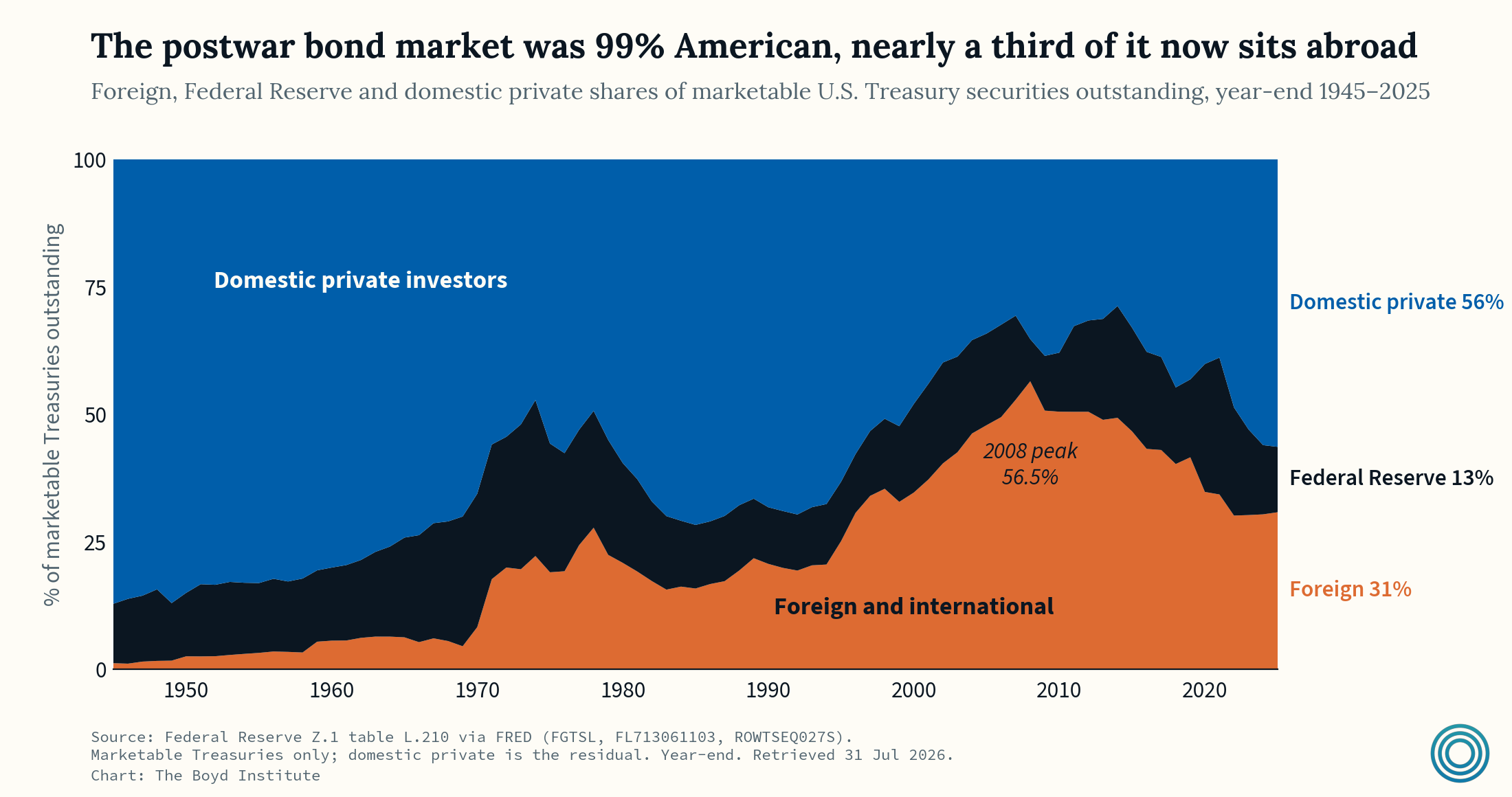
Over the years we’ve also seen a litany of other countries try to get cute and find alternative, more conspicuous escape hatches, often through monetary channels. These “fiscal dominance” tricks — namely inflating the debt away and/or financial repression —almost always fail. The US should not even consider them. The former would burn the very trust that makes our borrowing cheap in the first place, while the latter fundamentally requires a captive domestic bond market, a thing the US once had but no longer does.
So, if all the exits besides the “grow our way out” one are off the table, as is monetary sleight-of-hand, how do we craft policy that gives growth the best possible chance to materialize while not depending on first winning a national political argument? Well, what if I told you all that stands between America and a proper boom — a genuine, New Deal-scale building renaissance — is getting enough technocrats to read Ezra Klein’s book?

Kidding. But in all seriousness, cross-partisan, pro-growth policy preferences have gained very little traction outside the politically-online / econ-blogging milieus. Almost no ordinary voter understands “abundance” to mean anything in particular — a May 2026 Times/Siena poll found that 91 percent of Democratic voters had not even heard of it — so there’s basically no actual coalition organized around the label. And as an “elite persuasion” movement, outside a decent legislative push here and there, it’s arguably not doing much better.
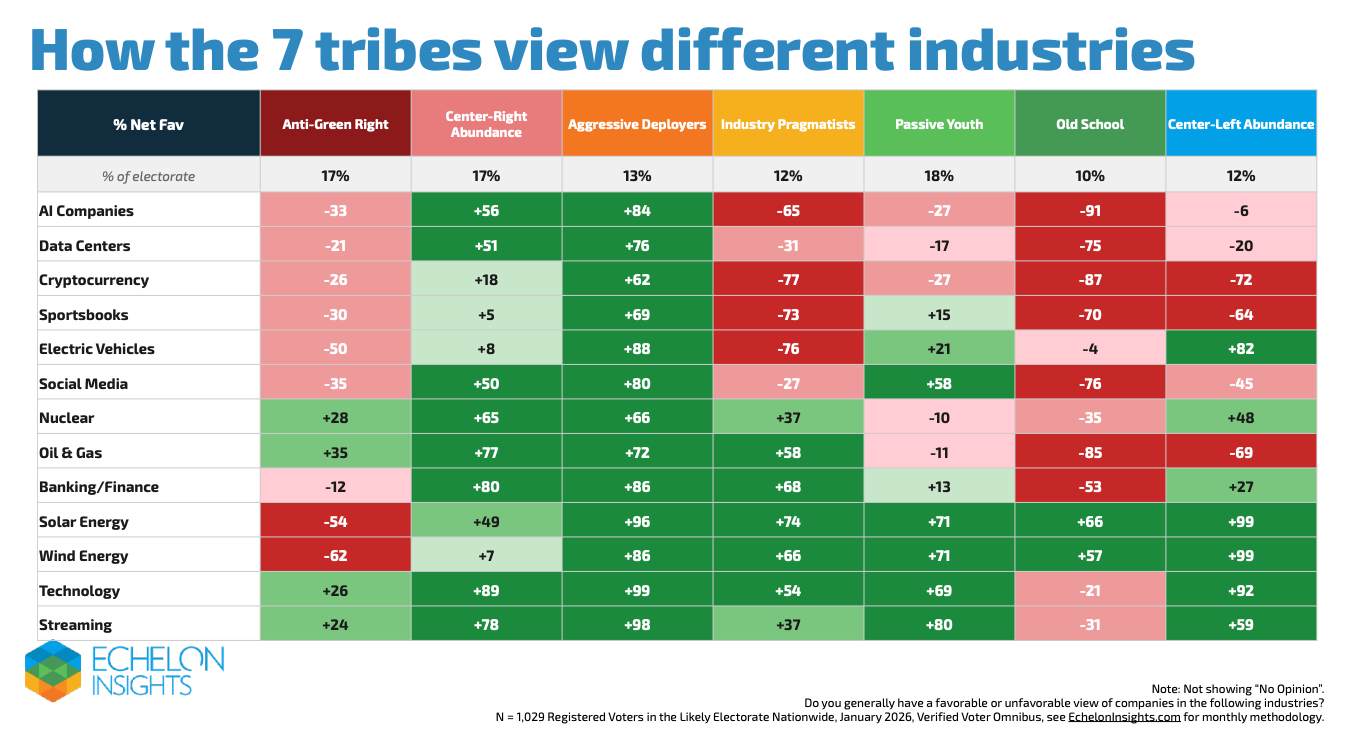
Meanwhile in Washington, mercantilism (the populist-MAGA-right), degrowthism (Boomers, NIMBYs, and modernity-rejectors), and neo-Brandeisianism (the “big is bad,” DSA-left) are all eating mindshare in alarming fashion. Among voters, the two tribes that are most reliably pro-growth — “aggressive deployers” and “center-right abundance” — together comprise just 30% of the electorate.
But here’s the good news: neither Washington nor the online commentariat — nor a critical mass of voters — is needed to summon investment in the real economy into existence. Instead, private capital, of its own accord, is already attempting one of the largest sectoral investment buildouts in American history, all centered around data centers and AI. That is the genuine economic and fiscal gift of our time. Not because of what the data centers themselves will pay in taxes — modest at the federal level, even if substantial locally — but because of the production levels the rest of the economy might be empowered to reach once compute is cheap, capable, and widely accessible.
It would be an almost incomprehensible own-goal for public policy to strangle this outcome before it runs its course. The policy task is therefore, if not simple, at least known. That is: stop our inherited veto points from blocking the investment boom, and keep the financial system from buckling along the way, so that capital can become powered compute, compute can diffuse through existing workflows, and the resulting additional output can yield more domestic taxable income.
“Growth itself is not a fiscal plan, but unnecessarily foreclosing the country’s largest growth option in generations is a fiscal choice.”
If “abundance” — abundant power, abundant access, abundant credit — cannot win as an electoral imperative, it has to at least become the institutional default.
How?
Reason from the principles of “abundance,” stop focusing on clever labeling and mimetics that clearly don’t work, ditch coalition-building and persuasion efforts, and just write the pro-growth solutions into the damn rules — for the systems that technocratic policy can make or break. For the electric grid that has to power the data centers, for the competitive interfaces that let ordinary firms use the compute, and for the dollar credit markets that must run smoothly to finance it all.
But before wonking out on policy moves, it’s worth wonking out on the data center-capex-growth boom already underway — to understand how it is distinct from a productivity boom, why the distinction matters, and why it’s the latter that’s required for the nation’s fiscal outlook to improve.
Capex surge ≠ productivity boom.
A brief moment to reflect on just how remarkable AI-capex boom really is. Economists and Wall Street spent much of the fifteen years following the financial crisis scratching their heads, wondering why cheap money was failing to get firms to deploy capital in the real economy. Rates are much higher now, yet only now has the investment arrived. Boy has it arrived.1
The scale is historic: information processing equipment, software, and data center construction accounted one third of all US business investment by Q3 20252, the largest share since records began in 1947. Harvard professor Jason Furman ran the numbers and found that combined, investment in information processing equipment and software accounted for about 4% of GDP and 92% of GDP-growth in the first half of 2025. A year later now, and that 4% of GDP has expanded to nearly 5%, eclipsing the dot-com era high watermark:
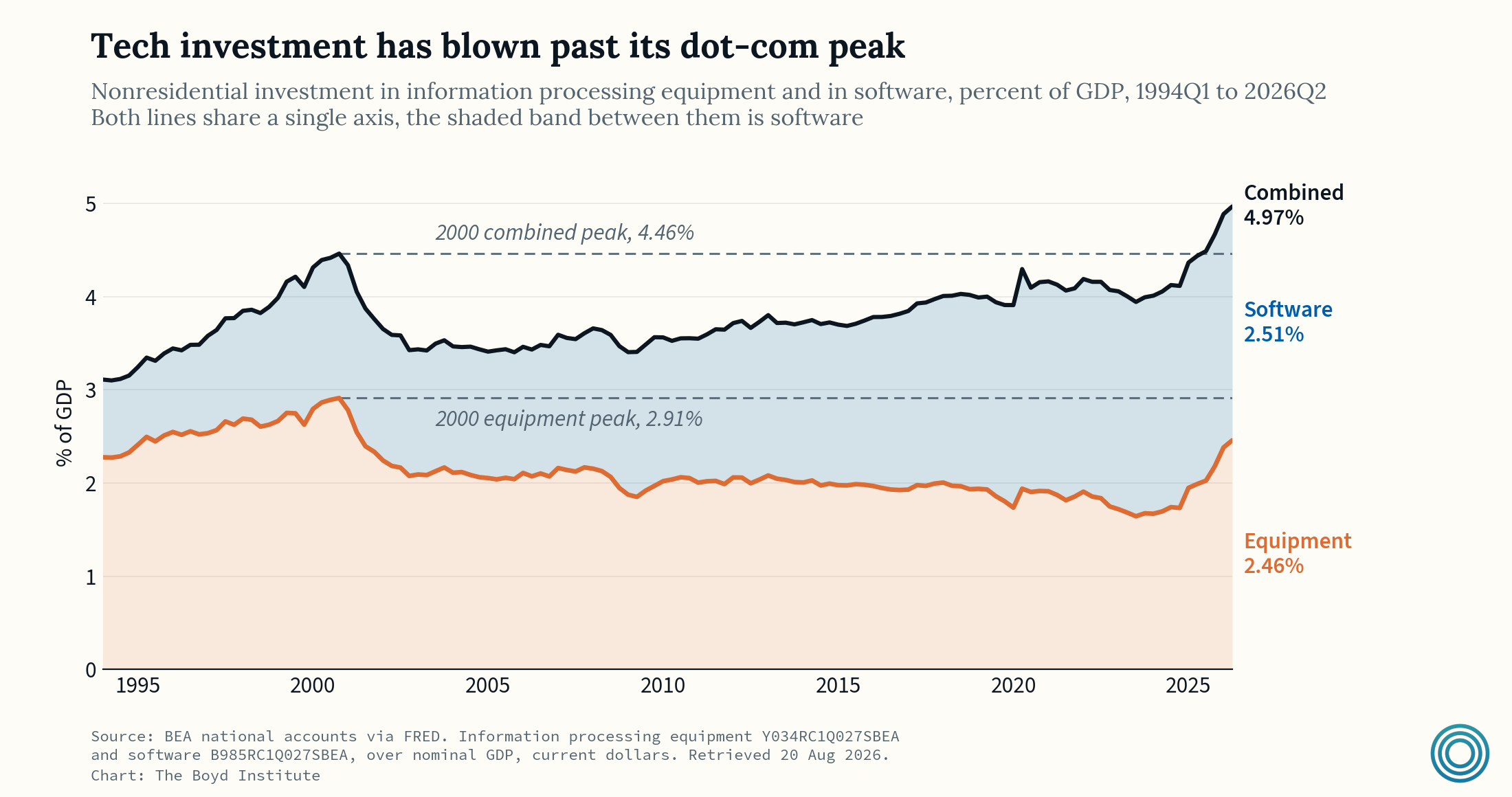
The last time these categories ran as hot as they are now was in the heat of the 1990s IT buildout, a worthwhile comparison for two reasons. One, because the internet was, like AI, a general-purpose technology with the potential for revolutionizing whole industries and sectors the economy. And two, because the dot-com investment surge came first, while the subsequent productivity payoff took the better part of a decade to show up. Indeed, the current growth being fueled by capex says little on its own about whether — or when — an economy-wide productivity boom might arrive:
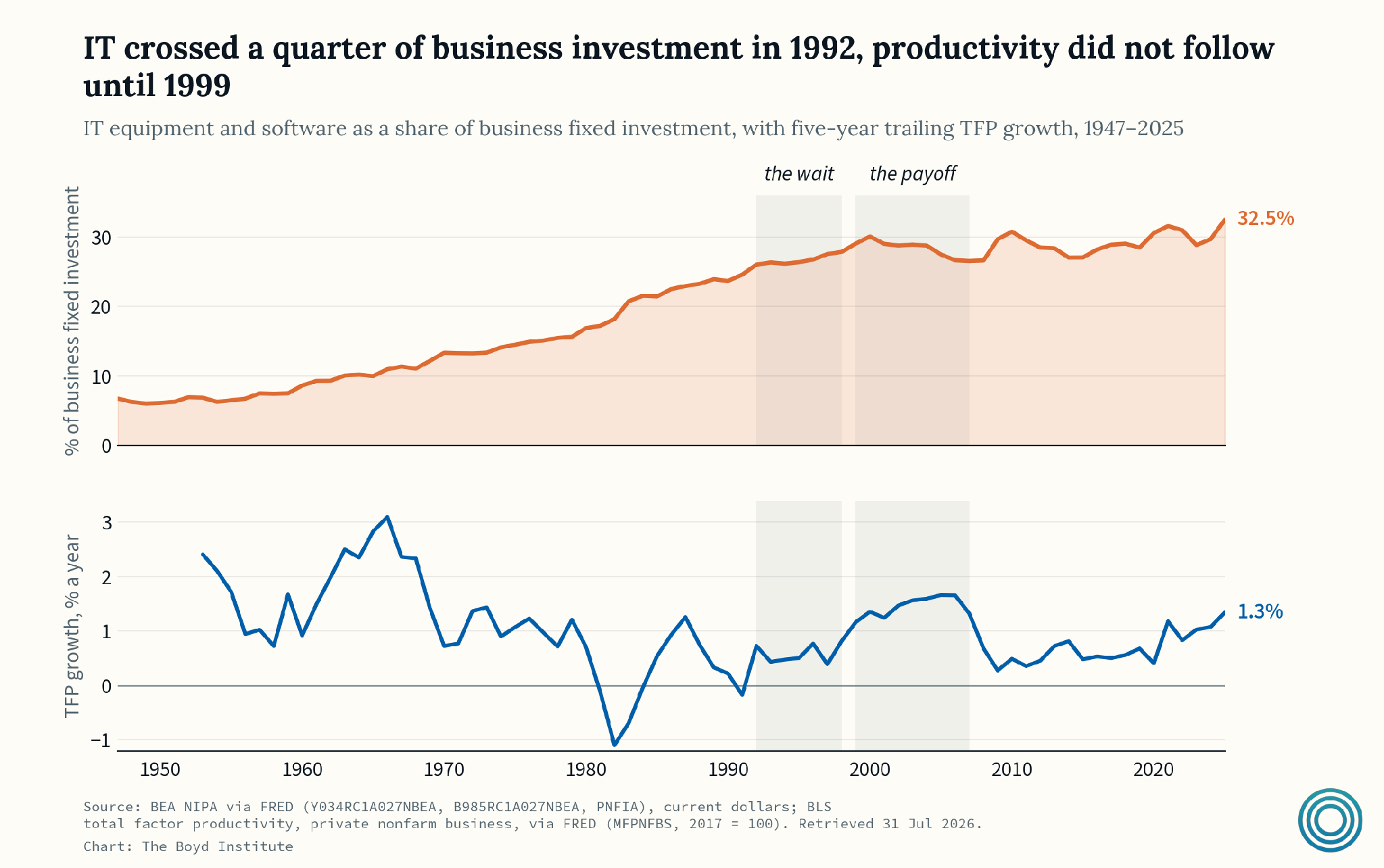
Think about it in b-school terms. If GDP is a country’s closest analogue to a company’s top-line (revenue), one could think of productivity as something like “operating leverage.” Whereas companies may use financial leverage to magnify returns by issuing debt to employ more capital, operating leverage speaks to a company’s ability to turn top-line growth into disproportionately higher earnings growth. This happens when a meaningful share of costs become fixed (vs. variable), such that total costs don't scale one-to-one with revenue.
Similarly, in macroeconomic terms, productivity is what determines whether output keeps compounding without inputs — labor and capital — increasing in lockstep. For the public balance sheet, that means higher wages, higher profits, and ultimately more taxable income against public spending levels and a debt stack that does not rise at the same rate. This is precisely where the fiscal case lives.
Why the capex-growth vs. productivity-growth distinction matters, fiscally.
First, if GDP growth is driven predominantly by heavy capex, the immediate result is a front-loaded surge in construction and hardware revenue. And that’s good. Nominally, near-term growth is good; more compute is good. But it does not yet imply a recurring productivity dividend.
Because after initial construction, data centers operate autonomously (not much ongoing human labor required), because of the way depreciation is treated in federal tax law (subsidized), and because the lionshare of maintenance capex is tied to replacing the semiconductor chips (which have short depreciattion cycles), data centers alone are not very tax-accretive. At least at the federal level, the payoff arrives only if abundant compute translates to increased output — higher wages and profits — across the wider economy, boosting federal tax receipts.3
Second, the expectation alone of a future productivity miracle can create a paradoxical demand shock today. Call it something like Greenspan’s famous hunch, but in reverse. In the ’90s, Greenspan’s bet that productivity had already accelerated became part of the Fed’s rationale for resisting calls to tighten. But now, the promise of future productivity — the economy-wide expectation of it — may be pulling spending (aggregate demand) forward today, keeping inflation higher than it otherwise would be. Businesses spend like profits will be higher tomorrow, while AI-driven stock wealth causes households to look at their 401(k)s and think, “yeah, I can afford this!”
That doesn't make AI mechanically inflationary, or the Fed mechanically hawkish. But if the buildout and the stock-wealth effect lift demand faster than new power and real adoption lift supply, the Fed has less room to ease — thus rates stay higher, and financial conditions tighter, for longer.
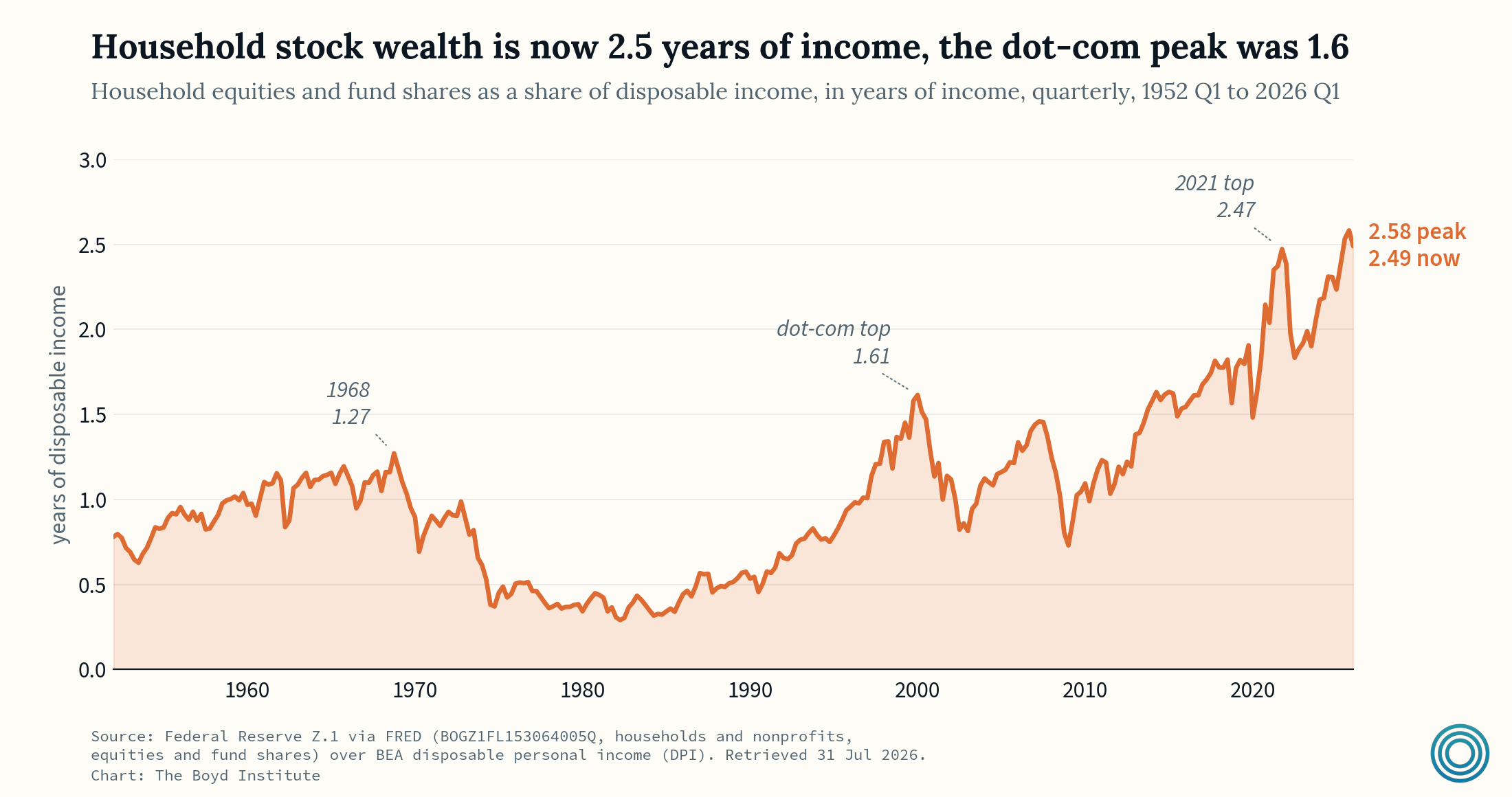
Which leads into the final point, on the public balance sheet impact. We are at a critical juncture. As of July 31, about a third of marketable Treasury debt is set to mature within twelve months — a $10.5 trillion maturity wall that must be refinanced. And the government's effective exposure is even greater than that number suggests. The Fed holds trillions in long-dated Treasuries financed by overnight borrowing from banks, which makes the consolidated public balance sheet more rate-sensitive still — because when rates go up, those overnight reserves reprice right away, hitting the government’s interest bill immediately. (The Fed’s profits and losses land on the Treasury’s books, which is to say, on the taxpayer.)
If one could wave a wand and make rates nil and inflation low again as was the case throughout the 2010s, the current capex boom would be considerably easier. But alas, if the buildout keeps demand hot while inflation remains above target, the Fed has less room to offset rising long-term rates without risking its inflation-fighting credibility. That means this enormous near-term exposure reprices at prevailing rates and the government’s interest bill rises quickly — potentially years before any productivity dividend could possibly show up in tax receipts.
Therefore the sooner the AI-productivity lift comes to fruition, the better the country’s fiscal outlook. That’s just the reality:
Like it or not, the country’s future is wagered on AI.
Not because Treasury borrowed to build data centers, or because David Sacks and Marc Andreessen are pals with Scott Bessent and advisors to the current administration, but because an already-deeply-leveraged fiscal regime has become unusually sensitive to whether taxable output rises faster than interest expense swells. It really is that simple. Stanford economist Hanno Lustig has called Treasuries a “long call option on AI”; Lazard CEO Peter Orszag similarly referred to the US economy as a “levered bet on AI.” These characterizations may seem provocative, but the underlying dilemma is real.
The bad side of the coin, the nightmare scenario, is where we — Washington, Wall Street, Main Street — hum along expecting a productivity payoff, the fruits of which may or may not actually show up tomorrow. In other words, a scenario where we will have invested in top-line growth to bolster the bottom-line, only to find out that the “operating leverage” was never really there to begin with.
How is the bet going?
The country’s “top-line” is growing. Task-level gains are real. Some firms now report modest positive effects — labor productivity (output per hour) is up about 2.5% a year since late 2022 — but this could just be the result of handing workers more capital and running it hot (tokenmaxxing). What it’s not yet proof of is an economy producing more with less.4
Total factor productivity, the actual efficiency stat (though noisier), has shown little clear, AI-specific acceleration. The KC Fed finds AI adoption explains little of which industries even drove the pickup, and nearly nine in ten executives in a survey of almost 6,000 firms reported no realized own-firm productivity gain over the prior three years. The same respondents nevertheless expected AI to raise productivity 1.4 percent and output 0.8 percent over the next three years.
That gap is the wager: capital is being committed against expectations, but the conversion has not yet shown up broadly in realized output. Basically, task-level savings haven’t yet translated broadly into measurable output and earnings — i.e., an economy-wide AI-productivity lift — which means the new taxable income, and therefore the fiscal dividend, has not yet appeared at scale.5
In short, and simply put, for the fiscal payoff to actually come to fruition, the following still must happen:
Capital deployed → powered compute
Abundant compute → broad AI-adoption
AI-adoption → additional domestic output
Additional output → higher tax receipts
Higher tax receipts → outpace the associated increase interest costs and spending
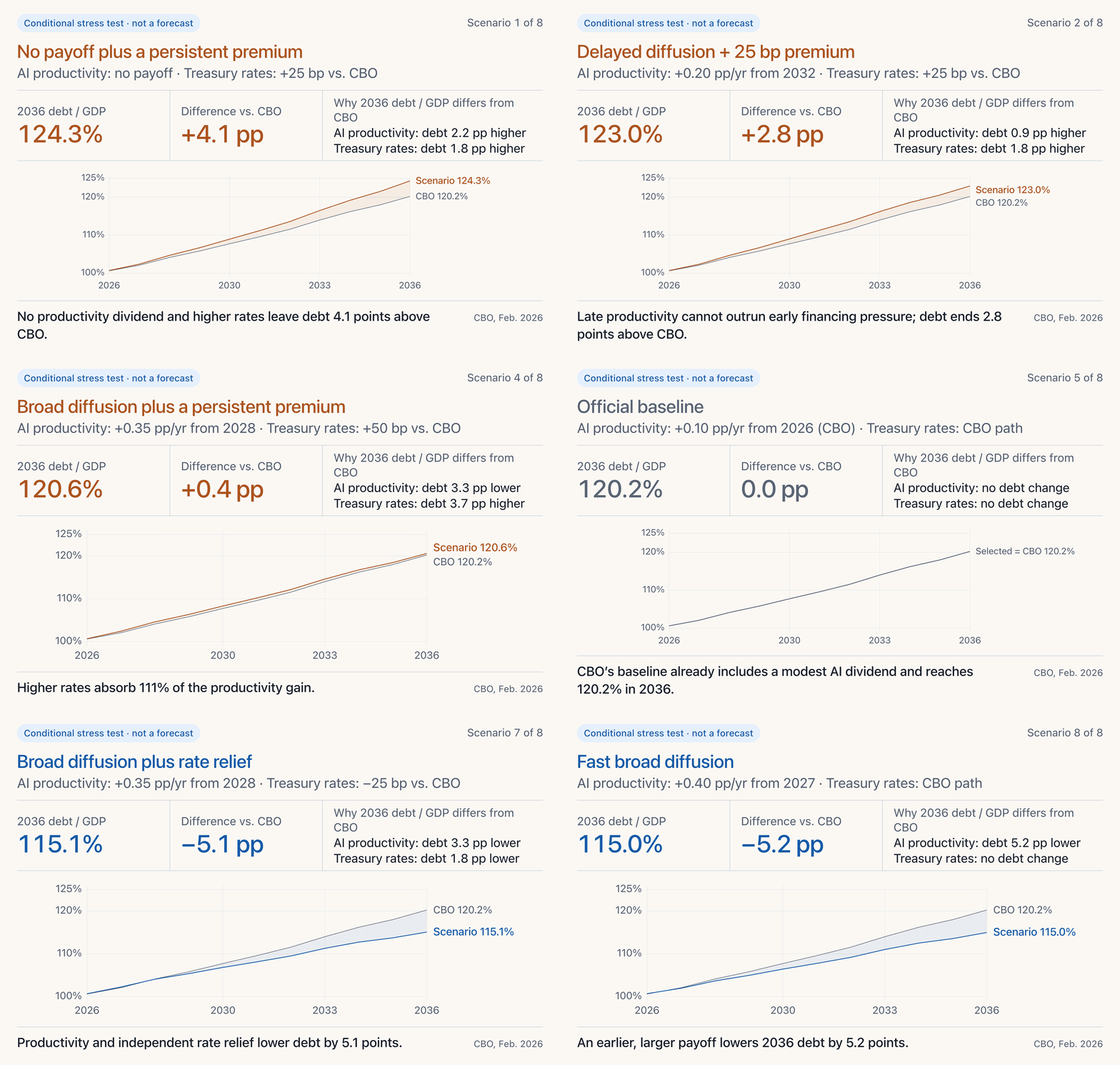
How much of the debt path is riding on the AI boom?
It’s not simply a matter of whether AI raises productivity. It’s also about ~when~ the productivity gains arrive, how robust they are, and what happens to debt/credit markets along the way. The dynamic is easier to visualize than to describe:
Policy moves to make the AI-bet pay off, fiscally.
Five policy moves, none of them requiring a voter mandate, nor politicians in Washington picking winners.
1) Decide where America can build, and then just let it build.
Plain-vanilla, pro-growth policy, straight out of Abundance playbook — but worth doubling down on, because people and firms trying to build things in this country still face a gauntlet of political and legal hurdles (veto points). This is now especially true for data center projects, which have rapidly become a breeding ground for hyperlocalism. But it can be routed around.
The federal government should, ex-ante, publish the permitting requirements and let states and localities opt into certified “zones.” And then, once a project meets the rules, review periods should mostly just be audits of conformity.
2) Give faster access to power to projects that help build out the grid.
A project shouldn’t have to wait years — sometimes as many as eight!! — for a conventional grid connection. If it is willing to add enough power and flexibility to smooth over the strain it might be placing on the grid, it should be fast-tracked.
Specifically, if a data center or any project requires new substations, transmission, or generating capacity, it should be able to sign a long-term take-or-pay contract, post collateral, and bear the stranded cost if it leaves. If it wants firm, round-the-clock power, it pays the full cost. If it can curtail during scarcity — or supply deliverable generation or storage — it should pay less. The theme here is just price the externalities.
Fortunately, FERC is already pushing regional grid operators in this direction — it’s pushing for flexible service for large projects willing to limit how much they tap the grid, paired with new generation slated to come online in that same constrained region. This is the right move, and a bargain that should be made national and enforceable.6
3) Make AI easy to try, easy to switch, and legal to use for ordinary firms.
The economic purpose here is diffusion of the general-purpose technology, and the barriers aren’t necessarily the technology itself, but permission structures and information security. It’s still very early-innings, but a few things are clear already.
First, a firm’s data should belong to it, and a firm should be allowed to point any AI tool at it, bearing the existing legal and business risks it already faces. There doesn’t need to be a policy for this; most companies already have internal AI committees and sometimes even entire departments taking these risks very seriously.
Second, with more than a fifth of American workers needing a government license to do their job, a safe harbor model should be adopted, allowing licensed professionals and firms to test and use AI for specified tasks so long as an accountable human remains in the loop and there are adequate disclosures and audit trails. Allowance for (and sandboxing of) iteration and tinkering is crucial for firms to find new technological use cases and deploy them safely. The regulatory approach should be in service of this, and the regulatory default should be permission with understood liability.
And finally, what should absolutely not happen is for anything resembling the EU’s growth-stifling tech-regulatory playbook (GDPR, Revised Product Liability Directive, Cyber Resilience Act, etc.) to even be considered in the US. These types of moves — such as the recently-passed watermarking rules under the EU AI Act, requiring providers of generative systems to embed machine-readable marks in their outputs — rarely lead to their intended outcomes, but instead impose undue costs on firms and consumers alike.
4) Stop manufacturing fiscal crises.
Kill the debt ceiling — it’s low-hanging fruit. I know this seems counterintuitive, and maybe even sounds orthogonal to the entire AI-fiscal thesis; it isn’t. A country asking global investors to absorb historic levels of debt issuance shouldn’t schedule recurring hostage negotiations with itself. Debt-ceiling impasses are entirely political theater. The ceiling never actually restrains spending, but the brinksmanship carries real, tangible costs. Shutdowns themselves have also been shown to reduce GDP by billions (permanent losses, not recovered).
However large or small the negative impact here, the point is that it’s all for exactly nothing. It’s completely fake, and avoidable, and we should just adopt an automatic continuing appropriation whenever Congress misses its funding deadline.
5) Don't let rising interest rates turn into a market meltdown.
In plain English: the Treasury market should be made more liquid, so inevitable bouts of volatility do not devolve into crises. A set of shock absorbers could be built-in. We already have circuit breakers in the stock market, and it turns out they work pretty well. Treasuries do not need identical trading halts, but they do need safeguards capable of stopping a temporary liquidity failure from cascading through a market that is orders of magnitude more important than stonks.
The policy moves here would materially improve both liquidity and information asymmetries in the most important market in the world. There is a caveat, which is that price discovery is incredibly important. Global bond yields are currently spiking for very real and fundamental reasons (not least the glut of government debt), and efforts by governments and central banks to fight this without getting their fiscal houses in order will have nasty second- and third-order consequences. So these moves aren’t about artificially lowering rates. Rather, they’re about insurance and information — and ultimately preventing legitimate market repricing episodes from becoming economic doom loops.7
First, complete SEC-mandated central clearing of cash Treasuries, tapering dependence on broker-dealer balance sheets in times of market panic. Second, make the Fed’s standing repo facility clearable, at a penalty price, so the backstop actually reaches the market instead of eating scarce dealer balance sheet capacity. Third, run a stress test America has weirdly never run: put banks, hedge funds, money funds, and the clearinghouse through the same shock, together, and measure the resulting leverage and liquidity in aggregate. Finally, give Treasury a standing way to swap fragmented old bonds for liquid benchmarks — the switch-style exchange operations it is actively studying now — and make the consolidated Treasury-Fed rate-reset picture a permanent and prominent part of quarterly refunding.
“But what about muh…”
Most of the pushback on accelerating the data center buildout and AI diffusion across the economy — water usage, noise pollution, aesthetics — is certifiably populist garbage. But some is legitimate. So I’ll address the three most legitimate counterarguments I’ve seen: jobs, the environment, and electricity prices.
Jobs?
This is the lousier of the objections. The premise is that economic policy should preserve the job market as it exists today. But when has that ever actually been a good outcome? Moreover, a serious question: why is it even a bad idea to vaporize all the bullshit tasks we currently do — e.g., email jobs, number-pushing, order-taking — such that humans may graduate to handling more meaningful types of work? Isn’t this exactly what has happened through every industrial-revolutionary phase?
Either way, so far the “jobs-pocalypse” is a dud. Now years into the AI era, still no data signalling any kind of meaningful disruption in the labor market. Most firms themselves, asked about their hiring outlook, say they’re actually discovering that deploying AI properly takes more people, not fewer.8
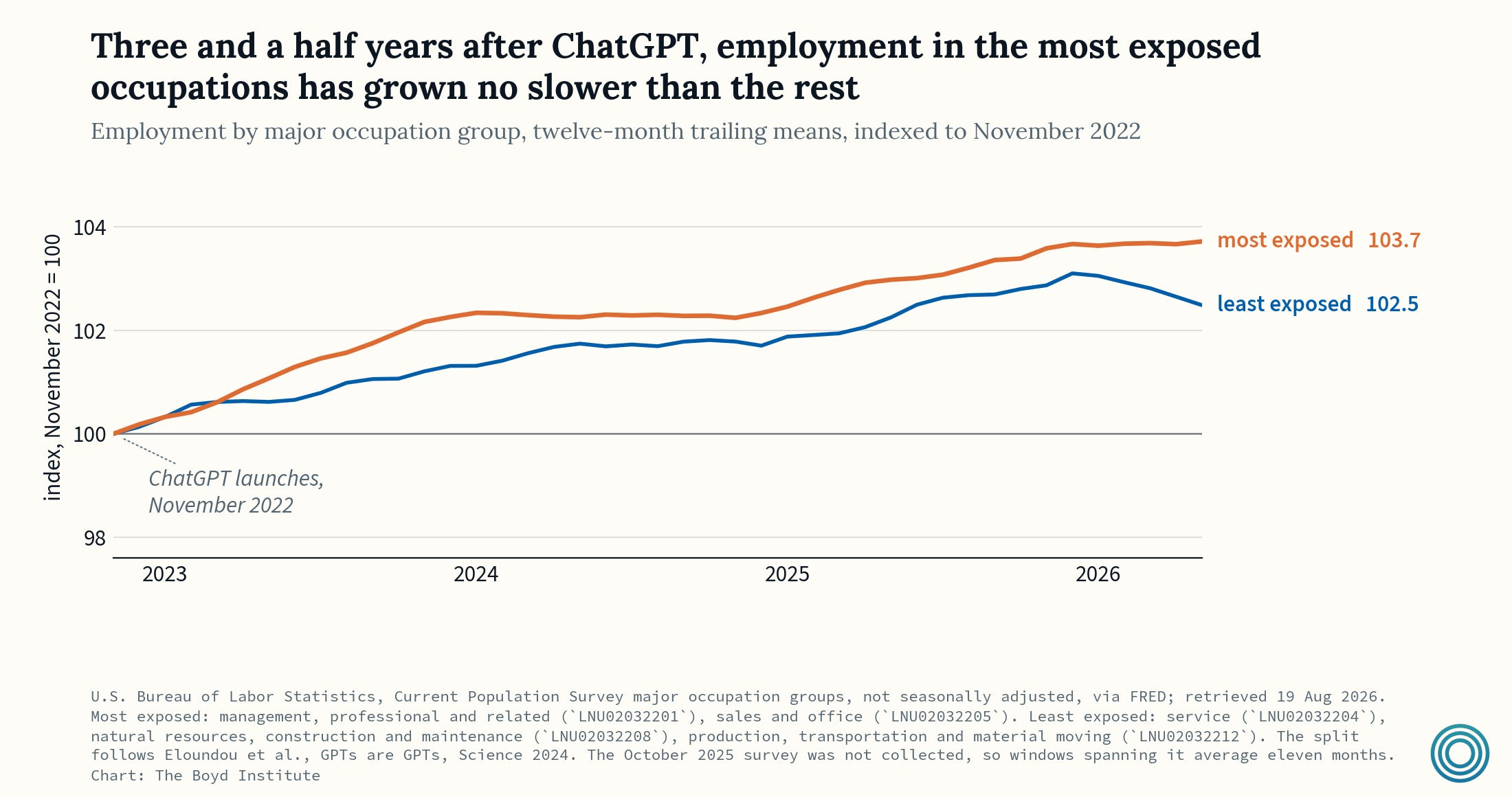
The broader point here though, irrespective of any near-term trend, is that creative destruction is good, actually. The economy already destroys and creates tens of millions of jobs every year underneath the headline numbers. And the world is as mobile as it’s ever been. Helping people traverse the job market and physically relocate are major modern problems we’ve gotten pretty good at solving.9 Being poorer and stagnant is not.
Environment?
To the tree huggers, with whom I genuinely sympathize: your concerns around the negative externalities imposed by data centers — especially emissions — are real. But direct your anger at the political, procedural, and vetocratic machinery that makes nuclear plants, transmission lines, solar farms, energy storage, and the rest take substantially longer than gas turbines to build and bring online.
What the data center moratorium crowd is seemingly confused about is that moratoria do functionally nothing to eliminate the demand for compute. Instead, these bans just determine where the next data center will not go, leaving the local tax windfall up for grabs for the next county or state over. The buildout pushes on regardless, and so long as clean power remains slower and more costly to get approved versus gas, the buildout will increasingly go fossil.
Texas is the counterfactual (notwithstanding Gov. Abbott’s recent degrowthism bent). Its permissive connect-and-manage grid enables generation to be built quickly — last year it passed California in utility-scale solar generation. Think about the irony: Texas, with its famously laid-back environmental regulatory regime, has emerged as the new leader in a major category of clean energy generation.
Electricity bills?
This objection is very real: recent Dallas Fed estimates point to a 3-5% increase in wholesale power prices nationwide, with larger effects concentrated in major data center corridors. But the answer is not hyper-regulating our way into lower demand for power. It’s exactly the opposite, which is government getting out of the way of supply.
The answer here is price — price the externalities, give permission to build, and ultimately leave it up to hyperscalers to face the true cost of the power they consume and determine whether that cost is worth building into anyway. Utilities, merchant generators, private microgrids, and even data center developers themselves, should be able to freely participate in an open marketplace to compete for who gets to serve the load.
If approached well from a regulatory standpoint, the hyperscaler buildout could serve as a strong catalyst for massively upgrading the grid both in terms of capacity and interconnectivity. In the long run, such infrastructure gains are shared by everyone, households and firms alike.
Conclusion: Growth = good.
What if the whole thing is a bubble? It might be! The AI-capex boom is disproportionately carrying growth right now, which cuts both ways. Absent it, inflation and electricity prices might be lower, thus lower interest rates, which would unlock higher growth potential in other sectors and potentially ease the government’s fiscal pinch. But rough estimates say that counterfactual growth rate would be half of what the rate of growth is now, at best. And all else equal, that would probably mean lower tax receipts for the government — higher deficits.
But let’s ditch the thought exercise and live in reality. The AI trade, if it goes tits-up, would mean the loss of the growth engine, it would mean household spending seizes up due to negative wealth effects, and it would mean AI-linked debt goes sour, which would potentially be a systemic event at this point. This is reality, and we should double-down on it.
In terms of policy moves, almost everything I laid out above is a no-regrets move, and would help, not hurt, in either the bull or bear case. Permitting reform, better grid rules, more seamless throughput in markets, less political theater in Washington — these things are worth pursuing in any event, but in the bear case especially. That’s literally the whole point of betting on sustainable institutional rule structures: the future is always uncertain, and popular opinion can remain irrational longer than we can remain solvent.10
Whether we can literally “grow our way out of the debt” is the wrong question. In the abstract? Yes. Within any plausible range of productivity gains? Almost certainly not. On current policy, it is a near-certainty that the debt will continue to swell decades into the future. So the real question concerns the second derivative — whether the debt trajectory inflects higher or lower, even if it’s still upward-sloping in either scenario. The fundamental economic question, then, is whether we can legitimately find ways to seamlessly diffuse the technology such that ordinary firms can produce more with less.
On a personal level, the growth-versus-degrowth tension really hits home. I am part of a unique generation that is old enough to remember AOL and dial-up internet, but young enough to see the value in a $200/month Claude Code subscription today. Unfortunately, I’m also part of the generation that has inhereted, with no real say, a growth-stymieing political, fiscal, and regulatory mess ushered in by a cohort of people who literally won’t live to know the difference. I don’t want my country to become EU-ified and sclerotic and dusty. France has wonderful cafés and a beautiful countryside… with the GDP-per-capita of, like, Mississippi. Yuck.
No, I want America to be modern, and to allow air conditioning without a permit. I want us to have dynamic institutions, and to maintain our technical supremacy. I want us to continue to show the world that leaving the private sector free to ‘just do things’ — crucially, at scale and for a profit — is the best formula for unlocking prosperity in the aggregate.
Growth itself is not a fiscal plan, but unnecessarily foreclosing the country’s largest growth option in generations is a fiscal choice.

We want Boyd’s funding to come from core supporters who want to be part of the conversation. For that to work, we need people like you to step up now, while it’s still early.
Here’s what we’re offering:
Supporter ($10/month or $120/year): Access to our private Discord community and a quarterly call, where you can talk directly with us and other members.
Founding Partner ($1,000/year): Everything above, plus a monthly one-on-one call with us.
The Boyd Institute is a 501(c)(3). All contributions are tax-deductible. If you’re able to give through a Donor Advised Fund or make a direct donation beyond a subscription, it would meaningfully extend what we can do. Reach out to [email protected] for more information.
Lest we forget that for much of the 10-15 years following the financial crisis — the “golden age of SaaS” — corporate America inhabited the opposite equilibrium than they do now. Margins and earnings had recovered, cash was beginning to accumulate, and borrowing was very very cheap. But capex stayed in a lull while buybacks and dividends climbed to historical highs. Even the 2017 tax law’s great repatriation of offshore cash produced a much larger surge in share repurchases than in new investment.
The reason was straightforward IRR math: if management teams saw too few projects capable of earning an adequate return, returning cash to shareholders was exactly what they were supposed to do. This is also basic capital allocation stuff in any corporate finance textbook — with rates so low for so long, it was an obvious choice to issue new debt to fund share repurchases so as to lower a firm’s weighted average cost of capital.
Simply put, the buyback glut was textbook adherence to fiduciary duty — the legal obligation management teams have to act in the best interest of shareholders. If you don’t like it or think it is immoral, a la Sen. Warren, advocate for changing the fiduciary laws instead of casting c-suites as evil, unfeeling boogeymen.
Granted, much of the equipment is imported, so the headline figure overstates the immediate addition to domestic output. Another qualification: this is so far partly a historic redirection of investment toward AI, rather than an equally large increase in total investment.
Data centers generate substantial property-tax revenue (state and local) while using relatively few labor-intensive public services; Loudoun County says data centers now supply 38 percent of its general-fund revenue. The distinction is jurisdictional: local property taxes do not service the federal debt. The national fiscal payoff depends chiefly on the buildout raising taxable output throughout the wider economy. Nevertheless, this does not minimize the direct local benefit.
Stripe’s chief economist Ernie Tedeschi finds that the industries adopting AI most heavily were already outperforming before generative AI; controlling for their 2016-19 head start reduces the relationship between AI adoption and recent productivity growth to essentially zero. He identifies greater utilization of existing capital as one plausible explanation.
This absence today is not proof of failure… general-purpose tech often prouces a J-vurve whereby retraining, reorganizing workflows, and installation costs initially reduce measured productivity before the lift happens.
Diffusion is also deeper than raw firm-adoption counts suggest, but shallower than the hype implies. Nationally representative Census work finds AI-adoption in business functions at 18 percent on a firm-weighted basis and 32 percent on an employment-weighted basis. But 57% of adopters use it in three or fewer functions. The unresolved question is whether organizations rebuild enough of the workflows to convert task speed into shipped output, revenue, and taxable income.
Importantly, that conversion can fail even while the technology works. Workers can take time savings as leisure. Consumers can receive better or cheaper services that create welfare without much taxable revenue. AI can therefore be a technological success, a welfare success, and even a measured-output success, all while remaining a federal-revenue disappointment.
Ideally: the applicant files one package covering load, new supply, transmission upgrades, telemetry, and curtailment; the grid operator responds with a firm price and deadline.
March 2020, during the Covid meltdown, is a clear example… forced unwinds of the basis trade overwhelmed the market, ultimately helping force the Fed to buy roughly $1.6 trillion of Treasuries to make it stop. April 2025 — the “Liberation Day” selloff — was another close call. The reality is that same ingredients are all still present, now even more pronounced (hedge funds now carry about $4 trillion of gross exposure to Treasuries, with an estimated $830 billion in the basis trade alone).
The latest Census survey: only about 5% of AI-using firms reported any headcount effect, split nearly evenly between increases and decreases.
AI is a great tool for finding employment opportunities, btw!
There is, of course, one other proven growth lever — letting more working-age people into the country — but that’s a different essay for a different day. However, Nathan Smith’s 3rd place submission in our recent essay contest is probably about the best solution we’ve seen on this!

Interesting take. Here's a potential counterpoint that has everyone invested in CRE projects thinking about the ripple effects.
https://contechroundup.substack.com/p/h1-2026-contech-funding-report-and?utm_source=share&utm_medium=android&r=439pc