

Last week I wrote about how seniority is strangling our government and in that article I briefly touched on the role that government unions play in continuing this rent-seeking. Today I wanted to attack public sector unions head on. My argument is that they operate as one of the most pernicious impediments to problem solving today and, frankly, need to be crushed.
Discussing public sector union rent-seeking can be complex for a couple of reasons. First, often the most powerful unions are powerful precisely because the services they provide are essential. Police and teachers unions are good examples: both wield enormous policy influence because their members are seen by the public as tasked with providing a difficult-to-deliver, essential service.
Second, most union rent-seeking doesn’t come in the form of unusually high wages. Studies find collective bargaining raises public sector pay by maybe 2–5%, but instead through their ability to veto unpleasant reforms and layer on expensive entitlements such as outsized pensions.
And third, public unions form a powerful spoils machine in the US, and they defend this vigorously with propaganda and media outreach. If someone, in particular a politician, is too actively vocal against a public sector union, the pro-union lobby will bring hellfire down upon their heads.
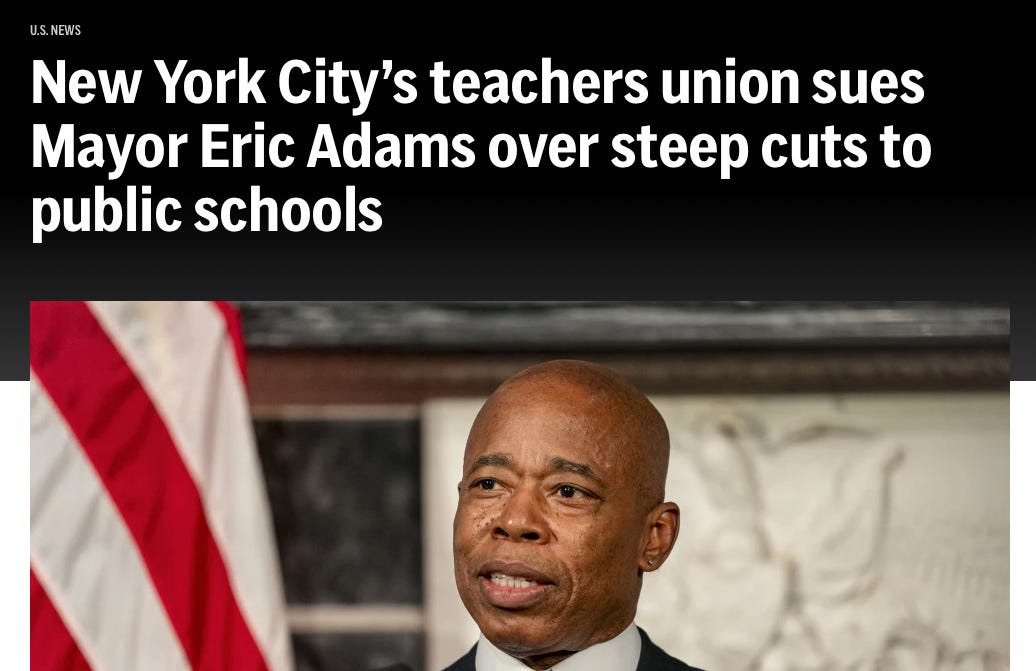
But the difficult-to-discuss problems created by public sector unions are unambiguous. They inflate long-term liabilities through pension obligations that crowd out present-day services; they insulate underperforming employees from accountability; they distort the labor market for public goods like education and policing; and they exercise political influence grossly disproportionate to their economic role, effectively allowing the state to bargain with itself.
These problems loom largest at the state level — particularly in blue states because of how closely most unions align with the Democratic Party. But it also creates problems at the federal level, such as through a defense of the seniority-biased GS system. If we ever want to reform our government, crushing the unions will need to be step one.
How Did We Get Here?
For most of post-industrial American history, the very concept of public sector collective bargaining was anathema. FDR, for example, wrote in 1937 that collective bargaining “cannot be transplanted into the public service” because the employer is “the whole people”. George Meany, who would go on to lead the AFL-CIO, shared this view, writing in 1955 that it was “impossible to bargain collectively with the government.”
This changed in the euphoric twilight years of the postwar boom. Wisconsin’s Governor Gaylord Nelson moved first when, in 1959, he signed the first state law granting public employees collective bargaining rights. He was followed three years later by JFK with Executive Order 10988, which extended this to federal employees. From there, a policy cascade ensued. Let it also be emphasized that this was a broadly bipartisan policy consensus at the time, with Governor Reagan signing California’s public employee bargaining law in 1968.
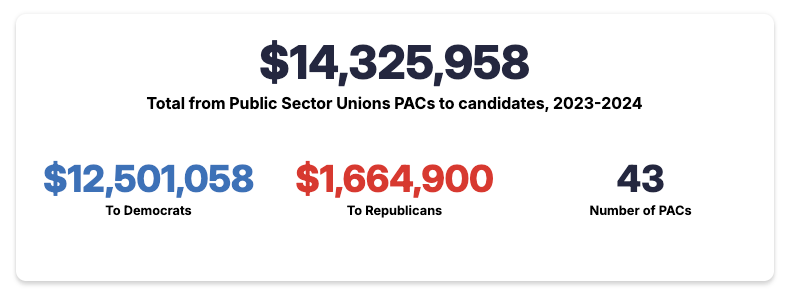
When Republicans began to sour on labor policy in the late 20th century, such as in the case of President Reagan’s firing of 11,359 striking air traffic controllers in 1981, the main effect was to drive public sector unions fully into the Democratic camp. Their size exploded — even as private sector unions largely declined.
Most people probably don’t know this, but as of 2025, public and private sector union membership is nearly identical in absolute terms — roughly 7.3 million and 7.4 million members, respectively — despite the public sector workforce being relatively tiny. In rate terms, the gap is staggering, fully 32.9% of public sector workers are unionized versus just 5.9% in the private sector.
Why Are Public Sector Unions Bad?
In order to understand the problem clearly, it’s worth taking a moment to consider what differentiates private and public sector collective bargaining. In the private sector, management is accountable to owners, who are focused on enterprise profit maximization, leading to their genuinely adversarial relationship with labor, a fundamental cost driver for the enterprise.
By contrast, in the public sector, “management” comprises elected politicians who depend on winning elections. Despite these elections seldom being decided on the basis of niche union demands, union dollars comprise a massive portion of campaign contributions, and union endorsements continue to mobilize large swaths of highly active voters. In other words, public sector union political power far outstrips its economic importance.
As Daniel DiSalvo framed it, public sector unionism is “basically the government bargaining with itself,” since both sides of the table share the same basic incentive to expand the state. What this creates is, as the political scientist Terry Moe describes it, a dual veto: unions are able to both shape institutions from the bottom up, through direct negotiation and employee action, as well as from the top down, through influence on elected officials and by proxy legislation.
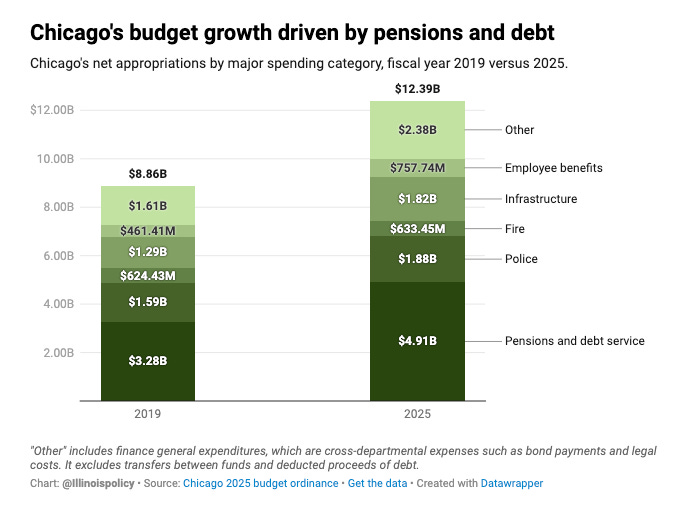
To further complicate the issue, unions have become masters at obscuring their rent-seeking, hiding it in low-salience expenditure that often doesn’t even show up immediately on the balance sheet. Take the example of public sector pensions, which have, in many localities, resisted the transformation into an employee contribution model that is the default in the private sector. Instead, prominently in the cases of Chicago and NYC, structural fiscal pressures have compounded due to what is, at this point, a virtually unfundable pension obligation to their past employees.
Other forms of rent-seeking take the form of functionally isolating employees from termination or even merit-based promotion, fundamentally undermining how efficiently public sector labor can be allocated. Civil service protections, originally designed to prevent patronage, have been co-opted by unions into near-absolute job guarantees. Disciplinary procedures can stretch over months or years, requiring exhaustive documentation and multiple appeals before any adverse action can be taken. The result is a workforce where the gap between the best and worst performers is enormous, but the consequences are negligible and where managers, knowing the futility of the process, simply stop trying to hold low performers accountable.
Is This Supported by Reality?
Yes.
We were recently given an example of how teachers unions can derail reform efforts when, in 2024, the California Teachers Association killed AB 2222. The purpose of this legislation was to shift the state towards evidence-backed learning methods, specifically the use of phonics. But the union resisted it largely because teaching phonics is unpleasant and boring. In their own words, they were protecting “professional autonomy.”
In 2011, Scott Walker, then-governor of Wisconsin, stripped most public employees of collective bargaining rights, giving districts de facto autonomy over compensation and leading to roughly half of them adopting performance-based pay. Barbara Biasi found that in this instance, the flexible-pay districts attracted better teachers while pushing out weaker teachers, leading to a significant improvement in student outcomes. Biasi and Sandholtz also looked at the same reform and found that after five years, test scores increased by 0.17 standard deviations, with these results particularly concentrated in poor students.
There is broad academic consensus around the negative effects of public sector unions, so we need not belabor the point. But people often underestimate exactly how large the effect size is. Lovenheim and Willén, for example, found that exposure to duty-to-bargain laws depressed male earnings by roughly 4%, with effects reaching 9.4% for Black and Hispanic men. This equates to an implied annual cost of $213.8 billion for the privilege of allowing our government workers to unionize.
Furthermore, the issue is, of course, not solely concentrated in education. In 2003, the Florida Supreme Court granted collective bargaining rights to sheriffs’ deputies — but not to municipal police. When Dharmapala, McAdams, and Rappaport examined this natural experiment, they found a roughly 35–40% increase in violent misconduct incidents at newly unionized agencies.
Finally, beyond the direct effects on service quality and institutional performance, both private- and public-sector unionization channels a macro pressure rarely discussed in the same breath as labor policy: inflation. Economists, including Harvard professor and former IMF chief Ken Rogoff, have observed that powerful wage-bargaining structures can make inflation more entrenched and persistent once expectations become embedded, because they rigidly reinforce wage-price spirals (i.e., the feedback loop between wages and prices that make bouts of inflation persistent).
While it may be true that inflation “is always and everywhere a monetary phenomenon,” and thus falls under the purview of monetary policy, Milton Friedman himself would have likely conceded that wage-price spirals can help perpetuate it.
So What Can We Do?
The goal is, of course, to crush them. And doing this does not require reinventing the wheel. I’ve broken my plan down into three items.
Public sector unions should be banned from political lobbying of any kind. The fact that they can currently directly lobby politicians is a national shame. They should at minimum be held to the same standards as 501(c)(3) nonprofits with respect to political advocacy. This is the single most important reform and if enforced it would effectively decapitate their political power.
Every state should adopt the Wisconsin model where bargaining, if it is to exist at all, is limited to base wages and there is no payroll deduction of dues.
Trump’s March 2025 executive order revoking collective bargaining for federal workers at agencies with national security missions should be codified into law, and extended to the entire federal workforce.
The gold standard would be to strip public sector unions of all collective bargaining rights and statutory privileges, but the three reforms above would go extremely far in removing their ability to manipulate the state and impose negative externalities on the public.
The other issue is that since the entire value of being a teacher, etc is in the pension, there is incredible incentives not to rock the boat once you've been around awhile. If the school system sucks then a younger teacher tries it for a few years and then bounces to a new career. If you're close to the 20 year brass ring you would literally murder a baby to get to that pension.
I do agree that unions are oftentimes blights on society, either rent-seeking or imposing a source of friction that’s not worth the cost. However, I want to push back on the idea that public sector unions have any less of an adversarial relationship with their employers than private sector unions do.
Politicians are not any more accountable to public sector employees than executives are to private sector employees. This is because public sector employees are not a large fraction of voters the same way as private sector employees are not a large fraction of shareholders. Executives want maximum revenue for minimum expenditure, while politicians want maximum political gain for minimum expenditure. This *can* lead to both wanting lower wages for the employees, since the budget matters for politicians. But more often politicians are adversarial for other political reasons. I was happy police unions existed during “defund the police”, even though that had nothing to do with a possible concern for policemen being stiffed on wages.
I don’t think unions should have outsize influence the way they do, and they clearly have engaged frequently in rent-seeking or otherwise detrimental behavior, but saying they’re not in an adversarial relationship or should only be able to bargain over wages seems to step too far. I’m frankly much more concerned about politicians taking foolhardy, shortsighted choices that sound good to the public than I am about executives doing so.