


The economic challenge for our health care system is to align costs and benefits. The information that policy makers would need in order to do that is difficult to obtain.
Many Americans complain about our health care system. We experience health insurance as confusing and bureaucratic, with ever-rising premiums. The bills that we receive from health care providers seem ridiculous, although with insurance the prices are heavily discounted and the consumer actually pays little or nothing.
Health care spending in America has increased dramatically over the past 50 years. On a per capita basis, our spending is now much higher than that of any other nation. Are the benefits commensurate?
One way to measure benefits is to use the reduction in treatable mortality. Whereas overall longevity statistics include deaths from automobile accidents and homicides, estimates of treatable mortality more closely measure the effects of medical care. In 2022, the most recent data available from Health at a Glance, treatable mortality in the U.S. was 95 per 100,000, vs. 77 per 100,000 in the OECD average. On this measure America is worse in spite of higher spending.
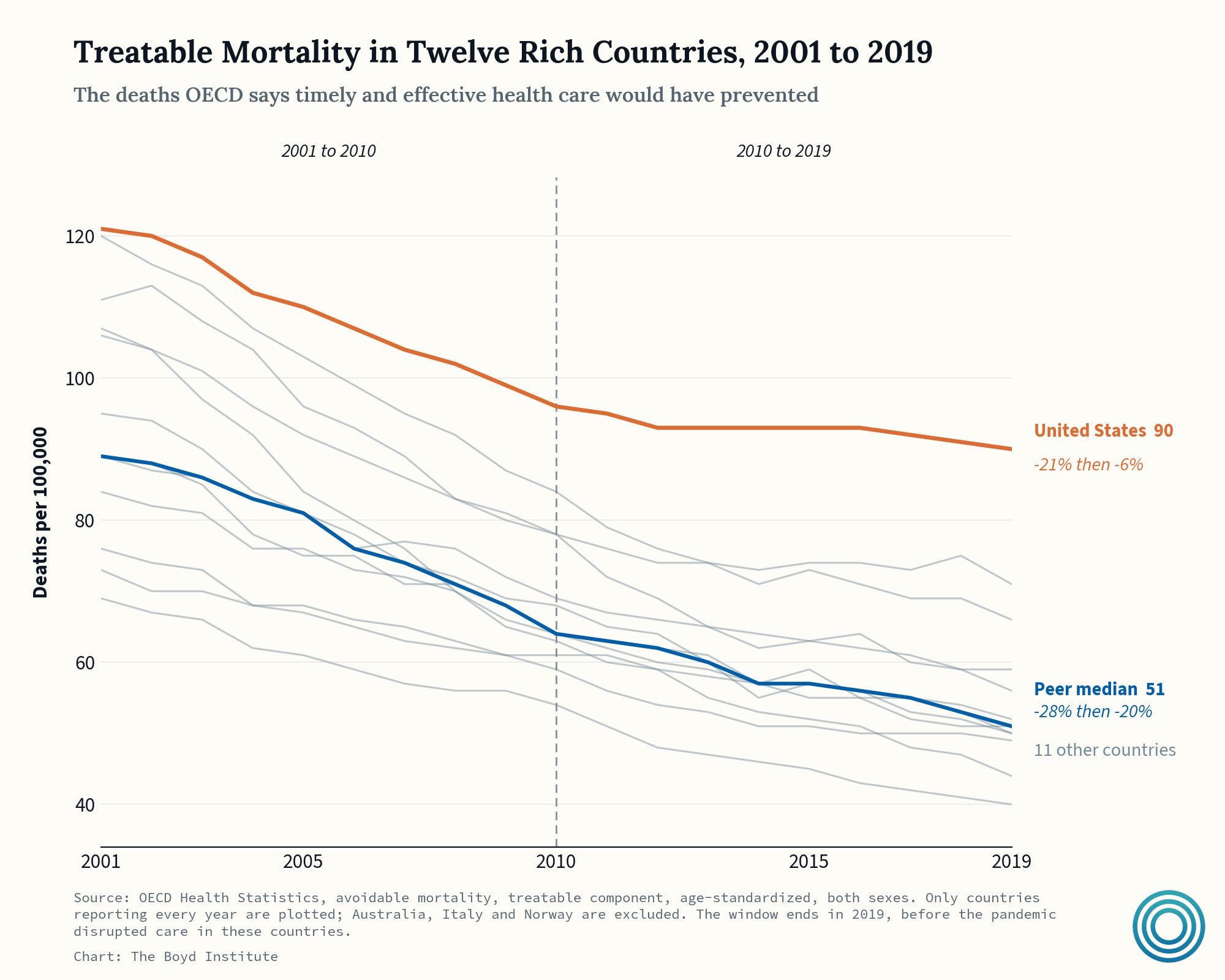
Another way to try to assess whether higher spending on health care reduces mortality is to look at sub-populations in the United States with similar characteristics and different levels of spending. Many studies show little or no effect of higher spending in lowering mortality. This suggests that there is a problem with cost-effectiveness in our health care system.
Note, however, that not every study fails to show a reduction in mortality from more spending on health care. Note also that mortality is not the only health care outcome that we care about. Quality of life matters as well. Procedures such as knee replacements or in vitro fertilization are expensive, but patients value them highly.
Our health care institutions face trade-offs. Consider the regulation of who can practice medicine. Medical licensing systems and practice regulations govern entry into medical professions. The malpractice insurance system is one mechanism for forcing exit from medical practice. These systems are costly to operate, but we cannot do without some costly system for regulating entry and exit.
Consumers and the third parties that pay for health care services have to make two types of decisions: which medical procedures to undertake; and how much to pay for those procedures. When health care is paid for by insurance companies or government, that means that third parties become involved in making these decisions.
In order to hold down costs, health insurance companies deny coverage for some procedures. They also negotiate with doctors and hospitals for lower prices. But consumers resent being denied coverage for a procedure. And hospitals, doctors, and other health care providers resent what they see as inadequate compensation. Government appears to be in a better position than private insurance companies to tolerate such resentment. Consumers in countries where government pays for health care find that some services, such as colonoscopies to screen for colon cancer, are not available. Doctor salaries appear to be lower in other countries than in the United States, although international comparisons are difficult given differences in hours worked and degree of specialization.
Concerning the question of which medical procedures are covered, consider this thought experiment: Imagine that you were offered a health insurance policy that only covered medical procedures that were widely available 50 years ago. The premiums on such a policy would be much more affordable than current health insurance premiums. But you could not be reimbursed for these expensive and now-common services:
Knee replacement
Liver transplant, lung transplant, or reliable heart transplant
MRI
Various heart procedures, including balloon angioplasty or stents
In vitro fertilization
Cell therapies, gene therapies, other advanced cancer treatments
Modern drugs, including biologics, proton pump inhibitors, GLP-1 agonists
These innovative treatments and procedures account for a lot of the increase in health care spending over the last fifty years. Health insurance premiums have skyrocketed as a result.
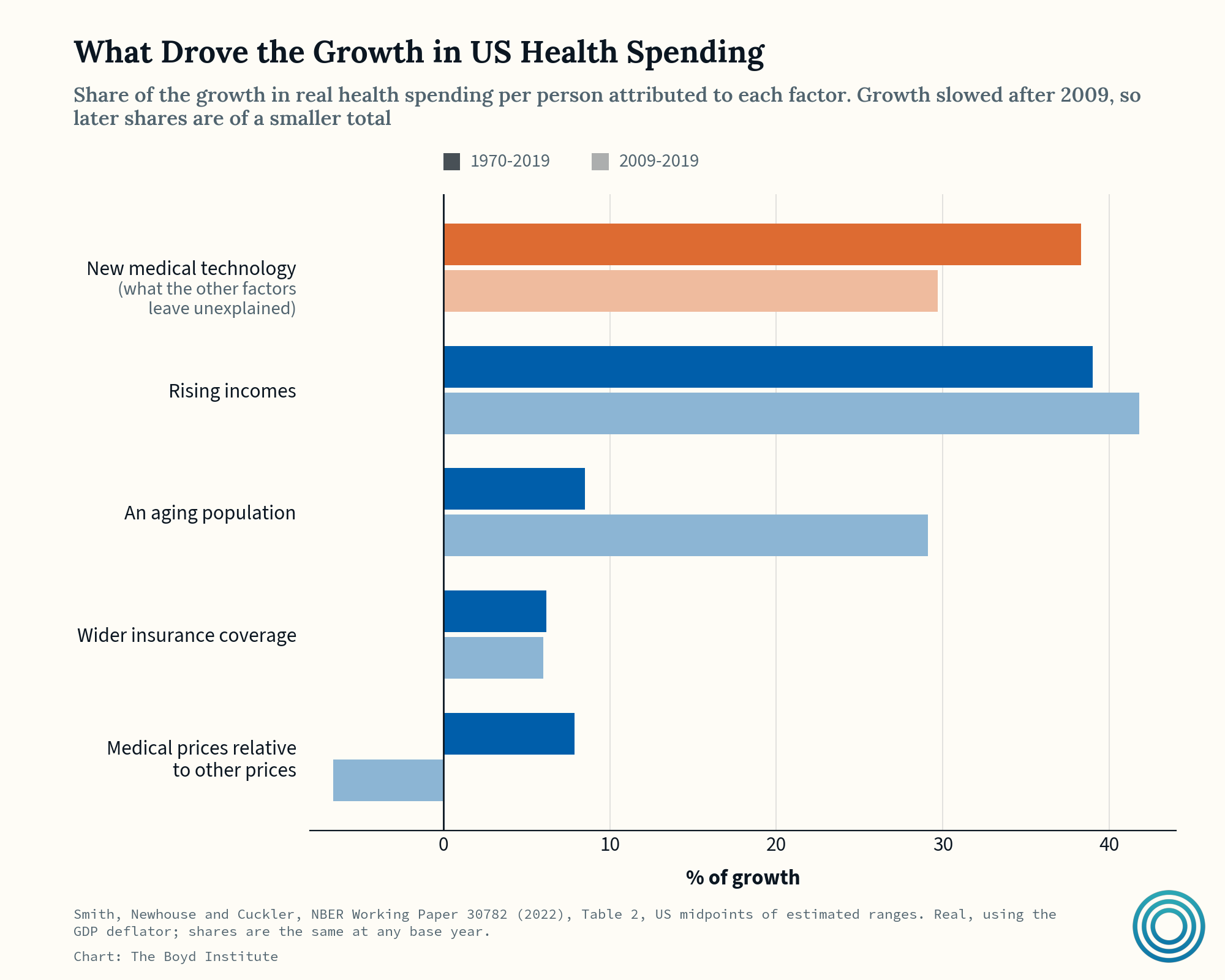
An increase in medical specialization over the past fifty years also has contributed to rising health care expenditures. Today, people are used to seeing neurologists, dermatologists, endocrinologists, as well as other specialists. For treatment, the general practitioner often serves in the health care system as a point of entry rather than the patient’s last stop.
The trade-off between overhead and fraud
At least some of the overhead in the health insurance industry is needed in order to prevent fraud. When a provider asks for reimbursement, the insurance company must screen for fraud. Was the procedure actually performed? The insurance company must spend resources to find out. If the industry were to reduce the resources used in deciding to approve and reimburse medical procedures, that would make it easier for providers to commit fraud.
Similarly, an insurance provider has to determine whether a procedure is necessary in order to know whether to provide reimbursement. When a procedure is covered by a policy and is necessary for the particular patient, it would be a mistake to deny coverage. But it also would be a mistake to provide coverage for a procedure that is not necessary for this particular patient. The insurance provider has to spend resources to screen out unnecessary procedures.
Procedures that are not cost-effective
But many medical procedures do not fall clearly into the binary of “necessary” or “unnecessary.” Instead, they fall in a gray area. Precautionary tests that may or may not reveal anything are one example. Treatments that have a low probability of working are another.
Colonoscopies to screen for colon cancer are an example. There is no doubt that these save lives relative to the alternatives, such as screening via fecal occult blood samples. But other countries rely on the less costly screening methods. They seem to have determined that the cost per life saved of routine colonoscopies is unacceptably high.
I believe that American culture, habits, and institutional arrangements lead to over-use of medical procedures that have high costs and low benefits. I doubt that this will be easy to change. What many doctors regard as futile care near the end of life is something that relatives often insist upon. And anything that smacks of health care rationing produces outrage. In 2009, for example, the U.S. Preventive Services Task Force recommended several changes that would have reduced the amount of breast cancer screening done in this country. The recommendations were denounced and rejected.
Pay for quality?
The fact that health care providers are compensated for performing procedures leads economists to suspect that providers are biased toward recommending more procedures and costlier procedures than are optimal. But any alternative method for compensating doctors poses problems.
If doctors are paid a straight salary, then they have an incentive to have only a small panel of patients. If they are paid by the number of patients on their panel, then they have an incentive to accept only the patients who require the least effort to see. If they are paid on the basis of the health outcomes of their patients, then they have an incentive to keep the sickest patients out of their panel.
One approach, championed by health economist David Cutler and others, is to pay physicians on the basis of how well they adhere to standards of care. For example, suppose that there are standards that say when a heart stress test is indicated or not. Doctors who either fail to give tests when indicated or give tests when not indicated will be compensated less than doctors who adhere to the standards.
This “pay for quality” approach imposes heavy information requirements on the third party setting the compensation rules. In effect, the standards based on generic cases are being used to over-ride the doctor’s judgment about the particular patient as seen in the office.
Pay less?
Another idea is to pay for procedures, as we do now, but pay less. The implicit assumption in this approach is that providers earn what economists call rents, meaning incomes in excess of what they require in order to supply their services. In the words of the title of a famous paper, “It’s the prices, stupid.”
The laws of supply and demand say that if the price is artificially high, then that should produce a surplus. But we do not observe an excess of doctors and nurses.
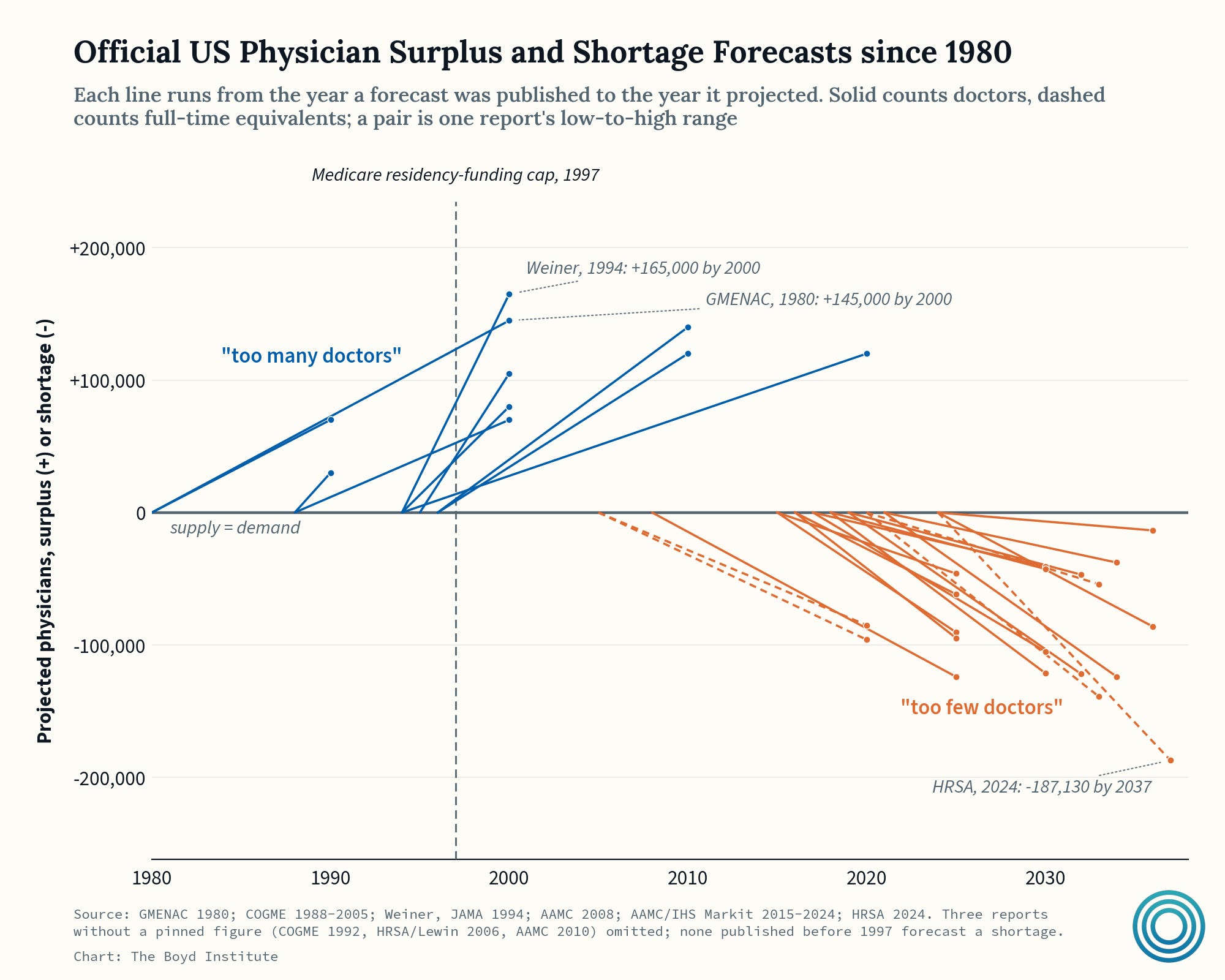
There could be a surplus of people who wish to become doctors, nurses, or other health care providers. They are prevented from doing so by medical licensing requirements. In my home state of Maryland, for example, one needs to obtain a doctorate in order to enter the physical therapy profession. Economists have long questioned whether licensing and practice regulations truly protect consumers, as opposed to incumbent health care providers.
If we believe that health care providers are paid too much, then one policy prescription for cracking down on excess rents is to increase the negotiating power of the third party payers—insurance companies and government. Doing so requires, at least implicitly, estimates of the elasticities of supply of various forms of health care provision. If supply is relatively inelastic, then lower prices will not cause providers to exit. But in fact there are doctors who refuse to take Medicaid or Medicare or even private insurance. Supply is at least somewhat elastic.
Conclusion
From an economic perspective, a health care system is a set of institutions that processes information and provides incentives to consumers and health care providers. What we have seen is that there are trade-offs involved, such as the trade-off between keeping administrative costs low and policing fraud. And the information to make good decisions about what procedures to provide and at what price is far from perfect.
It appears that America’s health care system has unusually high costs relative to benefits. Broadly speaking, there are two ways to attack this. One way is to try to reduce the use of medical procedures that have high costs and low benefits. The other way is to try to bring down the prices charged by health care providers.
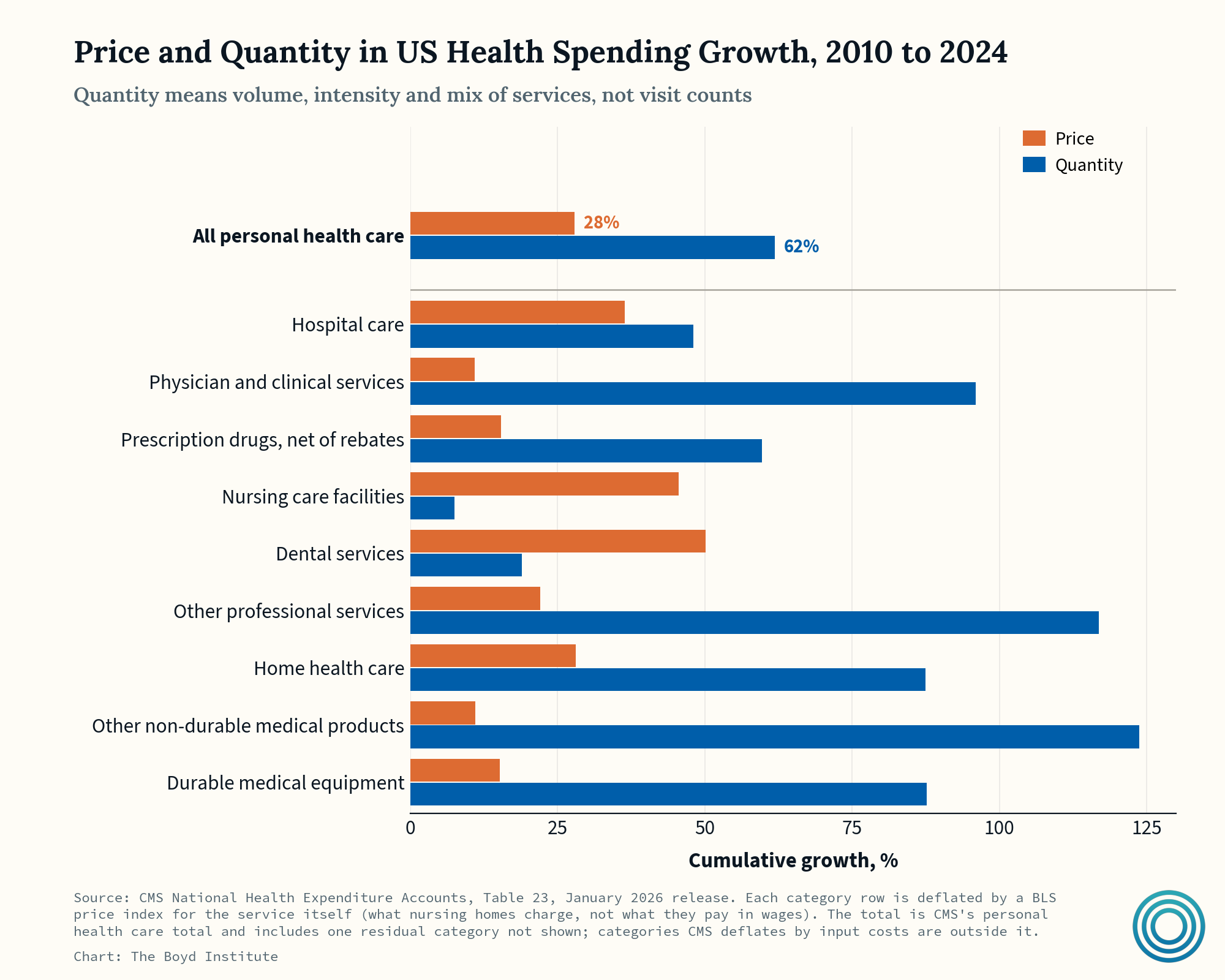
How can we reduce Americans’ use of medical procedures that have high costs and low benefits? If consumers had to pay for more of their medical expenses out of pocket, then they would purchase fewer medical services. But given consumers’ imperfect knowledge about the likely benefits of procedures, they might make choices to forego beneficial care as well as procedures that are not cost-effective.
The alternative is to have insurance providers, both private and government, make the decision to deny coverage for procedures that are deemed to have high costs and low benefits. But with imperfect information, third parties will make mistakes. Nearly every procedure offers at least some benefit, if only a slim probability of helping the patient to feel better. Insurance providers could be more rigorous about denying coverage for procedures that do not provide enough expected benefit to justify the cost. To do this well, third parties would need very good information about the average outcomes of various procedures. And even so, they would be in the position of over-riding the judgment of doctors concerning particular patients. More rigorous decisions would provoke more resentment from patients and their doctors.
For reducing prices, we have seen that one approach would be to increase supply in health care by loosening restrictions on licensing and medical practice. Another approach would be for insurance providers to negotiate for lower prices from providers. With either approach, a lack of knowledge about elasticities of supply will hamper the ability of policy makers to achieve desired outcomes.
We ask a lot of the institutions that make up our health care system. These institutions must govern who can supply various medical services. They must channel resources for innovation. They must encourage the use of cost-effective medical procedures while discouraging the use of procedures that are not cost-effective. They must provide adequate and appropriate compensation for health care providers, taking into account their incentives to take advantage of any system, including by committing fraud. They have to take into account political constraints, including the resentment that Americans feel toward any institution that is perceived as restricting insurance coverage of medical services.
In all of these activities, our capabilities are limited by a lack of available information. We do not know who is qualified to be a health care provider, so we rely on the licensing system to control entry and on the legal malpractice system to influence exit. We do not know what procedures are cost-effective on average, and we give doctors imperfect guidelines. Even if guidelines apply on average, we do not have the information that doctors obtain about particular cases. We cannot look over doctors’ shoulders to observe their behavior, so that we cannot be confident that whatever compensation system we are using is producing the right responses to the right incentives.
It would be easy to fix America’s health care system if there were a set of clearly identifiable villains. But the problems that we face are a reflection of imperfect information and trade-offs. There are ways to improve our institutions, but there is no miracle cure.

Arnold Kling is an economist who writes In My Tribe on Substack. He holds an MIT PhD in economics, worked at the Federal Reserve and Freddie Mac, and in 1994 founded one of the first web businesses. His books include Crisis of Abundance, on health care, and The Three Languages of Politics.

A very clearly written explanation of where we are. Thank you. Could you or someone else at the Boyd Institute please follow up with an analysis of various alternatives to our current system? I have a friend who is a retired family practitioner. He swears the only viable option is single payer but my conservative mindset rejects the thought of putting the government in total control of yet another part of our lived