


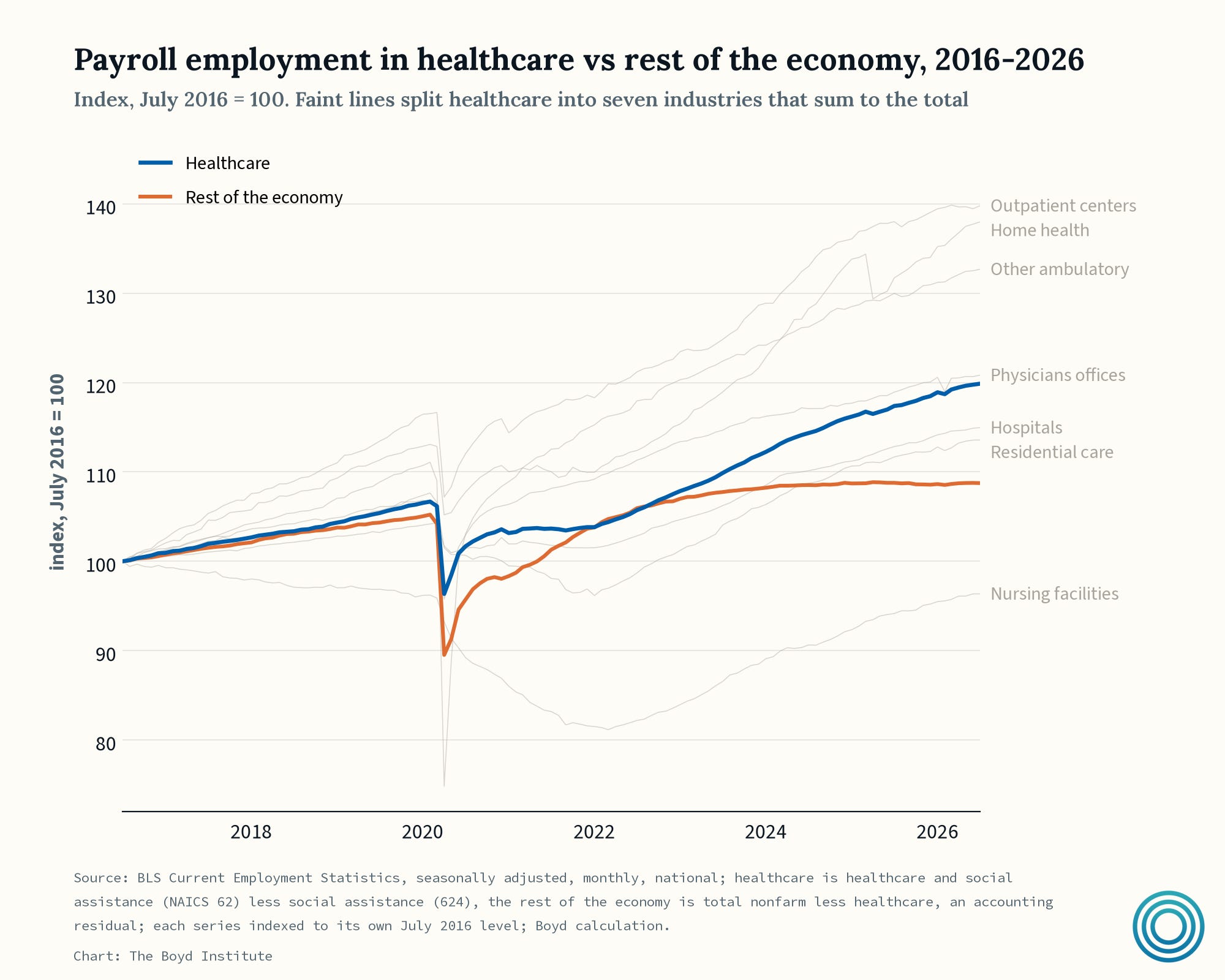
We were tempted to title this piece “The Baumol Economy,” after the economist William Baumol, who showed that work that can’t get more productive keeps getting more expensive. Healthcare is largely that kind of work, and it’s devouring America’s job market. Over the past year, the sector added 392,000 jobs while everything else combined lost 76,000.
Is that a sign of progress or decline? Our honest answer is “both,” which is not very satisfying. Below are 11 observations that explain why. Some surprised us.
1. The American economy today has a single driver of jobs: healthcare.
The rest of the jobs market has basically flatlined.
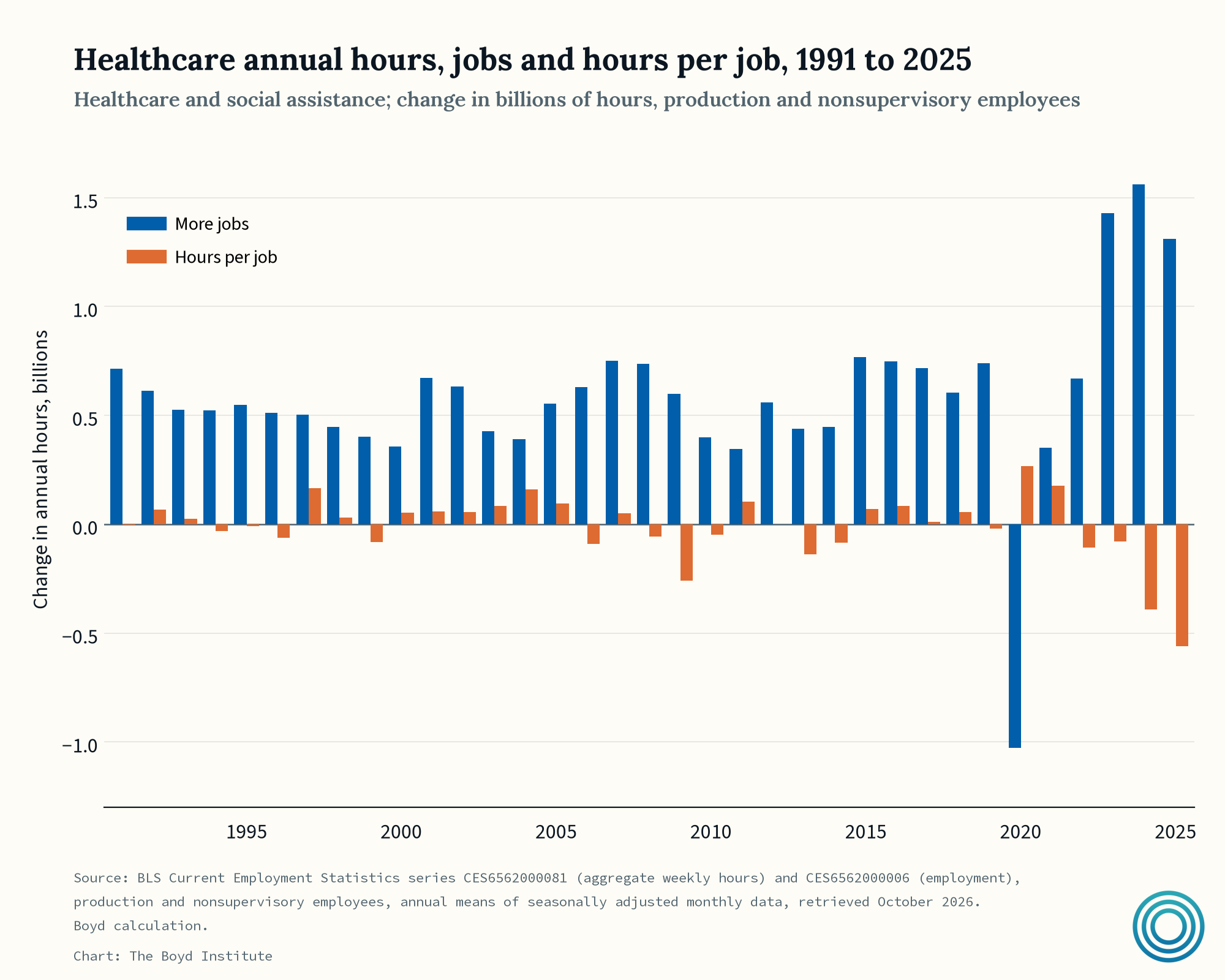
2. The growth is in headcount, not hours.
The growth has come almost exclusively on the back of new healthcare job creation, while hours per job fell.
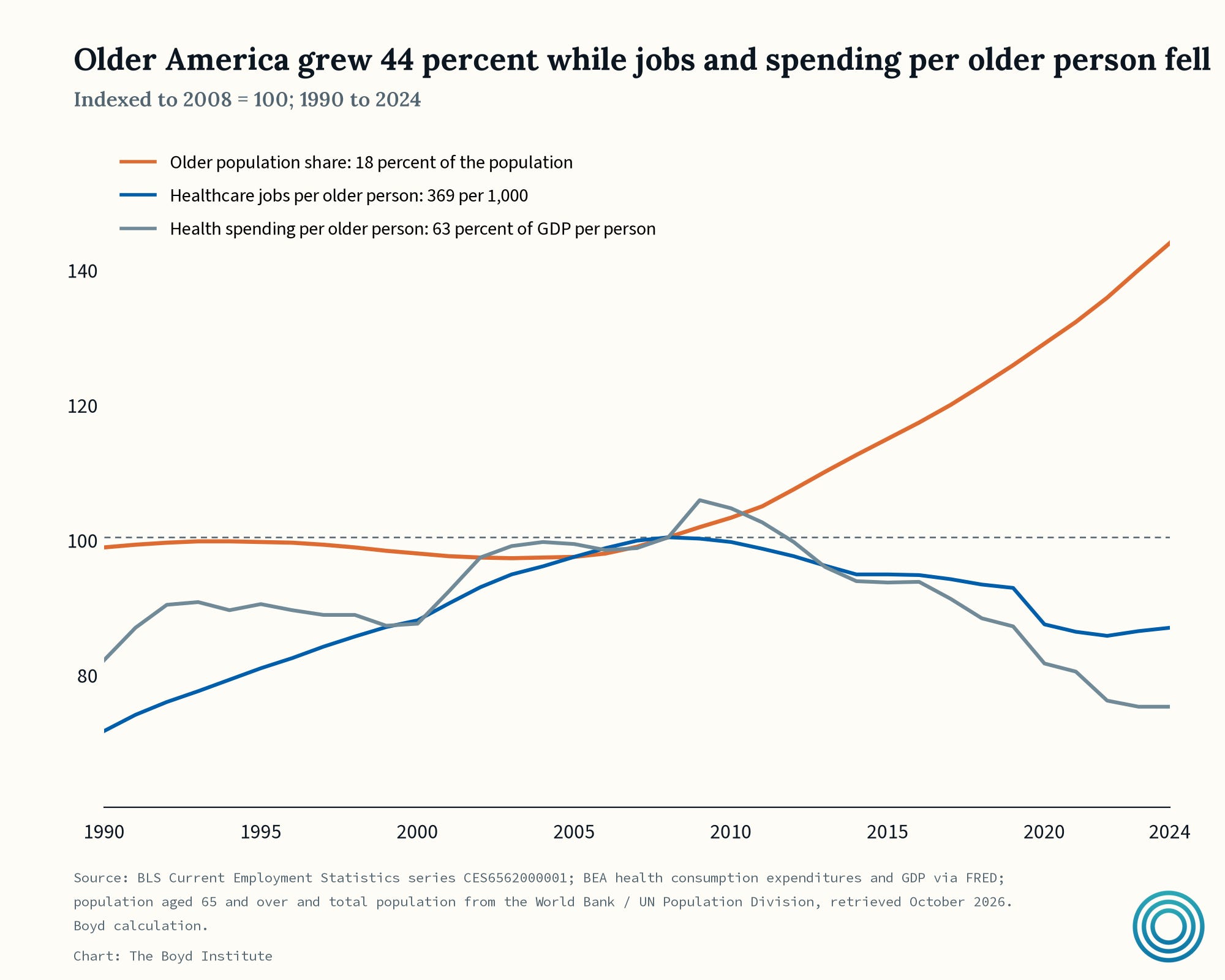
3. The over-65 population has grown faster than healthcare jobs.
Healthcare jobs per older person have fallen over the past decade.
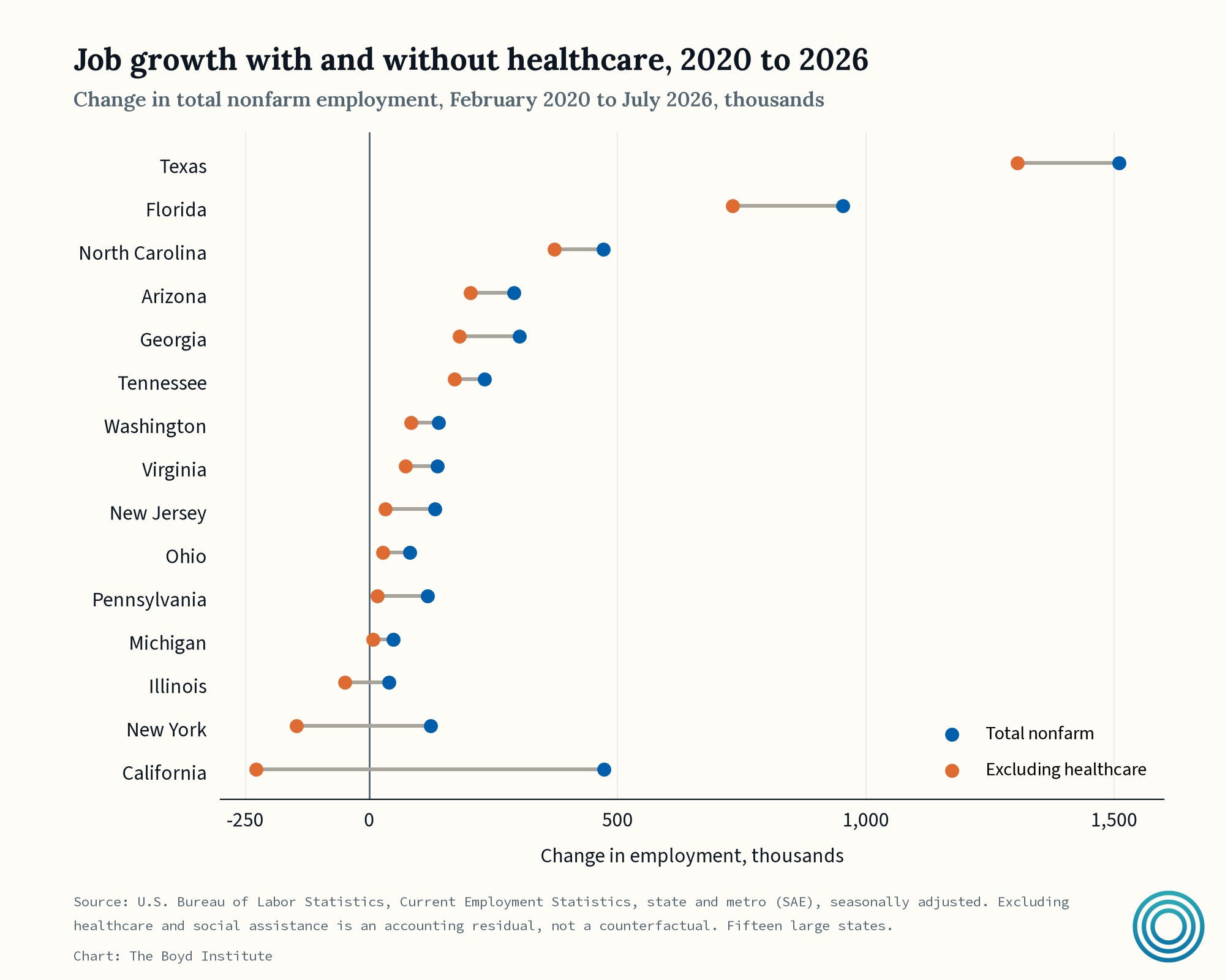
4. In California, New York, and Illinois, healthcare is all the job growth.
California, New York, and Illinois have had negative overall job growth since the pandemic when healthcare jobs are backed out. And none of the 15 largest states lost healthcare jobs.
5. Demographics explain hospital hiring, and little else.
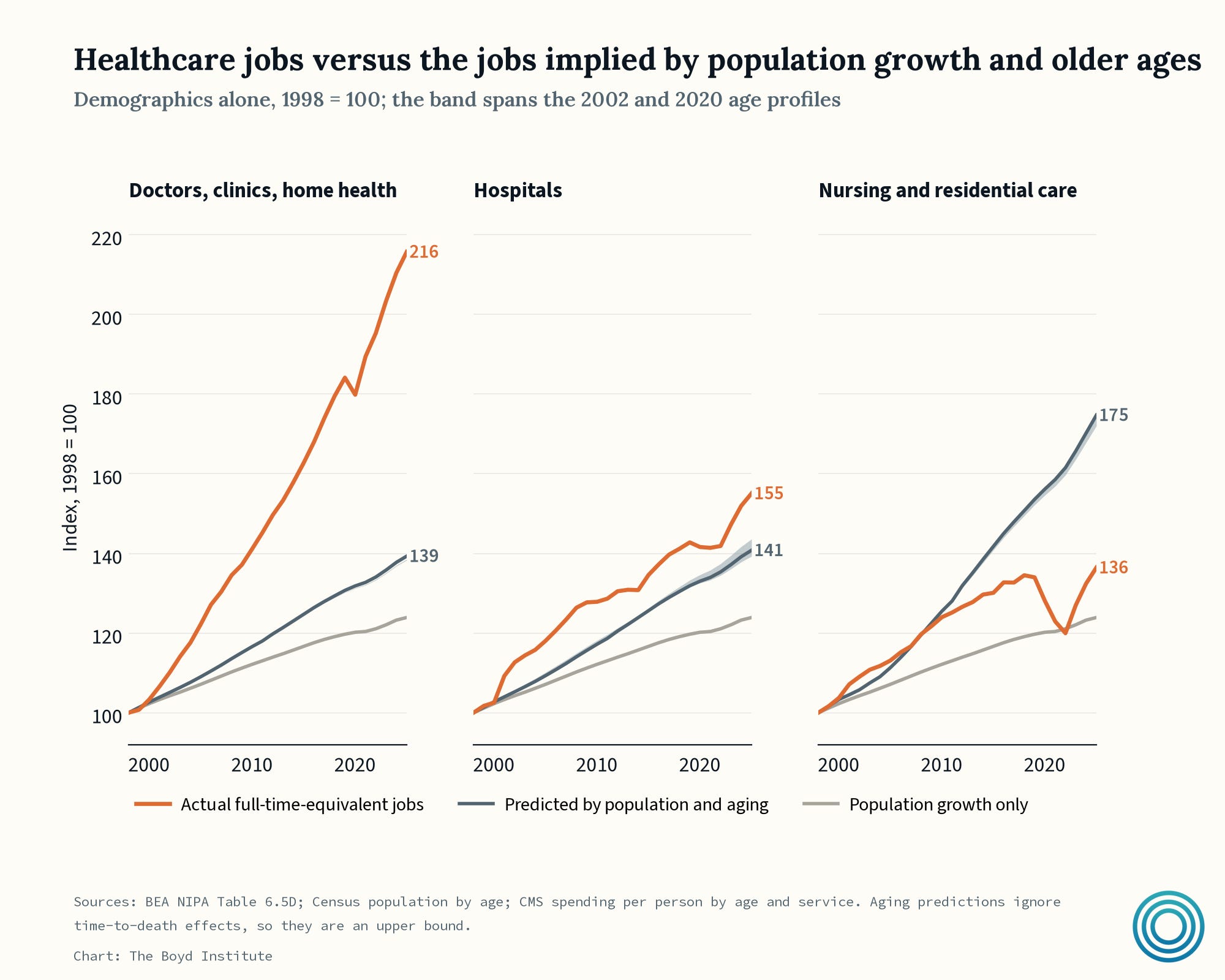
One might expect this to be a clear story of an aging population driving up demand for healthcare workers. That is true to some extent, and explains most growth in hospital hiring. But based on population growth and aging alone, the actual increase in nursing home jobs is much lower than demographics would imply. Doctors’ offices, clinics, and home health went the other way: jobs more than doubled, against roughly 40 percent growth predicted by demographics.
6. Half the new jobs are home care aides.
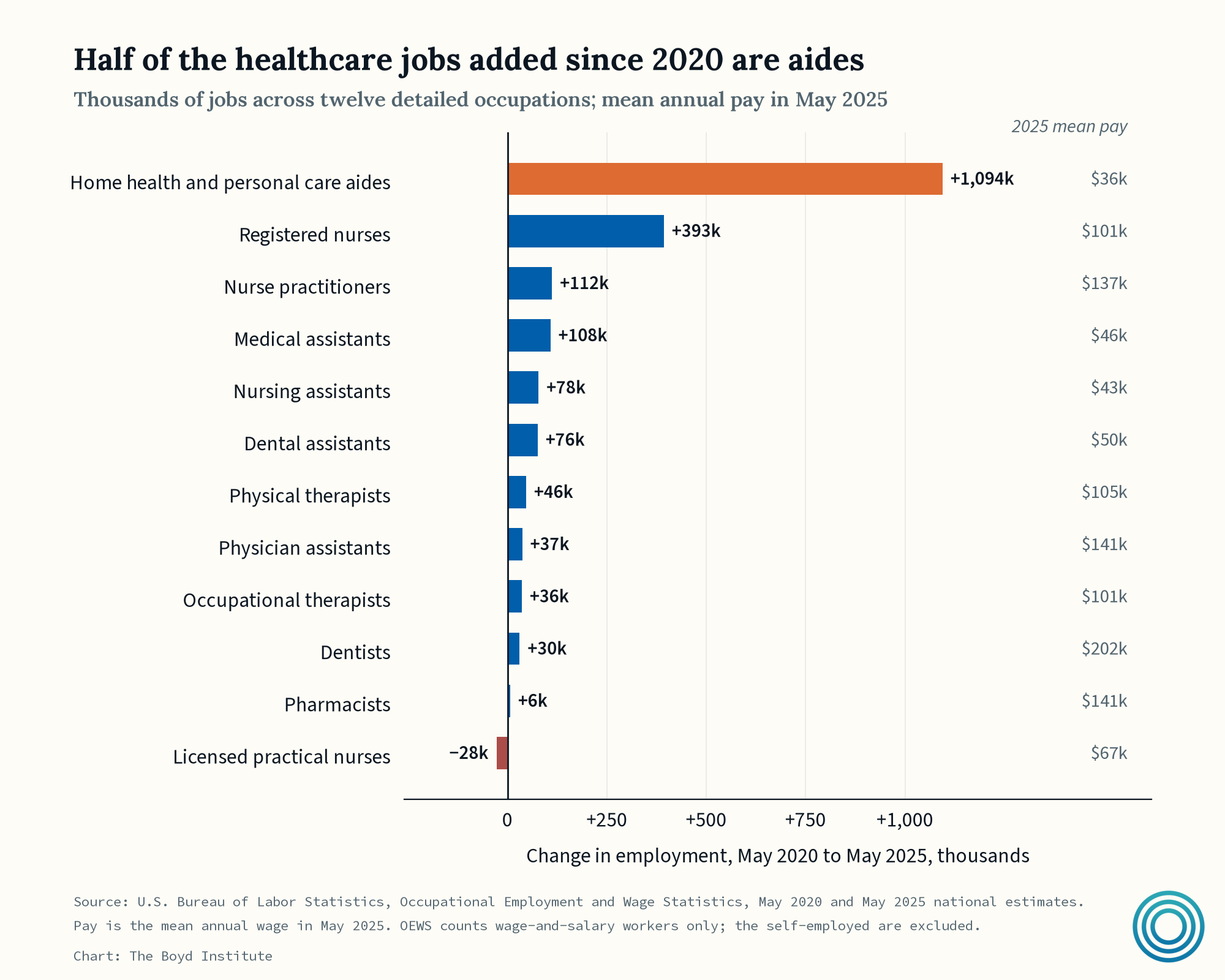
The bigger surprise is who got hired. Half the jobs added since 2020 across major healthcare occupations went to home health and personal care aides, who earn about $36,000 a year.
7. Where Medicaid home-care spending grew, home-care jobs followed.
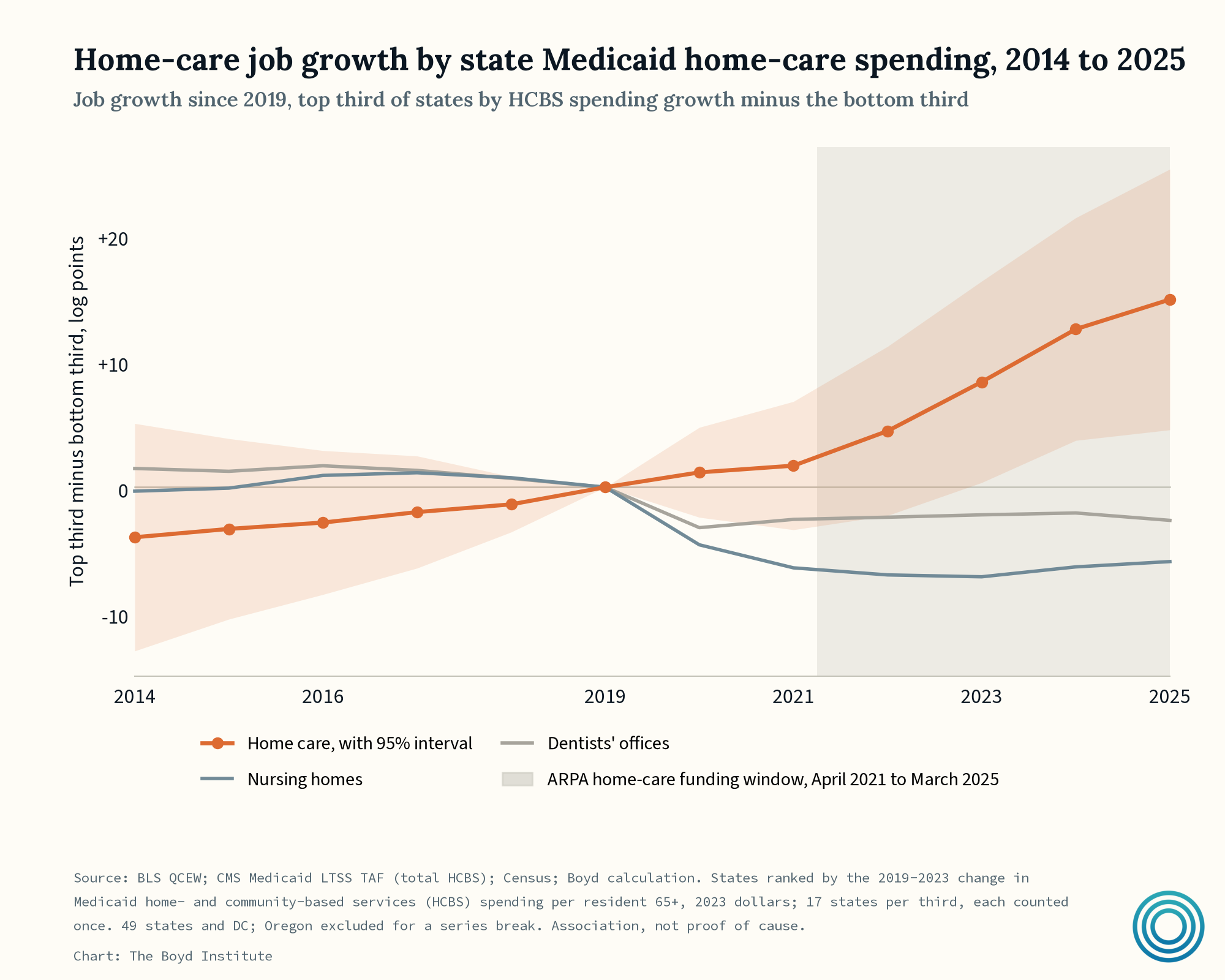
So what explains this? Medicaid. Compare the third of states where Medicaid home-care spending grew most with the third where it grew least. Home-care jobs grew about 15 percent faster in the first group, and the gap opened after federal pandemic money for home care arrived in 2021. Nursing home jobs moved the other way.
8. The work is done mostly by women and paid for largely by government.
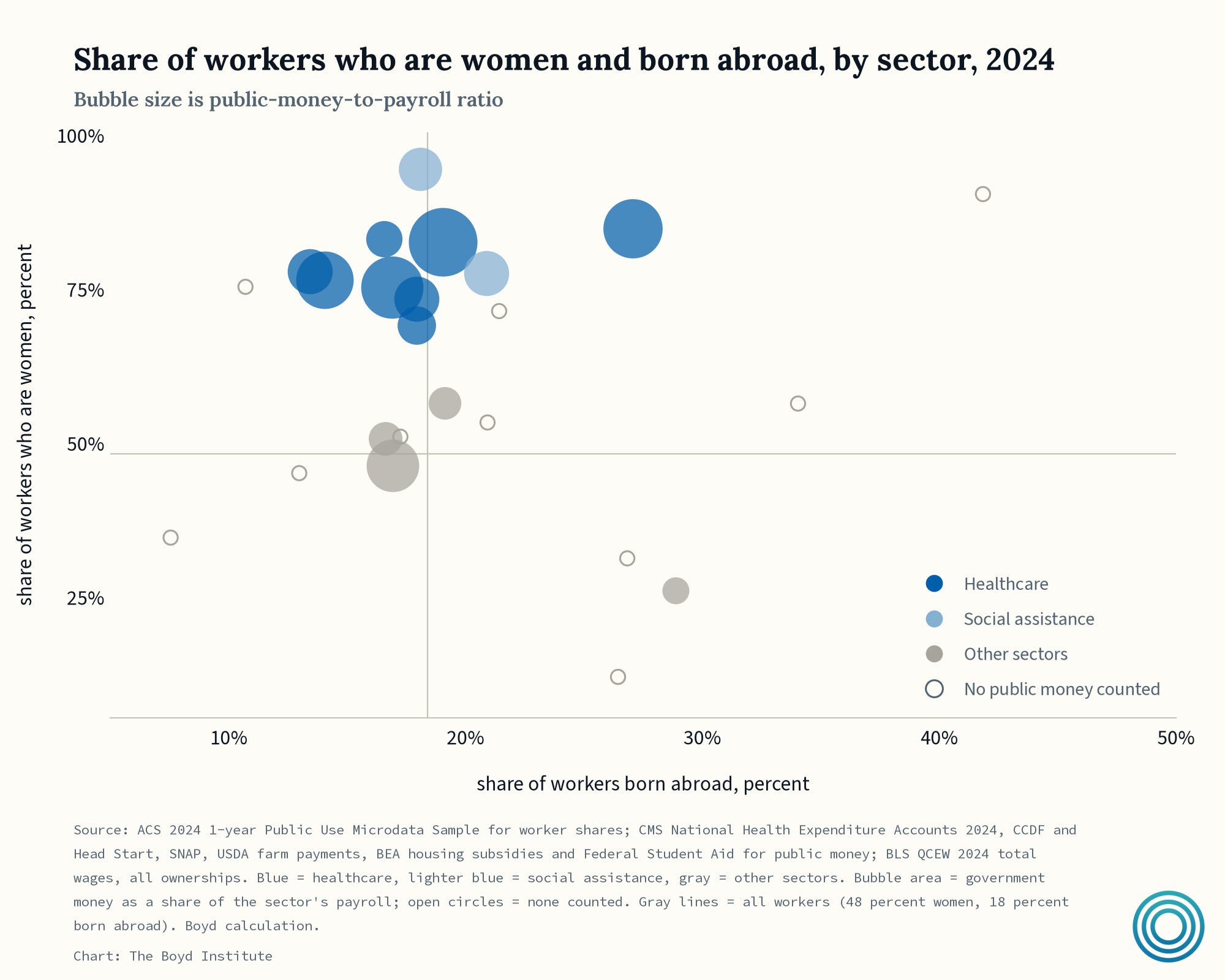
The net result is fewer nursing home jobs than in 2019 and far more low-paid work in people’s homes. That work is done mostly by women, in home care disproportionately by immigrants, and paid for largely by government.
9. Jobs grew faster than pay.
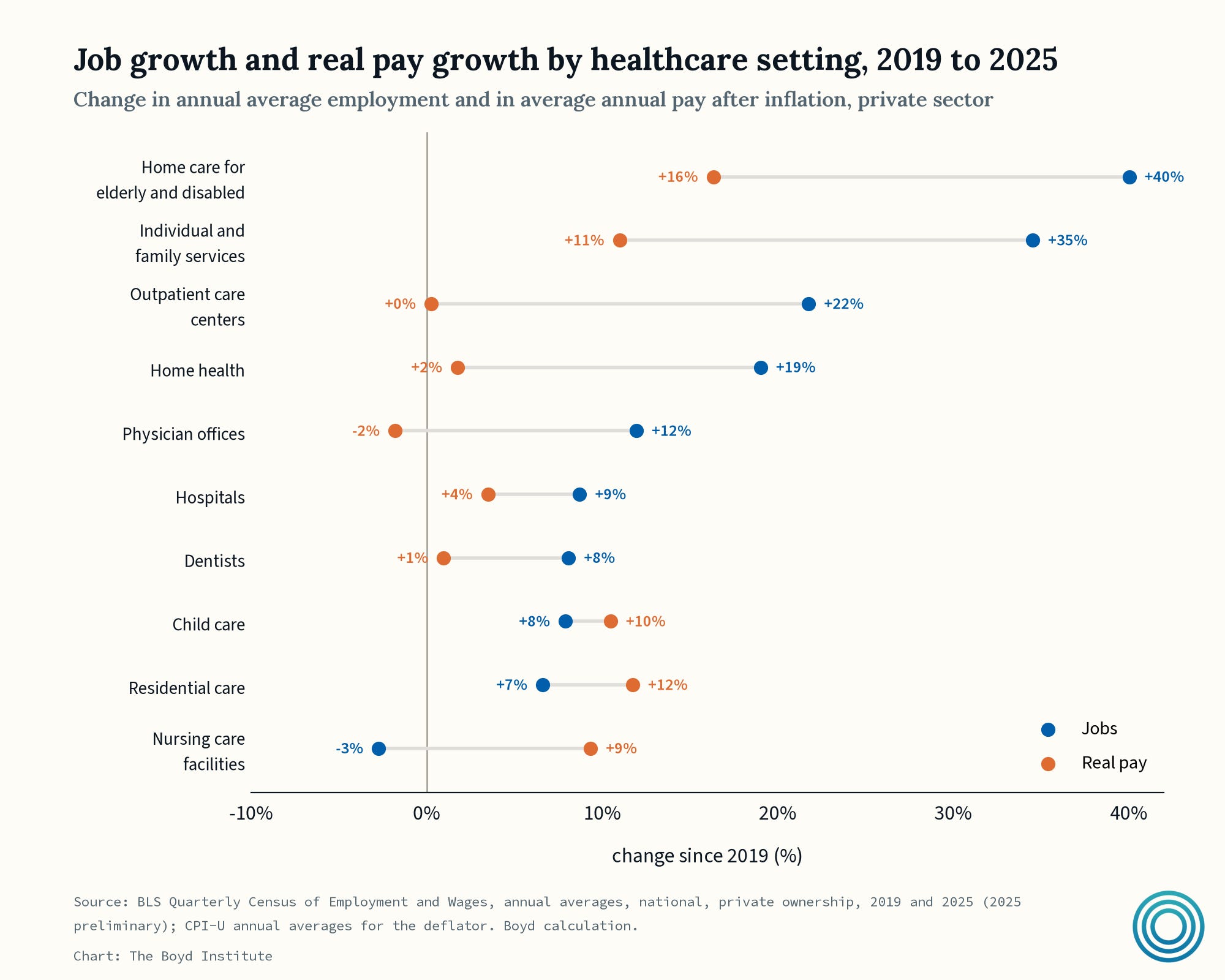
As healthcare swells to nearly a fifth of the US economy, the extra money is going to headcount more than pay. In every fast-growing setting, jobs grew much faster than real pay. Since 2019, home care added 40 percent more jobs and raised real pay 16 percent. Outpatient centers added 22 percent more jobs and raised real pay not at all.
10. Output per healthcare job grew half as fast as the rest of the economy.
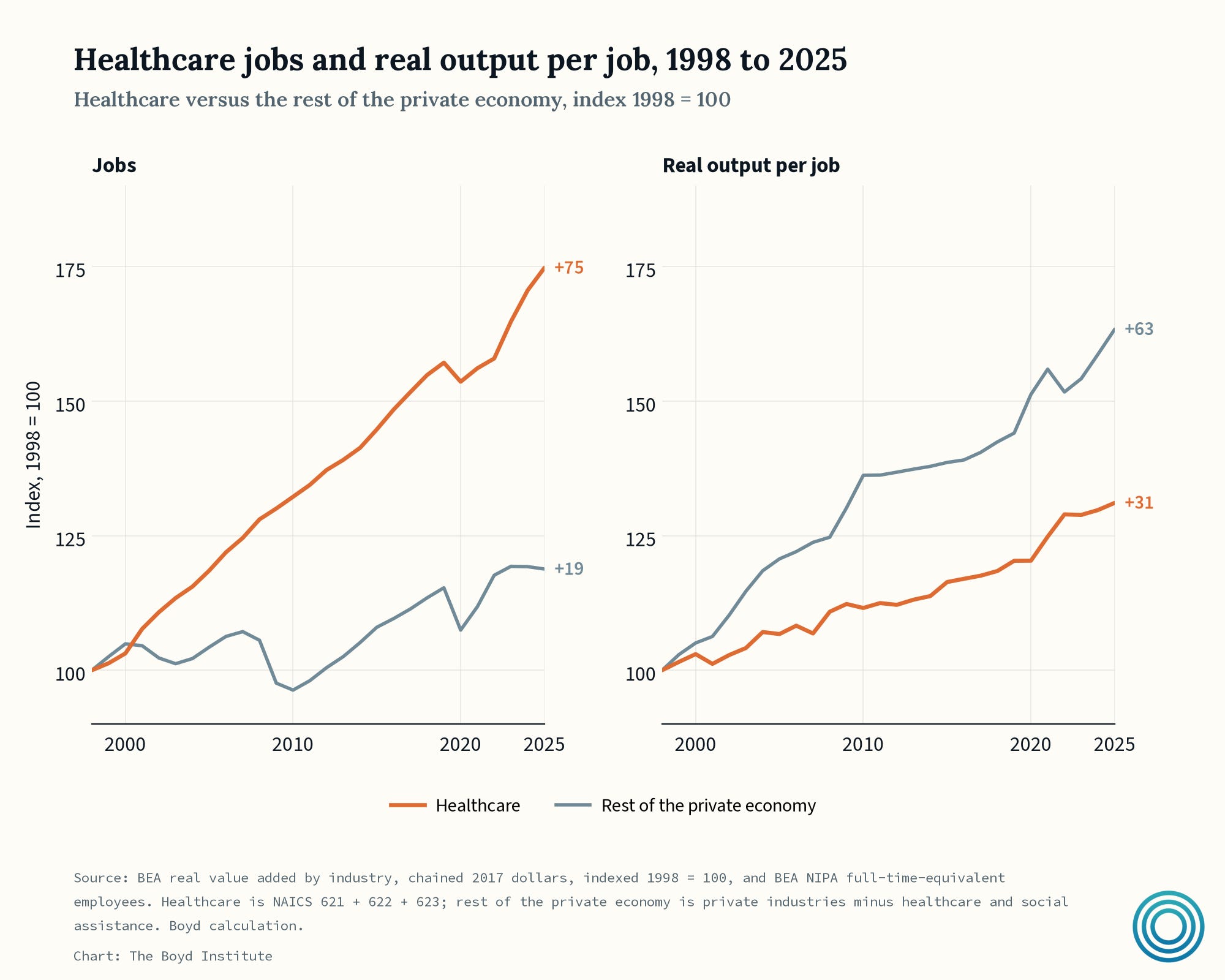
Zoom out, and one of the country’s slowest-improving industries is absorbing its workforce. Since 1998, healthcare jobs have grown 75 percent, four times the rate of the rest of the private economy. Output per healthcare job grew half as fast: 31 percent against 63.
11. Where productivity lags, prices rise and jobs pile up
This final chart shows the whole story: Baumol’s cost disease, the economic phenomenon where stagnant (often service) industries get steadily more expensive. Each bubble is an industry; the darker, the more its share of jobs grew.
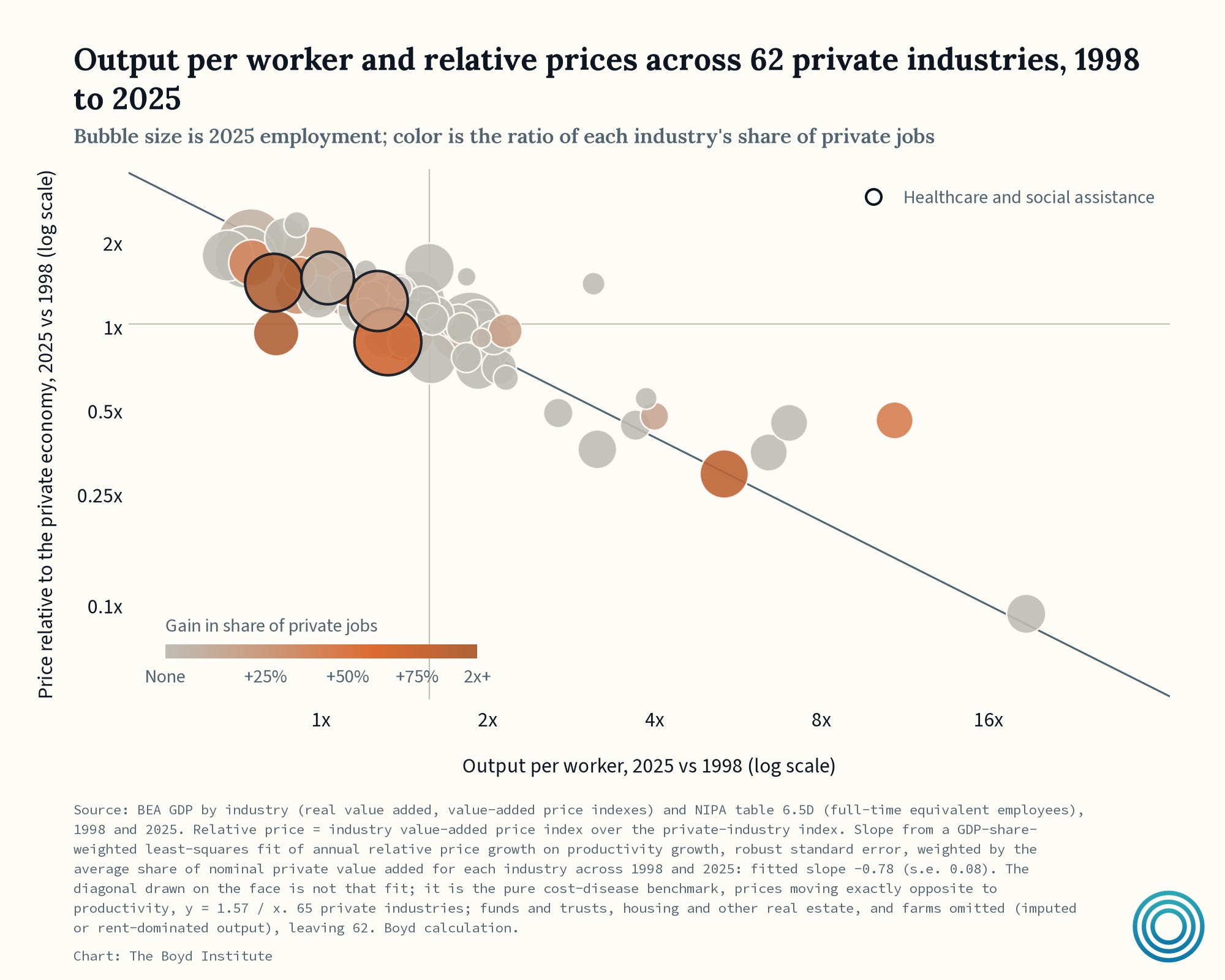
In most service markets rising prices would push buyers away or they would substitute. You can always trade a $100 night out with friends for a night in with Netflix, or your fade-and-massage for fifteen minutes at Supercuts. You can’t really trade a colonoscopy or a trip to the ICU for WebMD. So when healthcare gets more expensive, we don’t buy less of it. We find a government form to fill out, and more people get hired to do the same thing the same old way.
Is America’s healthcare boom a sign of progress or decline? 🤔
Some of this is progress. Older Americans who once would have gone to nursing homes are getting care at home, which is what most of them say they want.
But the economics are grim. Every year, a larger share of American workers is employed where output per worker barely rises, much of it paid for by taxpayers, current and future. None of this is a knock on the people doing the work.
The picture that emerges is mixed. There’s progress for families getting care and a slower-growing economy for everyone paying for it.
Thank you for another excellent report.
As you say, it seems clear that government (Medicaid) funding is allowing seniors to defer nursing home residence with home health. There may be a variety of causes for the apparent lag in output per job. According to workforce data, ~30% of home health workers choose part-time employment for non-economic reasons. Also, some of this can be explained by the fragmented nature of the work that requires client matching and travel overhead. At some point down the road Elon Musk's humanoid robots may be able to replace human aides. Until then, we can expect the workforce and economy to adapt to changing demographics.
It’s progress, and expect healthcare to become a bigger and bigger share of jobs. Because many other sectors of the economy will be automated.
And hopefully hours per job will keep reducing. We should all be working less hours. Keynes is still the wisest economist.