


Don Taylor is a professor of public policy at Duke University’s Sanford School of Public Policy. This essay expresses his personal views, offered under academic freedom, and does not represent the views of Duke University.
My youngest son is in law school, and when he turned 26 in September, he was no longer covered by my employer-sponsored health insurance. This meant he no longer knew how to answer a basic question of adulthood: “If I get sick or injured (or pregnant, if he were a woman), where would I get care, and how much will it cost?” In mid-October he enrolled in Medicaid, since North Carolina’s program rules allow being a full-time student as an acceptable reason to not be working. He was fortunate. In states that have not expanded Medicaid, a young adult in his position would likely have no such option.
His question highlights the two biggest problems in American healthcare: too many people have no reliable answer to where they will get care, and care costs too much for those who do. The first idea below would make it as easy as possible for people to get at least catastrophic coverage when they have no other source. The second would pay for it by capping a tax break that has hidden the true cost of healthcare from most insured Americans for eight decades. Each idea is stronger with the other, and I estimate the annual federal cost of joining them in North Carolina to create a catastrophic coverage plan for all citizens and legal residents. It would cost around 4 percent of what the tax break is worth to North Carolina taxpayers. I first proposed a version of this idea for North Carolina in 2013.1 This step could initiate a bipartisan discussion for more fundamental reform.
Idea 1: Washington pays and the states decide
The U.S. Congress that assembles on January 3, 2027, should pass a law offering each state federal funding to create a state-designed catastrophic health insurance plan for citizens and legal residents who are otherwise uninsured. The money to pay for it will come from the tax reform described in Idea 2. Joining the ideas would address several policy goals: extend catastrophic protection, provide an opportunity for modest federal deficit reduction, respect states’ ability to address a national problem, and cap an opaque tax break that provides larger income-tax benefits at higher marginal rates. Congress would operate in normal order, reconciling House and Senate bills and sending legislation to the President. States would then choose whether to participate and how to implement their programs. The plan would cover eligible citizens and legal residents, not everyone living in the United States.
Many policy and implementation questions arise, and states would decide within federal eligibility and funding rules. What dollar amount counts as catastrophic? What is included in the benefit package? Will there be choice of provider? How will uninsured individuals be enrolled? What premiums might be charged? Would some states choose to go further? Many questions with one answer: the states would decide, but with resources from Washington instead of an unfunded mandate.
A state-based catastrophic insurance program is more complicated than it sounds, for two reasons. First, what risk-pooling mechanism will be used? Medicaid, a new program, or perhaps the State Employees Health Plan are possibilities. Second, what price will physicians, hospitals and pharmacies charge patients for care received before the deductible is met, and what will the insurance pay after it is met? Again, the states will decide. If North Carolina asked me for advice, I would suggest using the State Employees Health Plan payment schedule to set the price paid by these newly covered people. If a colonoscopy costs the State Employees Health Plan $500 (just an illustration), then that is what it would cost a person covered by the state catastrophic plan before the deductible is met. This gives people with catastrophic insurance a price that is almost certainly better than one they could negotiate on their own for care they pay for out of pocket.
Idea 2: Cap the tax break
To pay for the resources provided to states, Congress should reform the federal tax code by capping the tax break that benefits people who receive health insurance from their employer. When the tax code treats otherwise similar persons differently, through differences in deductions, exclusions, credits or other tax preferences, that is a “tax expenditure” and it increases the federal budget deficit just like spending programs do. CBO and JCT estimated the federal tax value of the exclusion for employment-based health insurance at $345 billion in fiscal year 2023, including income and payroll taxes.2 That illustrates the scale of this tax preference, and it has operated as a default since World War II. If you purchase health insurance in the individual market, you do so with after-tax dollars, unless you qualify for another type of tax credit. Your W-2 reports the total cost of employer-sponsored health insurance coverage, in box 12, code DD.3 Mine said $17,349 in 2023 just as it did for all Duke University employees who choose the same plan, regardless of their income. Fully eliminating this tax expenditure, by making employer-paid premiums taxable as normal income and no longer allowing employee contributions to be paid on a pre-tax basis, would be a drastic change. The $345 billion illustrates the scale of the subsidy; it is not a score of the deficit reduction that repeal would produce. CBO distinguishes this tax-value measure from a tax-expenditure estimate, and actual repeal proceeds would depend on behavioral responses and other fiscal effects.
Because the federal income tax is progressive, the value of the employer-sponsored insurance tax break is worth more the higher your marginal federal income tax bracket. At constant marginal rates, making the full $17,349 taxable would increase federal income tax by $2,081.88 at 12%, $4,163.76 at 24%, or $5,551.68 at 32%. These are arithmetic illustrations to provide a sense of the magnitude of the tax break that flowed to Duke employees in 2023, while the actual tax effects of a change in tax law depend on filing status, sources of income, the employer versus the employee share of premiums, and whether the additional income crosses tax brackets. I also excluded payroll taxes to keep it simple, but shifting tax-free income to taxable income would increase Medicare payroll taxes and, for earnings below its wage cap, Social Security payroll taxes. Medicare has no wage cap.
If we want the health system to change, we will have to change something significant, and a good start would be capping the tax exclusion rather than eliminating it altogether. With a cap, only the combined employer and qualifying pretax employee premium contributions above a threshold would become taxable. Later in this essay, I also illustrate an alternative that caps only employer contributions. Doing so would achieve several things. First, people whose combined employer and qualifying pretax employee contributions exceed the cap would pay more in federal taxes. High premiums can reflect family size, local prices and the composition of an insurance pool as well as generous benefits. The current subsidy is blunt, and capping it would also be blunt. Second, the tax code would reduce an advantage tied to employment as a source of health insurance. Some people buying their own coverage already receive tax credits or deductions, and small-business employees with employer coverage could also be affected. A reasoned policy debate in the new Congress is needed; that is their job, after all. Third, the higher tax bill for people losing part of the subsidy would help fund catastrophic coverage and could spur a conversation between employees and employers that goes something like this:
“My taxes went up, and you say one reason raises are so low is the cost of health insurance benefits. If I have to pay taxes on part of my premiums anyway, I’d rather have more income that I can spend as I wish.”
So would begin a societal discussion, one employer at a time, about the cost of health insurance, which flows directly from how much care is used and the prices paid for it in an insurance pool. That conversation is already underway among those purchasing coverage in the individual or small-group market, and it needs to spread to those with employer-sponsored coverage. Capping the tax break could encourage less costly coverage and make its cost more visible, although it would not by itself lower provider prices. Over time, some compensation should shift from tax-preferred premiums to taxable wages, with consequences for both income and payroll taxes as well as individuals having choice over a larger portion of their total compensation from a job.4
Merging these ideas using North Carolina as an example
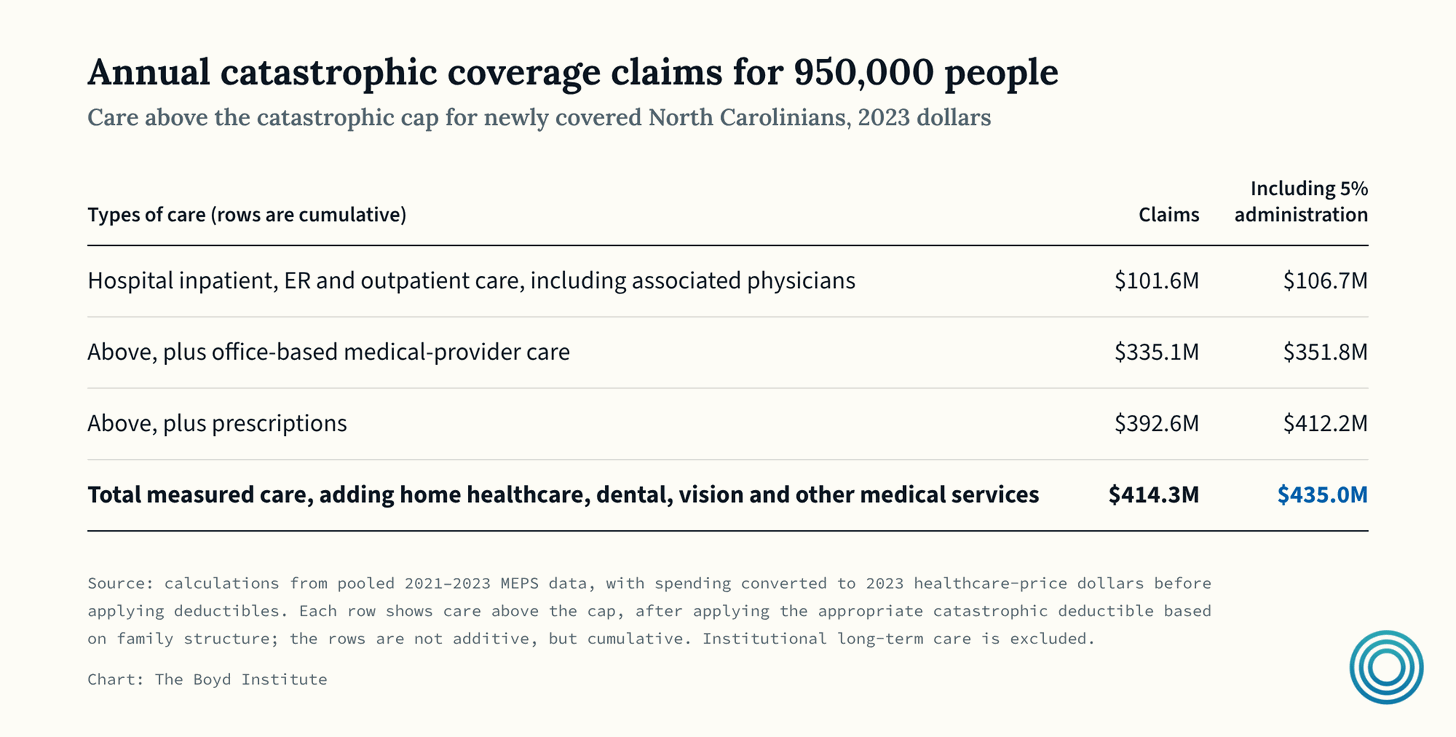
The two ideas are designed to work as a pair. On its own, Idea 1 asks states to take on a new responsibility, and Washington has a poor record of handing states mandates without money. Idea 2 supplies the money in a way that could strengthen incentives to control healthcare spending, setting the stage for more comprehensive reform. Total cost of care above the catastrophic cap for North Carolina residents newly covered by a simple catastrophic plan funded by a federal passthrough of costs incurred is estimated to be $435.0 million (95% CI $217.4M–$652.6M). The first row of Table 1 estimates $106.7 million in hospital-based care above the catastrophic cap with 5% added for administration, and each successive row adds new types of care to the estimate. The rows are cumulative, not additive (e.g. the $351.8M in row two includes the $106.7M in row one).
The corresponding per capita cost of care above the cap is $458 per newly covered person, including 5% for administration (95% CI $229–$687), or $436 in claims only (95% CI $218–$654). It is important to underline that neither the cost in Table 1, nor the per capita figures noted are total costs, but only those costs that would be reimbursable by the federal government in this example, because it is cost of care above the catastrophic cap. Individuals or families would continue to be responsible for the substantial costs below the cap, unless states decided to provide additional assistance.
For context, the 690,900 North Carolinians who were covered due to the ACA Medicaid expansion in 2024 had per enrollee costs of $6,115, underlining Medicaid’s expansive benefits with very low out-of-pocket costs.5 The cost of funding a catastrophic insurance program would thus be far less expensive than covering them via Medicaid, because one is a first dollar program and the other a catastrophic safety net. To underline this reality, in my estimates using the Medical Expenditure Panel Survey (MEPS)6, around 97% of persons had zero estimated costs above the catastrophic cap. Thus, they would pay for all care they received on an out-of-pocket basis. These estimates do not model behavioral changes in care seeking related to being uninsured versus insured. My son is better off covered by Medicaid, as he is now, than by a catastrophic plan. However, a knowable, predictable and automatic catastrophic safety net administered by individual states is a more stable policy equilibrium from which to continue reform. The gap between the first dollar coverage of ACA Medicaid expansion beneficiaries and a very large deductible may be viewed as too large a difference by states; they can decide to address this, or not. Or perhaps to start here, and observe how this works.
The 950,000 uninsured who would be covered is a rounded planning assumption informed by the American Community Survey’s 2024 North Carolina uninsured rate of 8.6%7, not an exact count reported in that policy brief or a verified count of eligible citizens and legal residents. ACS measures coverage at the time of interview, whereas this MEPS analysis selects people uninsured throughout the year. People uninsured all year tend to be healthier than those who move in and out of coverage, so this likely biases my per capita cost estimates downward. It is also important to acknowledge that people move in and out of health insurance coverage all the time. The MEPS8 sample is national and is not re-weighted to North Carolina, and this analysis does not screen it for legal eligibility. Its payments measure care actually received, not unpaid bills or care forgone while uninsured, both of which have substantial behavioral implications. Those limitations matter when moving from an illustration to a federal passthrough amount or a state budget. This is not a score of a proposal like the CBO undertakes, but an attempt to provide meaningful context to an idea.
The cost of care received above the catastrophic cap provides an estimate of a federal passthrough program that reimbursed states for these above-deductible costs, if they did not want to develop a more robust state-specific approach. A federally administered fallback for eligible residents of states that decline to develop a bespoke approach is likely a good policy choice, given the anti-commandeering doctrine cases New York v. United States (1992), Printz v. United States (1997), and Murphy v. NCAA (2018) which bar Congress from requiring states to administer federal programs. NFIB v. Sebelius (2012) addressed Spending Clause coercion through the threatened loss of existing Medicaid funds as part of the ACA.9 These doctrines constrain how Congress secures state participation, so a federal fallback makes sense. Again, if North Carolina asked me for advice, I would advocate trying the passthrough approach for a few years; health reform will never be final. Sticking with the federal passthrough approach, I estimated the cap on the tax exclusion for employer-sponsored insurance required to fund the cost of the passthrough care only, and then two other scenarios that achieve modest federal deficit reduction in addition.
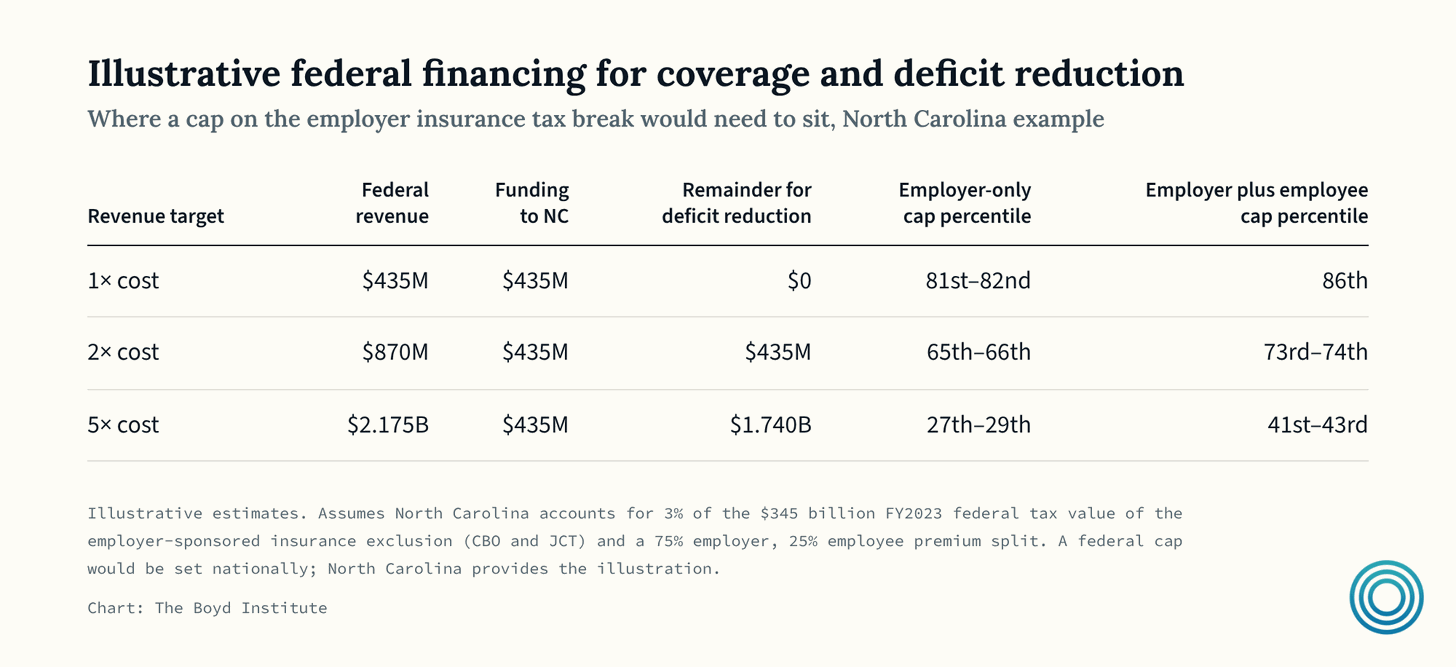
The costs above the cap come from the MEPS survey, and the confidence intervals are still large. The estimates below are even more preliminary, but my purpose is to illustrate that the tax reform idea could plausibly finance a bare bones federal passthrough.
To provide a rough estimate of the magnitude of the tax expenditure applicable to North Carolina, I started with the $345 billion federal benchmark for fiscal year 2023 and multiplied it by an assumed 3% (a rounded population-share allocation, not a verified estimate of North Carolina’s share of federal tax benefits), and then assumed a 75% employer/25% employee premium share (because box 12 on the W-2 does not distinguish employer v. employee share of premiums). Allocating an assumed 3% of $345 billion10 to North Carolina gives $10.35 billion. Assuming 75% is attributable to employer contributions gives an employer-only benchmark of $7.76 billion. Approximately 4.2% ($435 million/year) of the illustrative total value of the employer-sponsored health insurance tax break that accrues to North Carolina taxpayers ($10.35 billion)11 would be needed to fund the most basic approach. The corresponding share of the employer-only benchmark is 5.6%. Adding deficit reduction would expand the number of employees exposed to higher taxes. The percentile cap moves down as the amount of program cost plus deficit reduction increases. The cap estimates are less firmly grounded than the healthcare calculations due to their simplistic assumptions, but they provide an illustrative distribution shape inferred from CBO’s projected premium thresholds under the assumption that the share of employer-sponsored insurance contribution dollars taxed approximates the share of tax benefits recovered. Actual marginal income-tax rates, payroll-tax ceilings and employer responses matter. A federal cap would be set nationally; North Carolina is simply providing the illustration.12
On its own, Idea 2 carries a real risk. Some employers may stop offering coverage and some workers may leave it if the tax treatment of the employer-sponsored insurance were changed. Idea 1 would provide a floor for eligible people in participating states, but additional enrollment and increased use of care would raise program costs, especially if states decide to do more. Other federal coverage programs could also incur costs. Those responses are not included in the $435 million estimate and could reduce the amount available for deficit reduction.13 Congress has the ability to model such scenarios on a more robust basis.
This is the bargain. People with contributions above the applicable cap give up part of a tax break most of them do not know they receive. In return, eligible uninsured citizens and legal residents in participating states gain access to at least catastrophic protection, designed and run by their own state. As with the example I began with, those with robust employer-sponsored coverage commonly have family members who are not so covered for periods of time as they navigate life, especially in young adulthood. Together, these ideas would give eligible uninsured people at least a catastrophic-coverage answer to how much their care will cost if they get sick. I would pay more, but would have peace of mind about a safety net for my children and yours.
My son should not need luck, or a state’s particular Medicaid rules, to answer a basic question about his own healthcare. Neither should anyone else.
Calculation notes
Healthcare: select UNINSyy = 1 and positive family weights; group uninsured members by annual family; adjust spending using PCE-Health to 2023; compute max(covered annual spending − deductible, 0). Scale weighted claims per uninsured person to 950,000 lives. The unrounded recent claims estimate is $414,258,343.52; with 5% administration it is $434,971,260.69. The displayed financing targets round this to $435 million.
Financing: the employer-only benchmark is $345 billion × 0.03 × 0.75 = $7.7625 billion. Targets recover 5.60%, 11.21% and 28.02% of it. The broader benchmark is $10.35 billion. The illustrative lognormal shape parameters are ln(12,700/10,000)/0.67449 and ln(31,300/24,400)/0.67449, derived from CBO’s projected policy limits. For percentile p and z = Φ⁻¹(p), the share above the cap is R(p) = Φ(σ − z) − exp(σz − σ²/2)Φ(−z). Solve R(p) = target/benchmark. These are assumed shapes, not fitted 2023 NC tax-return distributions.
The healthcare claims totals were reproduced with a separate explicit family-level calculation. HC-036 matched all 55,580 family-reference-year records; the period-difference variance was checked using the equivalent covariance identity. I used ChatGPT to run these reproduction checks.
Don Taylor, December 12, 2013, How North Carolina could (sorta) have universal coverage by 2016: https://donaldhtaylorjr.wordpress.com/2013/12/12/how-north-carolina-could-sorta-have-universal-coverage-by-2016/
CBO and JCT. Federal Subsidies for Health Insurance: 2023 to 2033 (September 2023), Table A-2 and note b. FY2023 exclusion tax value: $345 billion. https://www.cbo.gov/system/files/2023-09/59273-health-coverage.pdf
IRS, Form W-2 reporting of employer-sponsored health coverage: https://www.irs.gov/affordable-care-act/form-w-2-reporting-of-employer-sponsored-health-coverage
CBO, Reduce Tax Subsidies for Employment-Based Health Benefits, December 12, 2024: https://www.cbo.gov/budget-options/60953
KFF Medicaid Enrollees by Enrollment Group and Medicaid Spending per Enrollee by Enrollment Group, calendar year 2024. https://www.kff.org/medicaid/state-indicator/distribution-of-medicaid-enrollees-by-enrollment-group/ and KFF Medicaid Spending per Enrollee by Enrollment Group: https://www.kff.org/medicaid/state-indicator/medicaid-spending-per-enrollee/
AHRQ MEPS pooled variance file HC-036 (h36u24.dta), supplied by the author: https://meps.ahrq.gov/data_stats/download_data_files_detail.jsp?cboPufNumber=HC-036 ; price-index guidance and April 2026 tables: https://meps.ahrq.gov/about_meps/Price_Index.shtml
Caitlin Carter. September, 2025. Health Insurance Coverage by State: 2023-24 American Community Survey Briefs, ACSBR-024. Health Insurance Coverage by State: 2023 and 2024
AHRQ MEPS pooled variance file HC-036 (h36u24.dta), supplied by the author: https://meps.ahrq.gov/data_stats/download_data_files_detail.jsp?cboPufNumber=HC-036 ; price-index guidance and April 2026 tables: https://meps.ahrq.gov/about_meps/Price_Index.shtml
NFIB v. Sebelius (2012), spending-power discussion: https://www.law.cornell.edu/supremecourt/text/11-393 ; anti-commandeering cases: New York v. United States, 505 U.S. 144 (1992); Printz v. United States, 521 U.S. 898 (1997); Murphy v. NCAA, 584 U.S. 453 (2018).
CBO and JCT. Federal Subsidies for Health Insurance: 2023 to 2033 (September 2023), Table A-2 and note b. FY2023 exclusion tax value: $345 billion. https://www.cbo.gov/system/files/2023-09/59273-health-coverage.pdf
Ibid.
CBO, Reduce Tax Subsidies for Employment-Based Health Benefits, December 12, 2024: https://www.cbo.gov/budget-options/60953
Ibid.