


In my last piece on trust and institutional paralysis, Jeff and Peter zeroed in on a three-word thread: “dismantle the vetocracy.” Over the course of our problem-solving sprint, I’ve thrown around this word, “vetocracy,” as well as “proceduralism,” fairly frequently.
I first encountered the terms in Dan Wang’s Breakneck: China's Quest to Engineer the Future, which Peter and I both read in January. Wang borrows from a broader literature — most notably Francis Fukuyama’s work — and uses the pair of concepts as a diagnosis of why the American state (and many of its once-productive institutions) has drifted into something of a failure mode, where it is excellent at blocking but poor at building.
In today’s article, the first in a two-part series, I intend to pull on the “dismantle the vetocracy” thread by: 1) adding some color on what proceduralism and the vetocracy actually are, 2) explaining how they interact to form collective action problems, and 3) outlining the roadmap YIMBYs used to overcome NIMBYism, which may be a solid template for overcoming the vetocracy.
Proceduralism
At a high level, proceduralism is the ideological and cultural layer of the problem.
In Wang’s telling, it is not simply the existence of procedures in the rule-of-law sense, but the gradual prioritization of process over outcome that has effectively hamstrung US state capacity. He describes decision-making across US institutions as having become dominated by a thicket of checklists and reviews whose original purpose, in all fairness, was well-intentioned and even prudent.1
But these compliance rituals have transformed from means-to-ends into, themselves, ends. In America’s “lawyerly society,” success has invariably become defined by whether every procedural box is ticked resulting in a risk-averse, growth-stifling equilibrium where failure happens, but no one is actually “responsible” for it because everyone follows the rules. Proceduralism, in other words, confers legitimacy to the state through legal process rather than through the ultimate delivery of material outcomes beneficial to the public.
Wang treats this “lawyerly society” as a cultural and elite configuration, not just a quirk of administrative law. The robust pipeline through elite law schools into government, he contends, means that American high-status talent is disproportionately socialized into a worldview where the primary civic act is to write rules, file lawsuits, and craft sanctions — establish “legalisms” — instead of designing bridges, factories, or power plants.
Now, the reason proceduralism matters is not simply because it exists as a societal configuration. Lots of worldviews that are fashionable yet arguably detrimental to American exceptionalism exist. But proceduralism, as a managerial class worldview matters in that it has been instantiated across governance frameworks, systematically reshaping institutional imperatives and incentives. The result, this instantiation, constitutes the “vetocracy.”
The Vetocracy
If proceduralism is the cultural layer, the vetocracy is the structural one.
It is the institutional design that, over the past half-century, has metastasized through a proliferation of agencies, review bodies, litigation pathways, stakeholder processes, and ideologically-funded thematic NGOs, with courts increasingly serving as the ultimate veto point. With authority fragmented across such a dense ecosystem of institutional actors, it has rendered the public works pipeline increasingly disjointed, riddled with chokepoints.
From this abundance of institutional levers that can stop a project cold — “productivity killswitches” — power has accrued to those with the authority to say no, producing a fundamental asymmetry. On one side, vetoes are cheap and easy to deploy, where any sufficiently motivated actor can stall a project or kill it outright. On the other side, coordination has become expensive and rare. Almost anyone can block action, and no one actor has the incentive nor the superseding authority to decisively move a project forward.
And even when a project isn’t blocked outright, exhaustive impact studies, public comment rounds, stakeholder engagements, and formal litigation risk assessments all serve to meaningfully delay. The pattern is visible across multiple domains in the physical economy:
Major infrastructure projects can spend four to ten years in environmental review under NEPA before construction even begins.
California’s high-speed rail project has spent over a decade and tens of billions navigating lawsuits, permitting disputes, and land-use challenges.
Interstate transmission lines capable of expanding the electric grid routinely die in a maze of state-level permitting vetoes.
Far from just public sector projects that fall victim, the vetocracy is equally stifling of productivity in private market settings:
(Say what you will about Chamath being a perennial grifter, or the All In guys perhaps being politically captured; this is a valid take.)
In any event, whether we’re looking at productivity in the public or private sector, the same structural pattern appears: veto power is cheap while coordination is prohibitively expensive. It is this perverse coordination paradigm — the stark asymmetry between the low cost of saying no and the high cost of organizing a durable yes — that needs shifting.
Collective Action Problems
The state capacity framework distinguishes between states that can act, and those that are constrained from acting. Wang’s core premise in Breakneck is that the “engineering state,” China, constitutes the former while America, the “lawyerly state,” doubtlessly the latter.
In this sense, it is the cheap-veto / expensive-coordination dynamic that can be thought of as the pattern that the two layers — proceduralism and the vetocracy — produce to hamstring US state capacity. Fundamentally, this pattern is a classic collective action problem reflecting several well-established paradigms in political economy.
First, as Mancur Olson famously argued in The Logic of Collective Action, small groups with concentrated interests organize far more easily than large groups with diffuse benefits. A neighborhood association opposing a housing development has clear incentives and a manageable number of participants. The beneficiaries of that development — future renters, workers moving to the city, or commuters who would benefit from lower housing costs — are numerous, dispersed, and poorly organized. The result is structural asymmetry: blocking coalitions form quickly while building coalitions struggle to materialize.
Second, political scientists describe institutional gridlock through what George Tsebelis calls veto player theory. As the number of actors with blocking authority increases, the set of policy changes acceptable to all parties shrinks nonlinearly. In the US, major projects now require alignment across federal agencies, state regulators, local governments, courts, and other stakeholders on the margin. The existence of each of these additional veto players dramatically narrows the path to action.
Third, as Ronald Coase and Oliver Williamson emphasized, institutional arrangements that inflate transaction costs can subtly yet meaningfully suffocate otherwise productive activity. Importantly, coordination itself carries transaction costs. Negotiating among many actors requires time, bargaining, information, and consulting and legal fees (not to mention interest expenses to the extent a project is financed but not yet approved). Each permitting requirement, environmental review, and litigation risk increases the number of negotiations — the transaction costs — required for a project to even get off the ground.
Finally, public choice economists have long noted that institutional incentives reinforce these collective action problems. For regulators, judges, and agencies, blocking a project carries little reputational risk. Approving a project that later attracts controversy or litigation can be career-damaging. Therefore, even in the event some project is socially desirable or beneficial, the rational bureaucratic posture tilts toward risk aversion: caution, delay, require an additional review, etc.
Then there’s the idea that political will sits downstream of material conditions. In a country that is, on many important dimensions — wealth, technology, security, economic stability — still delivering pretty damn favorable outcomes, it becomes enormously difficult to mobilize political energy around the counterfactuals: the roads not built, the mines not opened, the transmission lines never constructed. Alas, this ain’t China. There isn’t really anything akin in Washington to the Beijing Decree, where multi-year or even multi-decade national strategy is centrally-mandated, its execution directed to be carried out across provinces.
Mere consensus in Washington rarely exists, and is seldom successfully instantiated through edict or executive fiat even when it does.2 The New Deal and a few other industrial policy wins over the years were exceptions to the rule that, in a liberal democracy, the legislative process reigns supreme. As Justice Neil Gorsuch recently wrote in a ruling against Trump’s use of executive tariff authority,
“Most major decisions affecting the rights and responsibilities of the American people… are funneled through the legislative process for a reason. Yes, legislating can be hard and take time… but the deliberative nature of the legislative process was the whole point of [America’s] design.”
Indeed, absent pandemic or war — or, as Sol Hando suggests in his recent essay contest submission, something of an industrial policy approach where “purpose-built” public sector entities are commissioned with a preordained shelf life — structural shifts in governance overwhelmingly require a different kind of political economy force: coalitions.
The YIMBY Coalition Roadmap
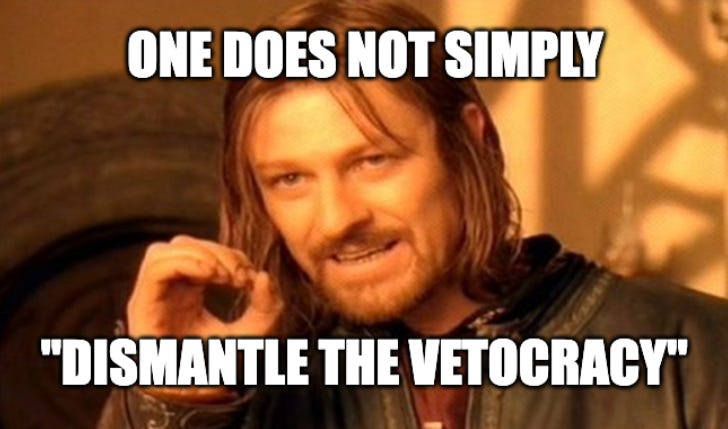
Simply calling for the vetocracy to be dismantled — even if the sentiment is widely shared — amounts to little more than punching air. Asked what, concretely, should change, most critics discover they are implicitly calling for the adoption of a new philosophy of governance: in this case, one that prioritizes the delivery of tangible outcomes over procedural legitimacy. This is much easier said than done. To every lawmaker, policy wonk, or bureaucrat in Washington, the definition of “good governance” differs slightly. Persuasion is slow, status quo governance sticky, and the bipartisan support required to rewrite institutional rules rarely materializes on its own.
Machiavelli wrote of this impossibility of reforming a system from within. Those who benefit from the existing order resist change, while the beneficiaries of reform remain uncertain and diffuse. Institutional equilibria therefore tend to persist long after their usefulness has faded. In the case of the vetocracy, more veto points amounts to more people with a strong incentive to preserve their authority. To overcome these headwinds, however, one powerful mechanism does exist: coalitional cross-pollination.
The modern YIMBY movement offers a useful illustration, and its archnemesis, the NIMBY, shares a similar ~energy~ to the vetocracy. Today YIMBYs comprise a strange-bedfellow, purplish overlap of several ideological traditions — pro-market neoliberals (concerned about supply constraints), social Democrats (focused on affordability), libertarians (strong-property-rights advocates), climate advocates (favoring transit-oriented development), and Jane Jacobs deciples (urbanists who just want denser, more vibrant cities) — all pulling in roughly the same “we should just build more housing” direction.
It’s producing real outcomes. YIMBY legislative victories are piling up across major states and metros from Los Angeles to New York, where pro-supply housing bills have been passing in rapid succession. Many of the reforms may appear niche or marginal on their face. Indeed, legalizing ADUs on its own is not the silver bullet to solve housing affordability. Yet taken together they represent a substantial rewrite of the rules governing how housing gets built. And as a result of the movement’s success, legislative environments in many major jurisdictions now reflect a new consensus about how housing policy ought to function. Deep blue territories are no exception — even the quasi-communist NYC mayor, Zohran Mamdani, publicly embraced YIMBYism.3
At any rate, the obvious question is how the hell such a strange-bedfellow coalition comes to pass in the first place.4 Sure, Ezra Klein and Derek Thompson’s 2025 best-seller Abundance catapulted the movement into national relevance. But long before the “A” in abundance was ever capitalized, the YIMBY movement had already done several things exceptionally well — things that widened its tent and made its eventual policy breakthrough basically inevitable.
A few key ingredients stand out.
Concrete Demands
First, rather than calling vaguely for “more housing,” the YIMBY movement articulated a concrete, legible set of demands.
Ask any YIMBY and without hesitation they’ll rattle off the movement’s demands: legalize ADUs; eliminate parking minimums near transit; enable permitting shot clocks and by-right approvals; upzone around rail stations and transit; lower minimum lot sizes; eliminate staircase requirements; etc. Making these proposals for legislative reform clear and portable has allowed them to be carbon-copied across jurisdictions, in effect developing a national template for pro-supply housing legislation. Without this level of policy coherence and concretization, it’s unlikely a coalition with such ideological heterogeneity could have held together.
Empirical Support
Second, the movement’s imperatives rested on a solid intellectual foundation.
The empirical support for supply-side housing reform began forming decades earlier. Beginning in the early 2000s, economists such as Ed Glaeser and Joseph Gyourko documented the relationship between restrictive zoning and rising housing costs. Their research transformed what had long been treated as a parochial local issue into a measurable economic constraint with national implications. By the time YIMBYism emerged as a political force, the intellectual groundwork had already been laid.
Namecraft
Third, the movement successfully labeled the pathology it opposed.
“NIMBY” — Not In My Back Yard — became a shorthand, a pejorative term, for a style of hyperlocal politics defined by obstruction. The term is mimetically powerful and carries moral weight as it reframes opposition to housing development not as civic caution, but self-interested resistance to change by wealthy incumbents. This may sound trivial, but language matters enormously in politics — and naming the pathology made it easier for YIMBYs to organize against it.
Issue Salience
Finally — and arguably most importantly — the issue of housing itself became salient.
For years, housing scarcity remained largely invisible to the broader public. Prices rose gradually and the causes were poorly understood outside academic circles. That changed during the 2020s. Pandemic-era fiscal and monetary stimulus — “helicopter money” — produced a powerful demand shock, housing prices surged, rates later rose off the zero bound, and affordability collapsed across much of the country. What was previously an abstract policy debate suddenly became a lived economic problem.5 Because of these emergent pain points, and the political will that followed, a movement like YIMBYism could finally escape policy wonk circles and translate into legislative action.
Applying the Roadmap to the Vetocracy
If the YIMBY movement offers a case study in altering the trajectory of housing policy, its roadmap is a useful template for thinking about how vetocratic paralysis might be reduced more broadly.
To reiterate: the core challenge posed by the vetocracy is that veto power has become cheap while coordination has become prohibitively expensive. Institutional actors across government, civil society, and the courts possess abundant tools for blocking projects, yet few possess the superseding authority or incentive to push them decisively forward.
So, if overcoming that asymmetry requires the same key ingredients that made the YIMBY coalition successful, here’s what those ingredients might look like.
Concrete Demands
The challenge here is that we’re not only talking about institutional reform across jurisdictions, but also across economic sectors. Nevertheless there are at least four high-level, broadly applicable reforms:
Create a single lead decision‑maker for each major project or regulated action, subject to firm, enforceable timelines and “deemed approved if no decision” backstops.
Reform legal processes and the courts by narrowing who can sue, when they can sue, and what remedies they can get. This could mean requiring concrete, non‑diffuse injury claims and limiting serial suits over the same project or rule, which would channel challenges into a single consolidated proceeding in a designated court. Challenges could also be time-limited.
Impose a cross‑government “rule cap” or regulatory budget threshold, with one‑in‑one‑out (or tighter) requirements at the level of requirements or compliance costs, not just headline rules, such that agencies must remove or simplify old obligations to add new ones.
Use time‑bounded participatory processes when setting general plans, standards, or zoning equivalents for projects; once those are in place, individual projects that comply are approved administratively with no new veto points beyond basic technical checks. AI could certainly help with implementation of this.
Empirical Support
The costs imposed by vetocratic regulatory environments are fairly well-documented.
Djankov et al. (2006) showed that improving business regulations, from the worst quartile to the best, increase the annual growth rate by 2.3 percentage points. Coffey et al. (2020) identify sectors affected by the regulations and concluded that economic growth in the US has been dampened by federal regulations by 0.8% per annum. Bailey and Thomas (2017) showed that the industries that are more intensively regulated experienced lower enterprise birth rate and slower employment growth. And Chambers et al. (2019) concluded that, in the case of the US, a 10% increase in the effective federal regulatory burden increases the poverty rate by 2.5%.
Then there’s Cato’s survey of state and local barriers to startups, which emphasizes that overlapping permitting, zoning, and licensing rules particularly deter small or innovative businesses, while large incumbents can more easily absorb compliance and lobbying costs. Further empirical work on federal occupational licensing and certificate‑of‑need laws finds higher prices and reduced entry in affected sectors, without commensurate gains in quality or safety, reinforcing the view that these procedural barriers mainly operate as entry vetos.
Further, Prosperity’s 2026 survey of 30 stalled projects in six states attributes at least 50,000 lost or delayed jobs and nearly $75 billion in economic benefits to permitting obstacles, with canceled projects alone accounting for $4 billion in lost benefits and 38,000 jobs.
And finally, a 2025 McKinsey study combining multiple federal datasets estimates that $240-280 billion in infrastructure capital expenditures enter the federal permitting process each year, with each dollar taking on average 4-5 years to clear, implying $1.1-1.5 trillion of capex is currently stuck in permitting. The study estimates that this backlog translates into $100-140 billion in unrealized returns on invested capital annually and $1.7-2.4 trillion in cumulative unrealized GDP from induced effects, alongside 24-30% cost inflation over project timelines due to labor, materials, and overhead.
Namecraft
This is straightforward — those looking to dismantle the vetocracy are, in essence, “growthers.” And the anti-term already exists: “degrowther.”
It is mimetically powerful, sounds derogatory, and could be an apt label for convincing folks to morally object to proceduralists and their vetocratic pathologies. Those six people who sued to block the Micron fab? Degrowthers.
Issue Salience
This is key to coalitional cross-pollination — that is, the tackling of an issue that a broad majority of Americans commonly face.
The challenging part here is that objections to “the vetocracy” can seem niche and technocratic to ordinary voters, whereas housing costs are directly part of their lived economic experience. Nevertheless it is true that every year we delay, e.g., grid upgrades and new generation, families pay higher power bills so a handful of degrowthers can feel virtuous. Moreover, when degrowthers sue to block domestic fabs and transmission, they are voting for higher prices on everything that depends on chips and electricity.
Essentially, degrowthers are inflationists for the poor — every procedural delay is a stealth tax on the people with the least margin. So the reality is that everyone experiences the costs of the vetocracy through higher prices and fragile supply. And polling does show that a broad, cross‑partisan public already wants to unclog the system6 and that degrowthers are the minority faction defending a status quo people already dislike.
Part II: Identifying Specific Sectors to Reform
Finally, since “the vetocracy” is such a broad, systemic phenomenon, targeting specific economic sectors individually is paramount to chipping away at its chokehold on productivity. This can be best determined through assessment: in which domains is the binding constraint on social surplus primarily procedural — reviews, overlapping jurisdictions, litigation leverage, etc. — rather than technological or fiscal?
Part II will take this assessment framework seriously in identifying a few specific sectors where procedural choke points dominate, and ask: 1) what it would mean, concretely, to reprice the veto in these sectors; and 2) which coalitional levers could plausibly be pulled to cross-pollinate support and achieve productive reform?
Given the litany of environmental, labor, etc. transgressions of corporations.
Try as Trump 2.0 might in testing this claim, several leading historians predict that his presidency will go down as relatively inconsequential, at least in terms of enduring legislative change.
YIMBYism is obviously utterly incompatible with Mamdani’s housing policy platform — namely DemSoc’s advocacy for rent control and inclusionary zoning policies, both of which are economically illiterate and disastrous for affordability — but it is telling of YIMBYism’s widespread popularity as a movement that Mamdani believed paying homage to the pro-supply side coalition was politically expedient.
You’d have consult the Jeff Fongs and Laura Footes of the world — which we did previously — to really understand the genesis of the YIMBY movement.
In a way, this kind of validated the supply-side theoretical work by Glaeser et al.
National polling on permitting reform finds that around 80–83% of voters support streamlining and speeding up approvals for energy infrastructure, with support spanning Democrats, independents, and Republicans.
I'm a growther. Degrowthers are the enemy
Well-named!
Interesting read. Two areas I think would be ripe for original analysis would be the plethora of elected positions in city and local government, even for positions that one would prefer to leave to qualified experts: for example, in my native Los Angeles both the County Sheriff and the Treasurer are elected by the voters.