



In 1984, a little girl was born with a heart defect called transposition of the great arteries. Only three years earlier, the surgery for it was crude and risky, and many children who survived it died young. But surgical technique had advanced fast. Doctors stopped her tiny heart, repaired it, and it worked. Decades of monitoring have found no lasting damage. She grew up healthy and strong, with children of her own. Those three years of medical innovation turned a death sentence into a long, healthy life.
That girl is, and thankfully remains, my sister. I was born three years before her, without the defect. I was lucky because of fate. She was lucky because heroes used their immense skill, intelligence, millions of dollars of research and hundreds of man-hours in the execution of her surgery, to make her well. That is what medicine is: holding back death.
Unfortunately, something less concerned with that mission has crept into the hospital room: healthcare.
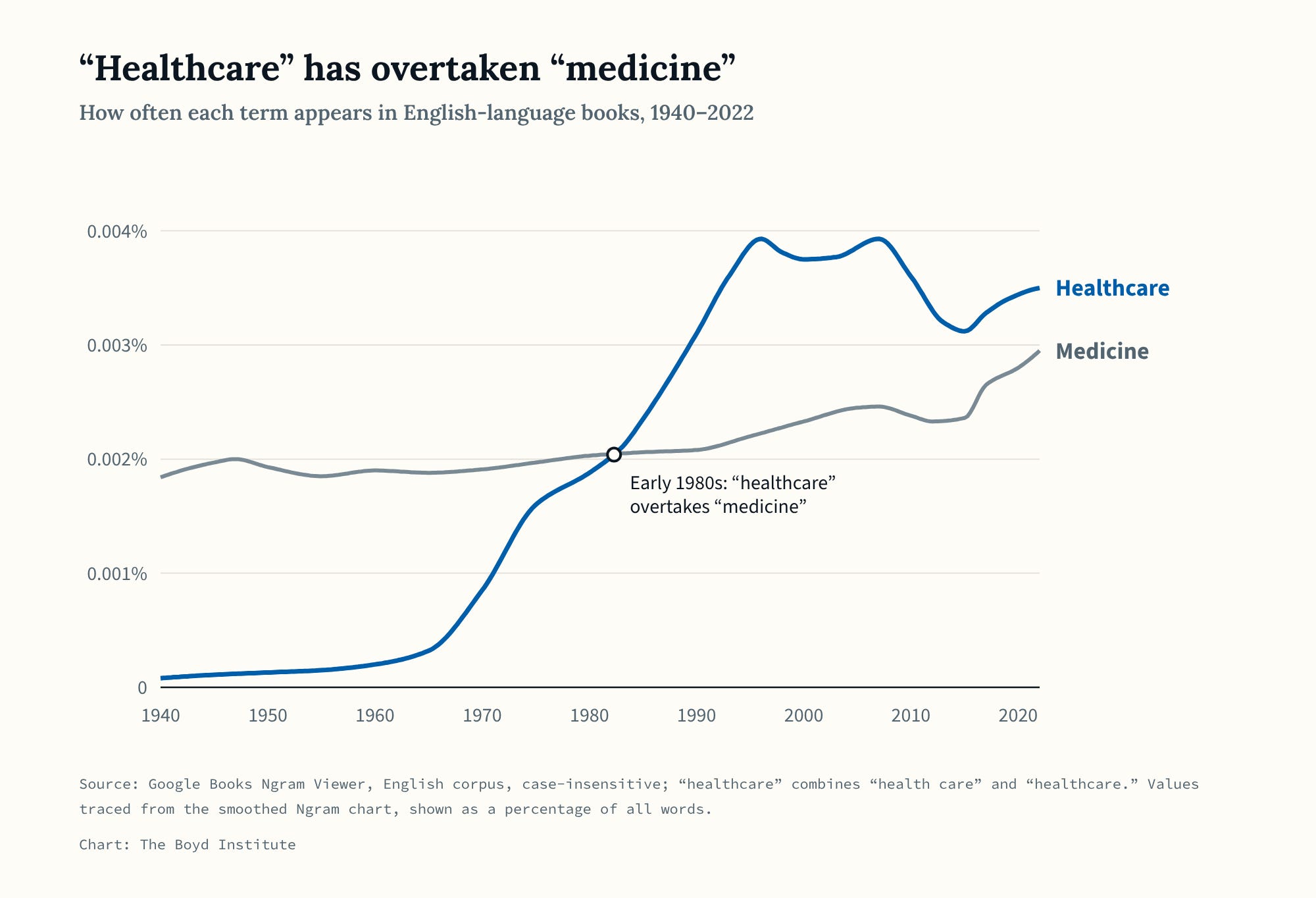
Healthcare is everything other than the actual practice of medicine — mostly the ways we regulate, insure and pay for it. Its expansion has accompanied the growth of federal laws, agencies, and spending related to medicine, and the increasing role of third-party payers. For doctors and patients, it takes up an ever-increasing amount of time and money, often at the expense of the care itself. Ask any doctor you know — even ones in specialties the average person would find morbid or disgusting — and they will all say they prefer the actual practice of medicine to the claims, billing or coding of “healthcare.”
Here’s the key difference. Medicine is judged by who it saves. Healthcare is judged by what it prevents, like the fraudulent claim, the unsafe drug, or the unproven procedure. Those harms are visible, so we count them.
But what about the patient who goes without care because of paperwork? Or who dies waiting for a treatment stuck in trials? They don’t show up in official cause-of-death stats. We only catch glimpses. In one American Medical Association survey, 7 percent of doctors said an insurer’s prior authorization rules had led to a patient’s disability, permanent damage, or death.1 When Congress sped up FDA reviews in the 1990s, one study found the faster approvals saved 180,000 to 310,000 years of life, far more than were lost to unsafe drugs.2 A system that counts only one side of the ledger will keep getting more cautious and more bureaucratic. Red tape kills too.
So how do we untangle medicine from red tape? Well, doctors know one surefire way to figure out what has gone wrong in a system that has broken down.
The Autopsy
When my wife was in medical school, she took me down to the hospital morgue. I came away queasy, but I learned the only way to understand how a body failed is to open it up. Healthcare deserves the same treatment.
The first thing we discover is that they are very entangled, particularly in how we think and talk about them. Someone can hear “we need to cut healthcare costs” — which we do — and worry that means they will be denied vital medical care. Others might see rising premiums and other costs, and not realize that much of it goes to paying for the coding, billing and administrative parts rather than healing the sick. Millions of others might not realize that filing a “health insurance” claim was not always a necessary prerequisite for receiving medical care.
And medicine itself has changed. For most of history, medical care had two usual outcomes: either they fixed you or you died, both being cheap and quick. Now, things are different: chronic (but long-term survivable) diseases (and their likely complications) are now the primary driver of all medical spending and can require treatment for decades. The CDC estimates that 90 percent of healthcare spending is on people with chronic or mental health conditions.3 These are commonly diabetes, obesity, hypertension, heart disease, kidney disease and all the complications and comorbid conditions that come along.
So now we’re elbow-deep in things, and we’ve found the vital organs — medicine — and the other secondary healthcare systems, which at some basic level are necessary, but have grown bloated out of proportion to their purpose. But in an autopsy, the most important thing to look for is the cause of death. And in our case, we’ve found it: the insurance system, the largest and most prominent component of healthcare.
The Insurance Cancer
Insurance is a brilliant invention, particularly for rare, unlucky events with a high cost. This is why it works so well to insure against car accidents, house fires, or emergency medical care. In the body, the same is true of cell reproduction—it is a fundamental building block of our existence. But when these cells expand into areas they don’t belong, they cause problems and get labeled cancer. And this is precisely what has happened with insurance. Through government policy, we’ve pushed much of routine medical care into the third-party payer model. And so this great tool, designed to help patients, has instead become an obstacle to their care.
When we apply all of the “insurance” features — premiums rather than prices, risk models, overhead to prevent fraud and waste, hideously complex data and analysis demands, and third-party payers — to routine, predictable care, this system corrupts and distorts. Most importantly, it distorts decision-making by concealing the price of a service from the customer receiving it. This distortion exists for any third-party payer, whether government or insurer.
If there is no other thing you remember from this autopsy, remember this fact, applicable in both medical and economic fields: systems, even highly effective ones, will wreak havoc in settings outside their intended habitat.
But there are other ways that a body can go wrong. Sometimes the immune system, designed to protect the body, can overreact and attack parts of the body that it has incorrectly recognized as a threat.
An Overactive Immune System
This is exactly what we see with medical innovation: an overactive immune response. We absolutely need to ensure that new processes, drugs and procedures are safe, but making it too costly in time or money can be deadly. My sister’s surgery was possible because of rapid progress in surgical innovation. The speed of that innovation is very literally a matter of life and death. If the new surgical technique had been required to be proven “safe and effective” to the level that many FDA drug trials require, it might not have been ready in time. She would have been another tombstone in Alex Tabarrok’s “invisible graveyard” of patients who die from conditions that could have been treated, if not for delayed innovation.
COVID was a nightmare, but it showed how fast medicine can move when we're motivated. Moderna designed its vaccine within days of the virus’s genetic sequence going public. Trials, manufacturing, and FDA review ran side by side instead of sequentially. The vaccine was authorized in under a year instead of a decade. For once, regulators factored in the cost of waiting.
The dose makes the poison, and in normal times we set the dosage too high.
Let Doctors Be Doctors
My entire life I have been surrounded by people who practice medicine. They are my family, friends and loved ones. The parts they love are the practice of medicine itself: treating, caring for, and healing patients. The parts they hate are inevitably the bureaucracy, rules and non-medical things we call “healthcare.” Nothing is worse than paperwork getting in the way of healing a sick child. I have no medical skills, but I can fight a war of attrition against bureaucracy. I want the people who practice medicine to take pride in their vocation, rather than see it encrusted with a million inane requirements that contribute nothing to patient care. The actual medical providers are being bureaucratized out of their profession by healthcare.
So What Can We Do?
For insurance, the solution is to cut out the tumor. Abolish the employer-insurance link. Return insurance to its job of only covering unpredictable, high-cost events, thereby lowering premiums. Move more routine, predictable care toward direct payment, with government subsidies where needed, financed in part by savings from lower insurance premiums.
In a patient’s daily life, the change means that their primary role is no longer a “policy member” on a payer’s roster, but instead a customer empowered to choose (and buy directly, instead of having to beg insurers to reimburse their doctor) the care that they value. It means never reading another explanation of benefits, except for when an actual insurable emergency event occurs, or spending exceeds the yearly deductible.
For innovation, the solution is to tamp down the severity of the immune response and ensure that it is proportionate to the threat. FDA trials — and safety regulation as a whole — must be more accurately and aggressively tiered in response to the effects and scope of the disease. A patient who is certain to die must be allowed compassionate use, based only on their approval and a willing credentialed doctor to prescribe the treatment. FDA trials can continue to work to prove safety and efficacy, but free citizens and their doctors should be allowed to judge that data themselves, and choose what level of safety and efficacy they desire for their own lives.
Our immune overreaction to fears of another thalidomide has led us to reject or delay treatments that might have saved lives and prevented suffering. Yes, someone might die from a drug that is less safe than it could have been. The world is not perfect. But as adults we must confront the other side of the ledger. My sister’s heart surgery was not that safe. A more risk-averse system might have said “no,” or demanded many years of clinical trials, and she wouldn’t be alive today.
Medicine has given my family purpose and has saved our lives. I am eternally grateful. In exchange, in some small way, I want to help save it from being swallowed up by healthcare. To do that, we must restore medicine to what it once was: a relationship of healing between physician and patient. Red tape kills too. It’s time we acted like it.
Brian Moore is a software developer working in healthcare data and analytics in Cleveland, Ohio. He’s passionate about medical price transparency.
American Medical Association, “2023 AMA Prior Authorization (PA) Physician Survey,” survey of 1,000 practicing physicians. Summary in “Exhausted by prior auth, many patients abandon care: AMA survey,” AMA, July 2024. https://www.ama-assn.org/practice-management/prior-authorization/exhausted-prior-auth-many-patients-abandon-care-ama-survey
Tomas J. Philipson, Ernst R. Berndt, Adrian H. B. Gottschalk, and Matthew W. Strobeck, “Assessing the Safety and Efficacy of the FDA: The Case of the Prescription Drug User Fee Acts,” NBER Working Paper 11724 (National Bureau of Economic Research, October 2005). https://www.nber.org/papers/w11724
Centers for Disease Control and Prevention, “Fast Facts: Health and Economic Costs of Chronic Conditions,” May 26, 2026; Agency for Healthcare Research and Quality, “Health Care Expenses for Adults with Chronic Conditions, 2005,” Statistical Brief No. 203, May 2008. The CDC’s 90% figure measures spending on people with chronic or mental health conditions, not spending directly attributable to treating those conditions. The AHRQ study found that just over half of adult medical expenses in 2005 were directly attributable to chronic conditions.