

In our recent Ground Truths piece on debt and deficits, we argued that American bases, fleets, and alliances are part of what holds up the dollar. Under the postwar international order, security guarantees, and the open trade they sustain, make dollar reserves and dollar invoicing the rational default for allies. That is a nontrivial part of why, historically, the Treasury market clears at yields below what America’s fundamentals alone would support — US military hegemony functions as collateral undergirding the dollar.1
These advantages are not free, and they are what make Pentagon waste worth taking seriously. The United States’ military might will come at a cost of more than $1 trillion in defense spending in the current fiscal year, and a meaningful share of it buys neither the capability nor the credibility that underwrites the dollar. It buys cost overruns, duplicative bureaucracy, books no auditor can certify, and congressional incentives that prioritize political considerations over fiscal discipline. Measured against a deficit near $2 trillion, the dollars lost to waste may seem relatively small. But the asset they erode is most certainly not.
Procurement Cost Overruns
One of the most visible sources of waste is the Pentagon’s procurement process. Major weapons programs routinely run over budget and behind schedule. According to the Government Accountability Office (GAO), the Department of War plans to invest nearly $2.4 trillion in its 106 costliest weapons programs. Yet those programs continue to experience substantial cost growth and delays.
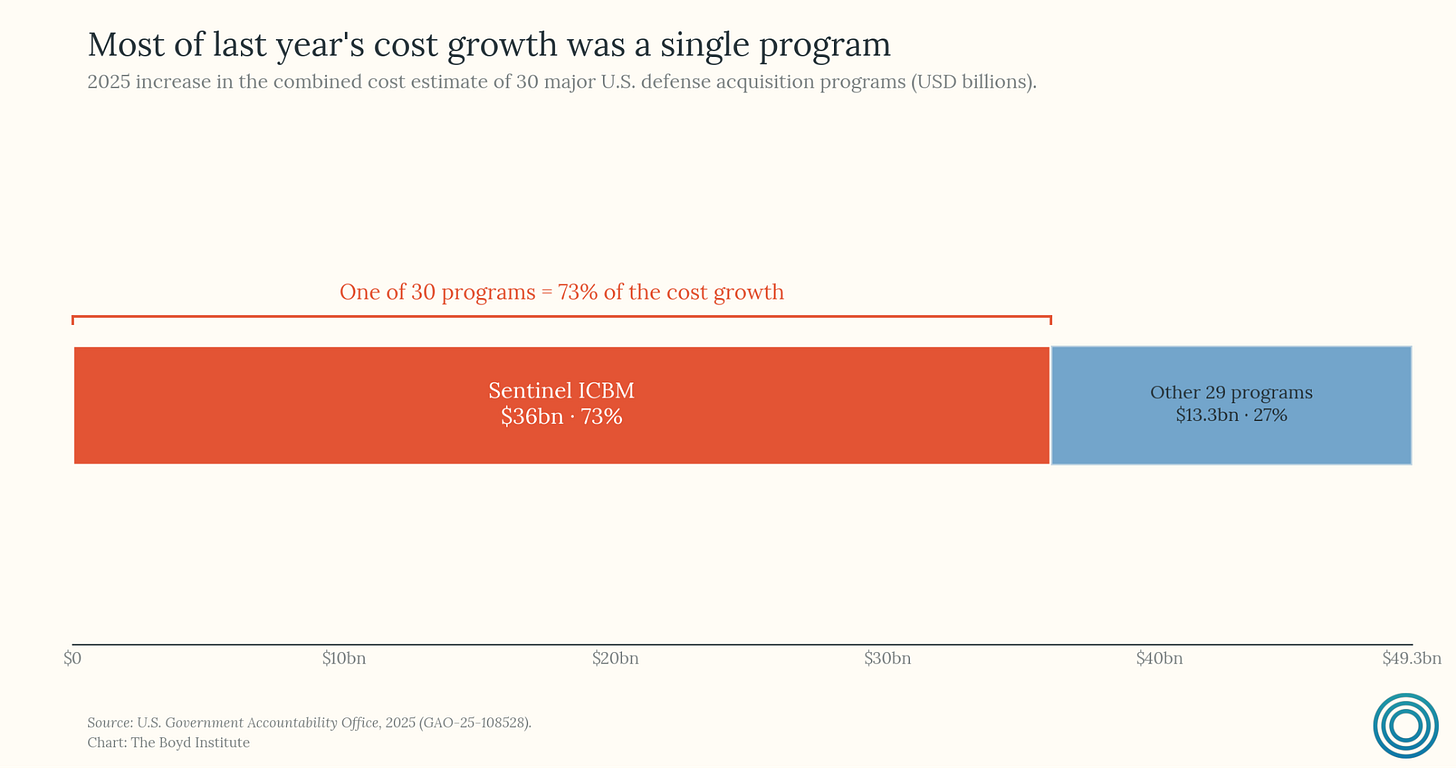
In 2025 alone, the combined estimated cost of 30 major defense acquisition programs increased by $49.3 billion. Remarkably, a single program — the Air Force’s Sentinel intercontinental ballistic missile replacement — accounted for more than $36 billion of that increase, or 73 percent of the total.
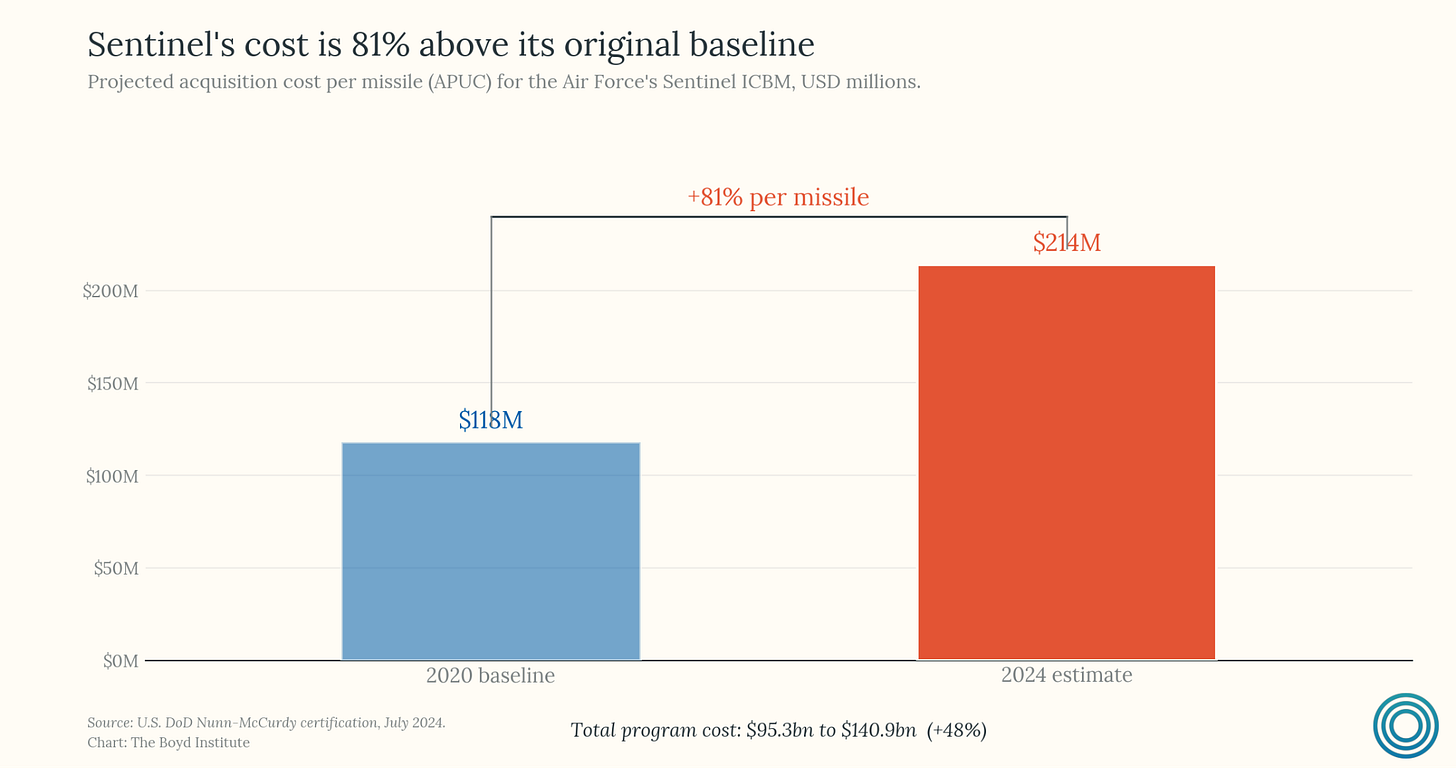
The Sentinel program’s projected acquisition cost has increased by roughly 81 percent since its original baseline estimate.
These are not isolated incidents. They are symptoms of an acquisition system that too often rewards optimism at the outset and tolerates cost overruns later.
Bureaucratic Inefficiencies
The Pentagon’s sprawling bureaucracy compounds these challenges. The average major weapons program now takes nearly 12 years to deliver its initial operational capability. Delays have become so commonplace that they are often treated as inevitable. Meanwhile, the Department of War continues to rely on dozens of outdated information systems. As part of its audit remediation efforts, the Pentagon has identified 89 legacy systems for retirement, a move expected to save approximately $760 million annually through fiscal year 2029.
Many of these systems were developed decades ago and were never designed to operate as part of a single integrated enterprise. Different offices often rely on incompatible databases and software platforms, forcing personnel to manually reconcile information across multiple systems. Maintaining these legacy systems is costly because they depend on outdated technology and specialized support, while their fragmented architecture makes it difficult to track assets, monitor spending, and produce reliable financial records. These shortcomings have been a major contributor to the Pentagon’s repeated audit failures and have made the department slower, more expensive, and less accountable than it should be.
Recent reform efforts have attempted to address some of these inefficiencies. Under War Secretary Pete Hegseth, the Pentagon announced in April of 2025 the cancellation of approximately $5.1 billion in consulting and support-service contracts, arguing that many of these functions could be performed by existing civilian personnel. Earlier in 2025, the Department of Government Efficiency (DOGE) identified an additional $580 million in spending reductions, including cuts to consulting contracts, administrative programs, and an over-budget human resources software initiative.
Although such savings represent a drop in the bucket relative to the Pentagon’s more than $1 trillion annual budget, they demonstrate that meaningful efficiencies can still be achieved without reducing military capability.
Poor Financial Management
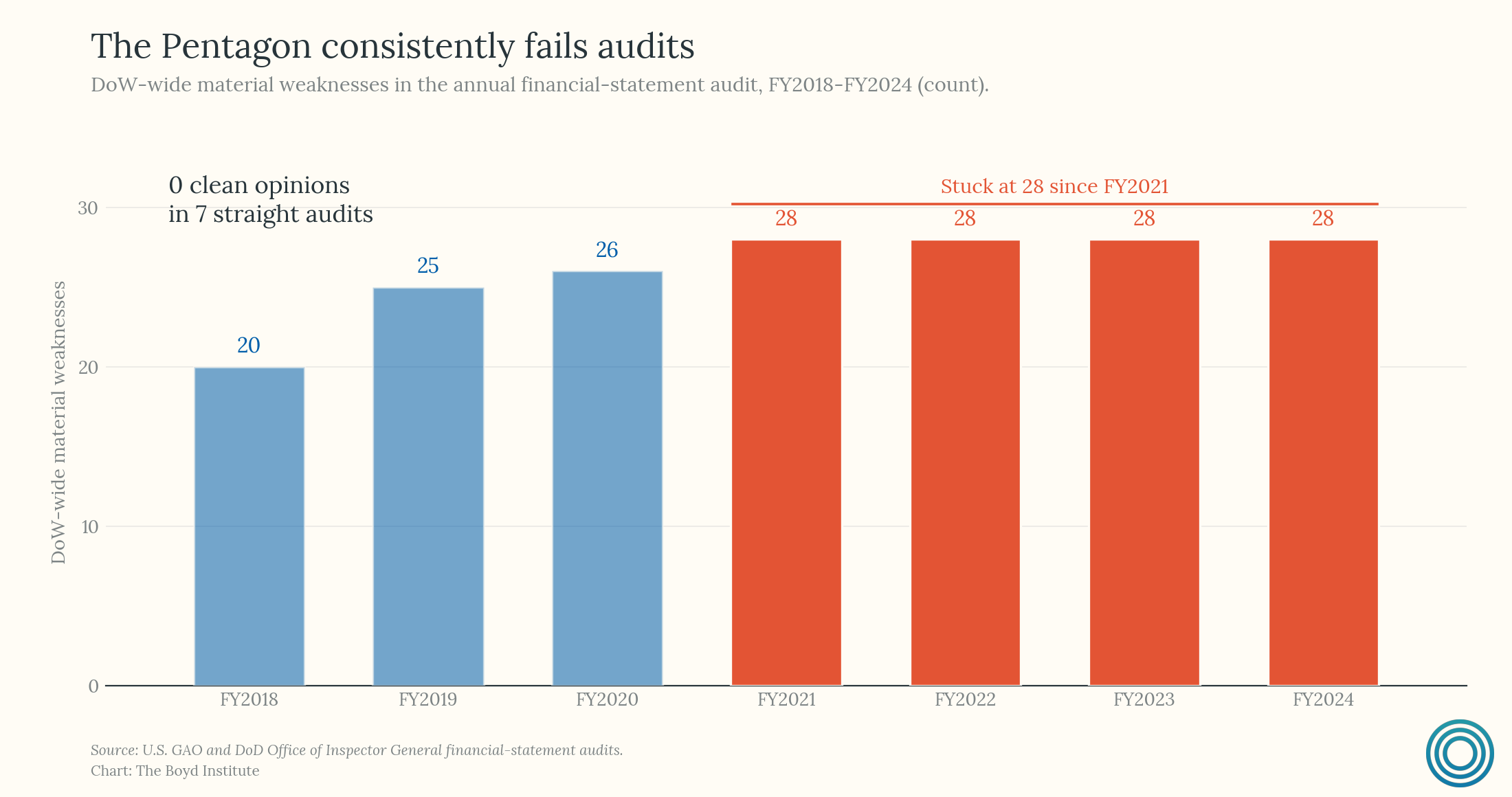
Poor financial management presents another major challenge. The Department of War remains the only major federal agency that has never received a clean audit opinion. Since the first department-wide audit in 2018, the Pentagon has failed every annual review. The FY2024 audit — alongside the three prior annual audits — identified 28 material weaknesses, two significant deficiencies, and six instances of noncompliance with laws and regulations.
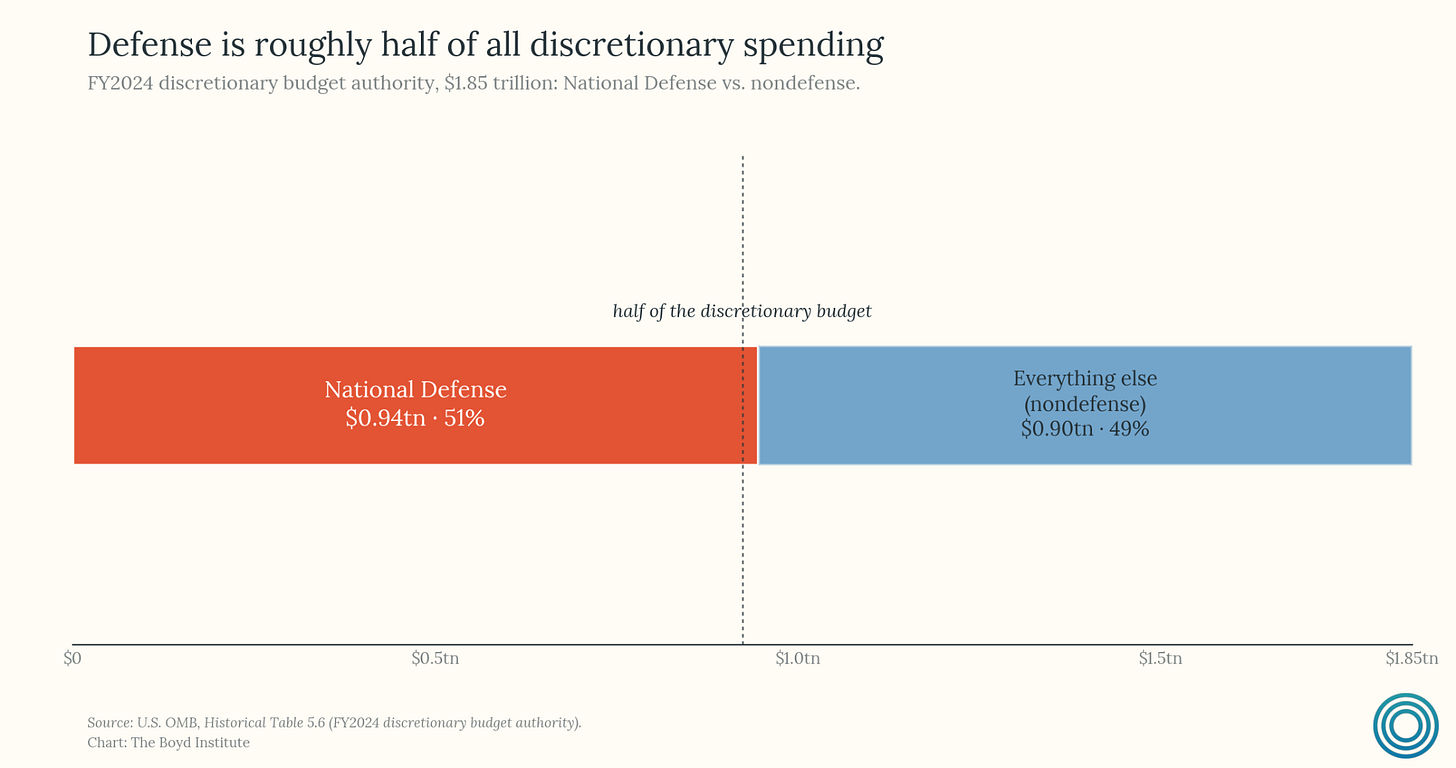
The scale of the challenge is enormous: the Pentagon is now responsible for roughly half of all federal discretionary spending and oversees trillions of dollars in assets spread across thousands of locations worldwide.
Without reliable financial records, policymakers cannot accurately determine where money is being spent, which programs are succeeding, or where waste can be eliminated.
Congressional Incentives
Congress is another author of the waste, and here the incentive isn't even hidden. A member who fights to keep a plant open or a production line running in his district is doing exactly what the job rewards him for doing — the problem is that it rewards him just the same whether or not the weapon at the end of that line is one the military ever asked for. In fiscal year 2024 alone, Congress added approximately $21 billion in defense spending that the Pentagon did not request.
Congressional appropriators have repeatedly inserted funding for weapons systems and projects that military planners considered lower priorities. Once a program’s production is spread across 50 states and 435 congressional districts, it develops a powerful political constituency that makes cancellation extremely difficult regardless of cost growth or strategic value. The result is a budgeting process that often rewards geographic distribution and political influence more than military effectiveness.
Solutions
The most urgent fix is to the procurement process itself. Congress should mandate independent cost assessments before major programs are approved, rather than relying on oversight mechanisms that typically identify problems only after costs have already spiraled. Senior-level reviews should be triggered whenever programs exceed their original cost or schedule estimates by meaningful margins, ensuring that the optimistic baseline projections that have plagued programs like the Sentinel missile replacement are challenged at the outset rather than accepted as inevitable. Congress should also more carefully scrutinize the Pentagon’s reliance on cost-plus contracting, which reimburses contractors for expenses while guaranteeing a profit margin regardless of whether projects remain on budget. Expanding the use of fixed-price contracts where feasible would better align contractor incentives with taxpayer interests and encourage greater discipline in program management.
One reform that deserves renewed consideration is another Base Realignment and Closure (BRAC) commission. Between 1988 and 2005, Congress periodically authorized independent bipartisan commissions to identify military installations that were no longer necessary for current force requirements. Rather than allowing lawmakers to protect individual bases in their districts, the commission would submit an entire package of closures and consolidations for an up-or-down vote. Previous BRAC rounds generated billions of dollars in long-term savings, and Pentagon officials continue to argue that the military maintains significant excess infrastructure. The Pentagon’s most recent publicly available estimates suggest that the military still possesses roughly 19–22 percent excess infrastructure capacity, indicating that substantial savings could be achieved through another round of closures and consolidations. A new BRAC round would allow resources currently devoted to underutilized facilities to be redirected toward readiness and modernization.
Fixing financial management means treating the Pentagon’s audit failures as the serious institutional problem they are. Congress should establish clear benchmarks for audit compliance and require annual public reporting on unresolved deficiencies. The Department of War cannot credibly claim to spend taxpayer money wisely while remaining the only major federal agency that has never passed a clean audit. Reliable financial records are not a bureaucratic nicety — they are the foundation on which every other reform depends.
Finally, Congress must bring its own incentives into alignment with fiscal discipline. The $21 billion in unrequested defense additions in FY2024 alone illustrates how readily political considerations override strategic ones. Separate votes on major unrequested expenditures, stricter justification requirements, and greater transparency in the appropriations process would help ensure that defense dollars follow military priorities rather than district maps. Procurement reform achieves little if lawmakers continue treating the defense budget as a vehicle for job creation rather than a tool of national security.
Conclusion
Both of the usual camps have it backwards. The deficit hawk who wants to fix the budget by trimming the security architecture is sawing at the branch he sits on — that architecture is part of what lets the United States borrow as cheaply as it does, and shrinking it would tighten the very constraint it was meant to loosen — while the appropriator who defends an 81 percent overrun on the Sentinel, or a base the Pentagon has begged to close, tells himself he is protecting national strength when what he is really doing is spending it down for district payrolls.
A capable military and a disciplined budget are not competing claims but two sides of the same dollar. Every dollar lost to an unbuildable program or an unauditable ledger is a dollar not buying the deterrent. And for a country whose currency rests on that deterrent, waste is corrosive, amounting to a slow strategic withdrawal.

Thank you, as always, for reading and engaging. We want Boyd’s funding to come from core supporters who want to be part of the conversation. For that to work, we need people like you to step up now, while it’s still early.
Here’s what we’re offering:
Supporter ($10/month) and (Annual $120/year): Access to our private Discord community and a quarterly call, where you can talk directly with us and other members
Founding Partner ($1,000/year): Everything above, plus a monthly one-on-one call with us.
The Boyd Institute is a 501(c)(3). All contributions are tax-deductible. If you’re able to give through a Donor Advised Fund or make a direct donation beyond a subscription, it would meaningfully extend what we can do. Reach out to [email protected].
The structural fact is that US security guarantees, the alliance system, and the open trade order they sustain make dollar invoicing and dollar reserves the rational default for allies. And the empirics on this are sharper than we let on in the piece.
Eichengreen et al’s “Mars or Mercury?” (2019) finds that military alliances raise a currency’s reserve share in an ally’s holdings by about 30% controlling for size, credibility, and trade depth. The Fed’s own IFDP work finds that roughly 3/4ths of foreign government holdings of safe US assets are by countries with some military tie to the US. During COVID, US military allies were nearly 50% more likely to get a Fed swap line than non-allies — dollar liquidity itself is rationed along security lines. The 2022 Russia case made it operational in real time, crossing the security line cost Russia its dollar holdings.

Enjoyed this.
Theres a good book I read when I was a Lieutenant about acquisition reform, and it was appropriately titled "Defense Acquisition Reform: An Elusive Goal."
A couple of thoughts I had while I was reading:
1. Some of this Pork Barrel stuff has a sort of existential character for certain (especially southern) cities/states. I was stationed at Fort Knox for a bit. Knox was a BRAC victim, and you could really tell. We joked about how the area around the base looked like "something happened to it". It was like the boarded-up storefronts of a small town but on a city scale. I understand that the area is better off since 2019 but I think about how much of Alabama's total GDP comes from Military Keynesianism. Hawaii's GDP is like 20% DoW injections. I totally think that we should axe a ton of these bases. I just think it will be harder than the usual hard political thing.
A sort of corollary is that because this Keynesian project does contribute a nontrivial part of GDP, cutting it suddenly would probably have serious negative consequences, and I have always believed we will have to do cuts slowly so the private sector can effectively absorb the surplus. Sort of the difference between giving someone a drink of water and waterboarding them.
2. Personal opinion: I think the USD is floated by the Navy but massively undercut by the Army. You could make massive cuts to the DoW while actually improving national and global security. Related: From a purely economic PoV (and putting aside the arms race with China) increased US naval spending might tend to decrease global naval spending, especially to the extent that the US Navy bills itself as a guarantor of freedom of navigation (we could do better on this). But on the flip side, since the US Army is an offensive weapon, global military spending would decrease with a decrease in US Army allocations. (Europe is probably the counterexample here, but Russia might balance the equation.)
3. One of the things that makes a lot of acquisitions stuff (and really everything in the military) inefficient is the insane personnel churn. People stay in roles (even executive roles) for a blink of an eye, and they can't bring favored subordinates with them to future roles. You will not find this written anywhere and nobody will admit it, but this is a policy to reduce coup risk. If you've ever read Harrison Bergeron, it's the same idea. (There are stories about this, including recent stories. The system is extremely aggressive and effective. There is no coup risk.) Acquisitions is actually a bit better about this, with it's own "functional area" but it isn't much better because "going Acquisitions" is seen as a step you take in order to retire.
4. Another thing that makes military acquisitions inefficient is the super reasonable preference for acquisitions to be demonstrably not corrupt. This explains a lot of the bureaucracy surrounding the process. I worked with horses in the Army for a while and we had to buy a lot of unique stuff, but we could never just go buy it because of the process to ensure that we weren't just hiring someone's buddy. As an example, we ended up paying literally 10X more for farriery than it normally costs because we had to get the farriers into the government registration system and have them submit bids (normally they just show up at a ranch and take cash). At first it seemed really dumb to me, but there was a case of really mild graft that I witnessed (and reported) and after that I was fully onboard with all the procedure. I think it is genuinely good for the state to "overspend" on transparency.
3 & 4 being said though I think there is huge space for reform as told.
I really do hope we can take on military spending both as a means of improving the fiscal situation and also as a means of making the world a more peaceful and prosperous place.
I wonder: what if we made some big cuts to defense, move a certain percentage of those cuts to build millions of drones domestically, and end up saving money while also having a stronger defense posture and overall economy than we do currently. Maybe there’s something I’m not seeing but I don’t see how our current billion dollar planes, aircraft carriers, and vehicles are worth the equivalent amount of drones