

At every level from the bureaucracy to Congress, the United States government is weighed down by a seniority system that privileges people who have been around the longest over the most capable. One particularly egregious example is Congress, where committee chairs, those who control the legislative agenda and oversee the executive branch, are selected based on whichever majority-party member has sat on the committee longest. But the pattern extends everywhere the tendrils of the state touch.
Seniority
Take the General Schedule (GS) pay scale for example. The federal government employs about 1.5 million people under the GS system and under it advancements are governed almost entirely by time served.
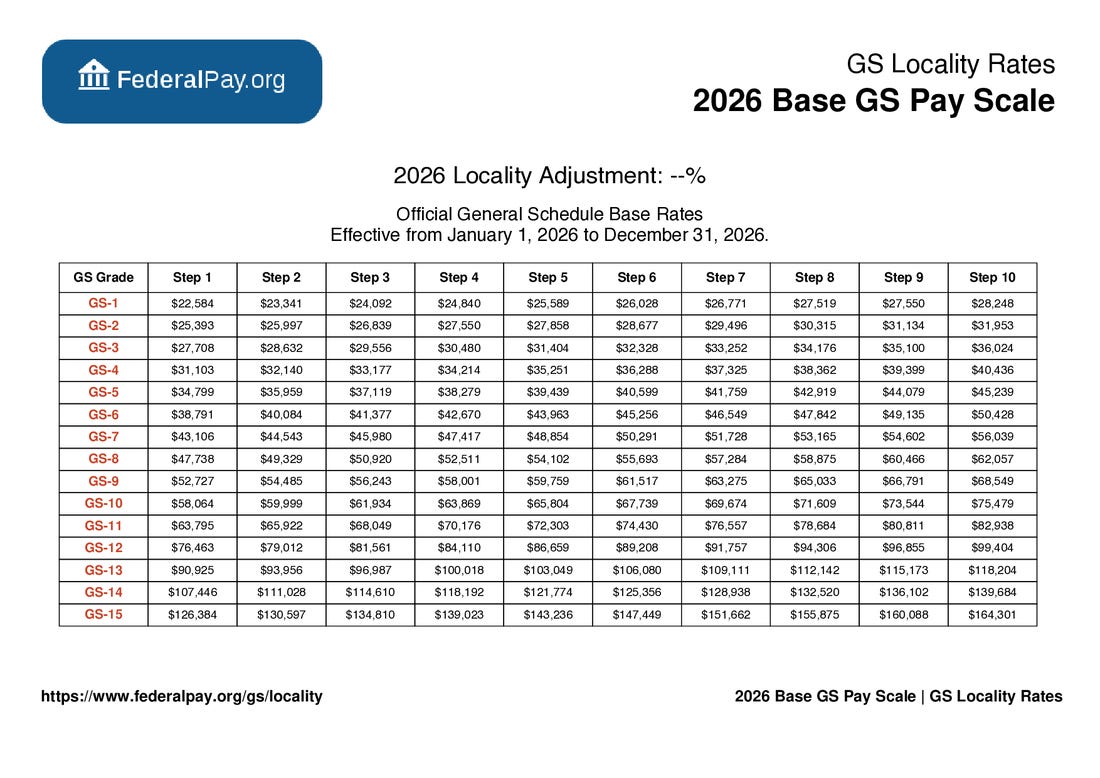
Within a single grade, step increases follow a fixed time schedule. You can move up a grade after serving a minimum of 52 weeks at the grade below. And you rise up the steps automatically as long as you have at least a “Fully Successful” performance rating.
What this means in practice is that the median analyst and the absolute best analyst at, say, the Department of Energy, share roughly identical compensation trajectories. The only notable exception to this is that people who achieve ‘exceptional performance’ are moved up one step, in a 150‑cell pay grid.
This structure also exists in the military where, under the Defense Officer Personnel Management Act (DOPMA), officers are promoted in cohorts by year of commission. You make captain around year four to six, major around ten, and lieutenant colonel around fifteen. There is some variation at the margins: if you aren’t selected for promotion twice you’re discharged (the “up or out” rule). But what does not exist is the ability for a brilliant officer to rapidly climb the ranks. The economist Tim Kane, who has written extensively on military talent management, called DOPMA “the root of all evil” in how the armed forces handle their human capital.
Ultimately, these seniority protections survive because insiders have captured the system, especially public‑sector unions inside the bureaucracy.
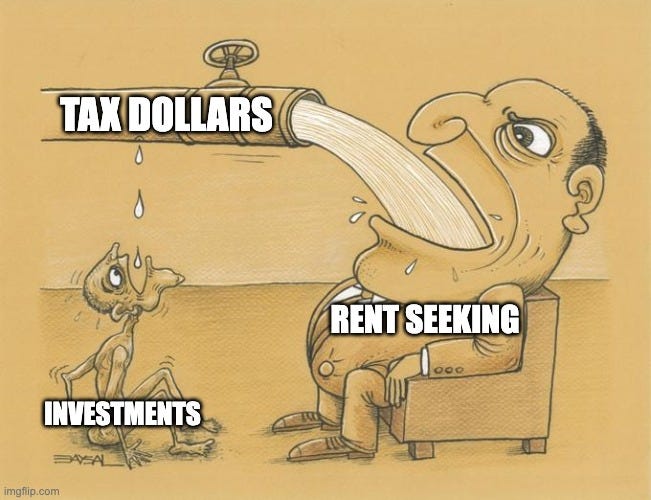
But what this rent-seeking accomplishes primarily is chasing away the most capable people from a job in the government and staffing many of the public sector’s most important management positions with the mediocre.
The obvious counter to what I’m saying is that seniority protections exist for a reason; namely, protecting lifetime bureaucrats from political capture and pressure, as well as allowing people with the most experience to run our institutions. The system was built after the spoils era, when incoming presidents would fire entire agencies and replace them with loyalists, a problem the seniority system was supposed to solve.
But today the primary friction is not that public service incumbents are being thrown out too regularly. Instead, these seniority protections leave our institutions increasingly sclerotic, with the very people who benefit from the status quo empowered to block any meaningful reform.
An exception to the seniority system is the Federal Reserve, which sits outside the GS pay scale and can set its own compensation and promotion schedules. The Fed has meritocratic hiring and advancement based on ability — and for someone working there, such work experience grants them an enormous amount of private sector employment capital (regardless of which White House administration coincides with that work experience). As a result, the Fed is able to compete with top Wall Street firms for top economists and rising analysts.
The Fed is also, in my opinion, and by way of reputation and results, the most competent institution in the federal government — a status that flows directly from its freedom to hire, fire, and pay on merit.
I want to be clear, the issue is not that average pay for federal employees is too low. On average, they earn about $101,000 a year, well above the national median household income of $83,700, and although DC is expensive this is largely the product of high salaries chasing a limited housing pool. The problem is that the range is compressed to the point that the most hyper capable workers cannot be retained, much less hired in the first place. Contrast this with the private sector, where there is often wide variance in the compensation of any two given employees in the same market tier with the exact same job code. (This is especially true in finance.)
Moreover, contrast America’s civil service with Singapore’s, where public sector employees are recruited from the tops of graduating classes through competitive scholarships, and where promotions are based exclusively on performance. Top government salaries are designed to be directly competitive with the private sector, with the benchmark for an entry-level cabinet minister being set at the median income of the top 1,000 earners in the country, discounted 40%. In practice, they will earn about $1.1 million a year. In the U.S. a GS-15 step 10 — the ceiling of the normal federal pay scale — tops out at about $162,301.
Cognitive Decline
All of this would matter less if the seniority system did not also undermine congressional oversight of the executive branch. This monitoring, in theory, should be done through the committee system, since committee chairs have subpoena power, control hearing agendas, and can direct investigations. But these roles are seldom filled by members with the cognitive sharpness the work actually requires.
The current chairman of the Senate Foreign Relations Committee, Jim Risch, is 82; it is fair to ask genuine questions about his ability to monitor the Trump administration, especially during a period of abounding active military operations. Last week when the US struck Iran, the Gang of Eight — the congressional leaders and intelligence committee chairs who receive the most sensitive national security briefings — got an hour-long briefing from Secretary Rubio beforehand. Schumer, a spry 75, was in the room and said the briefing was “completely and totally insufficient.”
Effective oversight of military operations requires people who can process classified intelligence with quickness and rigor, and ask precise, pointed questions in a time-pressured setting. Does anyone think that this ability is mostly determined by time served in Congress? Even if it is, the issue of aging monitors has real national security ramifications. A significant body of research confirms that, once a person reaches their 60s and 70s, their cognitive faculties reliably and steeply decline. To the surprise of no one, a RAND report found that officials in cognitive decline have inadvertently compromised classified information in the past.
The late Dianne Feinstein sat on the Senate Intelligence Committee — the body that oversees the CIA and NSA — at the same time that multiple reports described serious cognitive decline. She did not leave her seat before passing away in 2023, and there existed no reliable mechanism for removing her.

Even in settings where formal seniority doesn’t exist, our political culture has a tendency of deferring to politicians who have been around the longest. This is true in both parties, but the Democratic presidential primaries in recent years have shown it at its worst. In 2016 there was a strong sense that Hillary should be the nominee because it was “her turn.” Then in 2020 Biden was elected in no small part due to his role as an elder statesman in the party, a fact that led directly into his aborted attempt to run again in 2024 when most people close to him knew he was not in fact “sharp as a tack.” In both cases the informal system that produces nominees operated on the logic of seniority rather than meritocracy.
I want to be precise, because obviously experience matters. A person with twenty years on the Armed Services Committee, or decades of experience in the bureaucracy, knows things a neophyte doesn’t and can’t. Boards of directors in the private sector are primarily staffed by veterans for a reason. But experience is only a heuristic — one we should use, among many — for determining who is most capable.
So, what do we actually do about this?
Three fixes.
First, replace the GS system with a compensation structure that resembles the private sector. A much steeper pay curve, a much wider range, and promotion based on performance rather than time-in-grade.
Second, remove all seniority-based systems in Congress. Committee chairs should not be awarded based on length of service but instead on their ability to serve.
Third, wherever possible, the government should hire by open competitive examination. This should be modeled off of the Foreign Service Officer Test, which already does an exemplary job of selecting new employees — about 20,000 people sit for it each year and roughly 2-3% end up with an offer.
We’ve talked before here at Boyd about how America is in a state of “managed decline”; structural seniority is perhaps the purest case in point. It is a system designed to lose slowly and resist change at any cost. If we want to accelerate our ability to solve problems, dismantling structural seniority in the public sector is a fantastic place to start.
Repeal the 17th amendment! Restore the spoils system.
The spoils system was a check/balance against permanent mediocrity. Government jobs should be insured (parachutes provided), but they should not be assured (we can’t get rid of you). The goal of each administration should be to purge the incompetent/disruptive, keep the able, and put in place the loyalists. The people who stay, stay because they are able to be sieved through the upsets. For those, each administration becomes a renegotiation opportunity for promotion.
Ultimately, game theory will win the day on the spoils system.
I agree that in a high-performing, elite team, there's a good overlap between the "favorites and protégés" and "high performers." However, in a low-performing unit or branch, the favorites might be "drinking buddies of manager" or "college buddies of leader."