



Albany, Georgia, used to be a factory town. Now it’s a hospital town.
In the 1980s, Firestone closed its massive tire factory there, eliminating some 2,000 jobs. Cooper Tire later reopened the plant, only to close it again in 2009. Today, Phoebe Putney Health System is one of southwest Georgia’s largest employers. Around 27 percent of jobs in Dougherty County depend directly or indirectly on the health system.1 The hospital isn’t just where locals go for medical care. It’s one of the institutions keeping the local economy afloat.
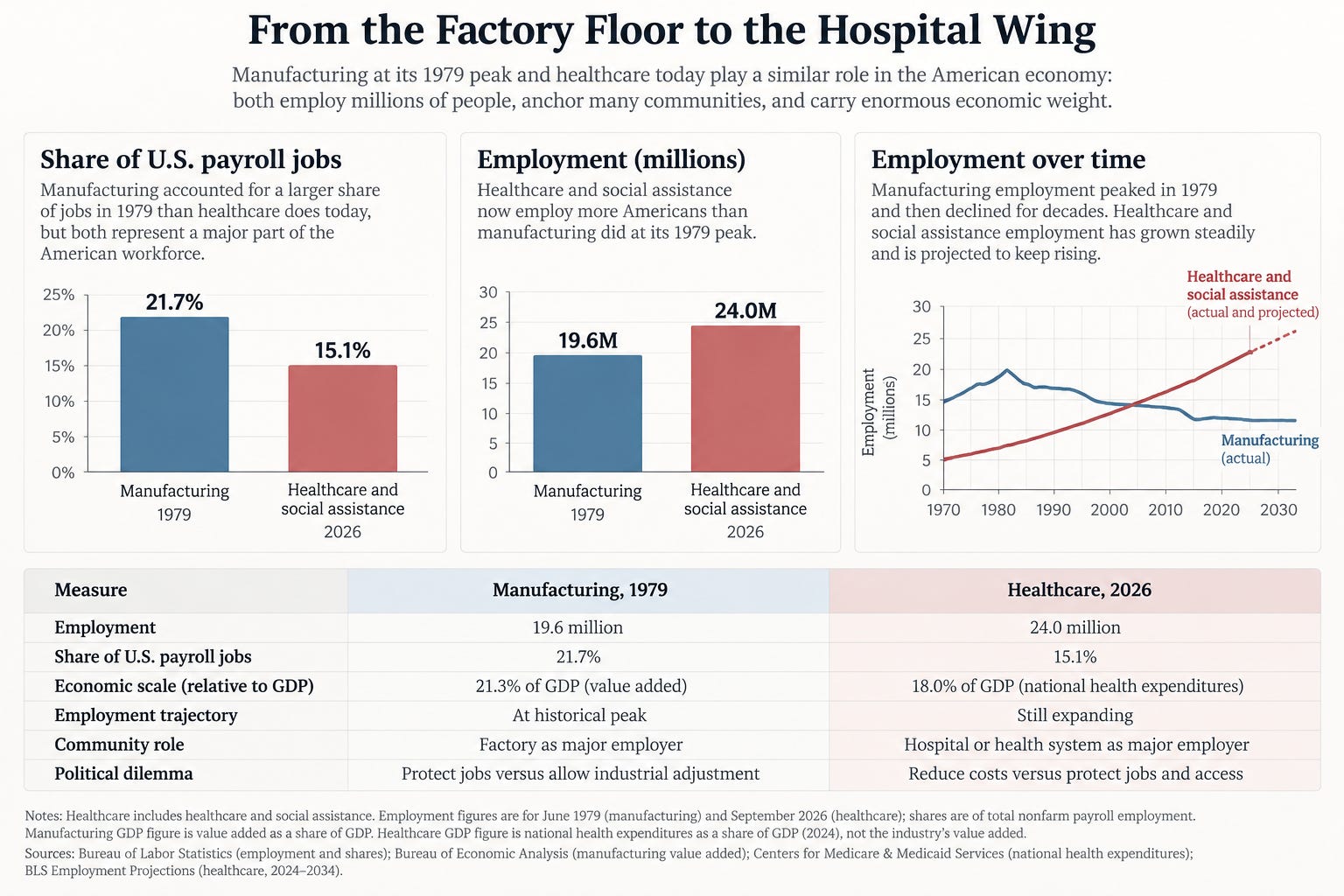
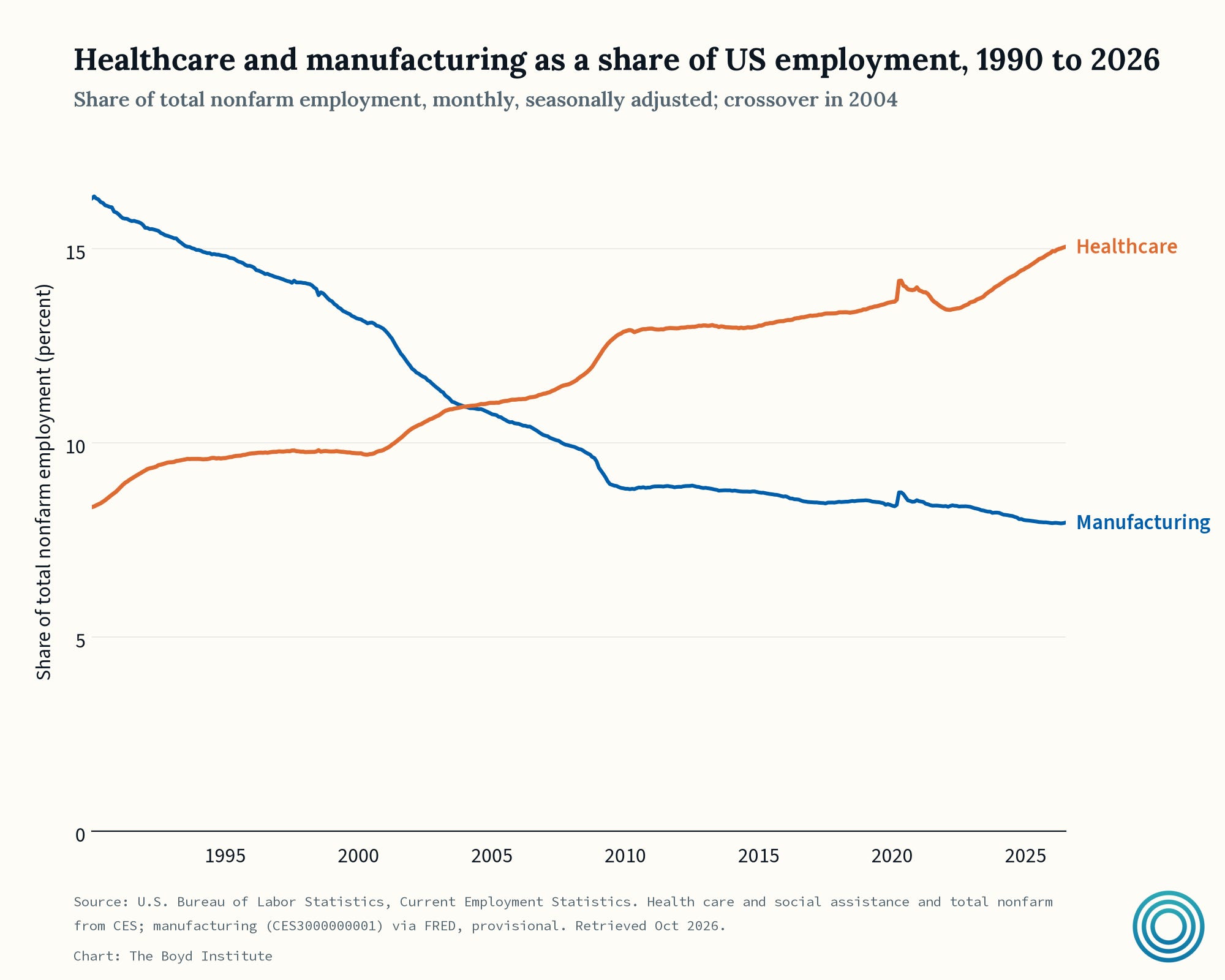
In 1979, American manufacturing employment reached its peak, accounting for roughly 22 percent of all nonfarm payroll jobs.2 Factories were more than workplaces. They supported towns, sustained families, anchored local politics, and offered a plausible path into the middle class. When industrial employment declined, entire communities lost their economic purpose, and the political aftershocks are still with us.
Healthcare now occupies a comparable position in the American economy, accounting for roughly 15 percent of nonfarm jobs and growing.3 According to a 2025 Kaiser Family Foundation analysis, hospitals rank among the five largest employers in 22 states and among the eight largest in every state.4 In many places, the hospital is the largest employer, the most important civic institution, and one of the few reliable sources of well-paying jobs.
Healthcare also absorbs an ever-growing share of what Americans earn and spend, making up about 18 percent of today’s GDP.5 In 1979, manufacturing was about 21 percent of GDP.6
America’s healthcare system has become both an economic lifeline and an economic burden. We need to make healthcare more affordable, but doing so could threaten millions of jobs and the communities that depend on them.
We talk about fixing healthcare as though it were mainly a matter of finding the right payment formula or insurance arrangement. But the harder problem is political. Lower spending means lower revenue for somebody, often people and institutions deeply embedded in their communities. Some healthcare growth reflects genuine medical advances. Some reflects inflated prices and inefficiency. One person’s healthcare waste is another person’s paycheck. Including mine.
I’m a nurse practitioner. Any slowdown in healthcare spending would hit me personally, but I’m not here to defend the status quo.
The hospital has leverage
Albany’s story is playing out across America. Hospitals are major employers, civic institutions, and sources of economic stability in communities that have lost other industries. They employ nurses, technicians, administrators, custodians, and physicians. They sponsor local events, support nonprofits, and put executives on civic boards. And in places with few competing providers, they may have considerable bargaining power over insurers. A threat to the hospital can feel like a threat to the community itself. A 2025 ProPublica investigation into Phoebe Putney revealed how the hospital’s economic dominance gave it extraordinary influence over local politics and healthcare prices.7
Phoebe Putney shows how hard that power is to check. In 2011, Phoebe bought Palmyra Medical Center, its only real competitor in Albany. The Federal Trade Commission sued to block the deal, arguing it would give Phoebe a monopoly over hospital care in the region. The case went to the Supreme Court, which ruled unanimously for the FTC in 2013. Phoebe kept the hospital anyway. By then the merger was complete, and Georgia’s certificate-of-need law made it nearly impossible to undo, because no new owner could get state approval to run Palmyra as a competitor. The state’s own rules protected the monopoly. In 2015, the FTC settled without requiring Phoebe to sell anything. The federal government won the argument and still couldn’t break Phoebe’s hold on Albany.
I see this from the inside. I work as an independent contractor, which makes me a threatened species. The share of physicians in independent practice has fallen sharply as hospitals and corporate buyers absorb their practices. I’ve picked up a good number of patients from independent practices that were swallowed by these expansions, and many describe confusing care, often seeing a different provider at every appointment. That has helped my business, but it hurts patients and communities. The Washington Post reported that many hospitals bill more for the same care simply by changing the site listed on their claims, with no difference in quality or outcomes.
Hospitals also write non-competes into their physician contracts, restricting doctors from taking patients with them if they leave the system. I understand that hospitals invest in their physicians. But these clauses limit patient choice and can harm outcomes, because the relationship between patient and provider is one of the most important factors in care. It doesn’t take an economics PhD to see that less competition means lower quality and higher prices.
That leverage shows up in price negotiations too. When a dominant hospital demands higher reimbursement, the insurer responds with higher premiums and deductibles. Employers pass along some of the increases, leaving less room for wage growth. Families are angry, but the anger usually lands on the insurance company. Nobody blames the hospital. The hospital, meanwhile, can point to its lifesaving work and warn that lower payments will mean reduced services or layoffs. The politician caught between them has little incentive to challenge the town’s most beloved employer and every incentive to challenge a faceless corporation with no local representation.
It’s easy to denounce healthcare waste in the abstract. It’s harder to tell a hospital to accept less money when it employs your neighbors and runs the only emergency room for miles. Every proposal to spend less threatens someone’s livelihood.
In 1979, protecting every factory wasn’t the same as building a healthy economy. Today, protecting every healthcare job and institution isn’t the same as building better, more affordable healthcare.
The political trap
Healthcare reformers offer competing technical blueprints, from single-payer insurance to market competition. But even a technically sound reform runs into a more fundamental question: Who takes the loss? A hospital paid less for a procedure must absorb the reduction somewhere. A physician group facing tighter reimbursement may change staffing, compensation, or the services it offers. Private rooms may give way to semi-private ones. Some of these adjustments would represent genuine efficiency gains, like skipping the television in every room or the lavish new lobby. Others could reduce access, especially in rural areas already struggling to recruit clinicians. The trade-offs cannot be waved away with the word “efficiency.”
So why is this so politically difficult? Healthcare providers have both economic importance and moral authority, a combination most industries can only dream of. Their work is unusually intimate. People encounter doctors and nurses during births, emergencies, cancer treatment, and the final days of life. Many healthcare workers regard their work as a calling, and patients have good reasons to be grateful. Nurses and physicians are consistently ranked among the most trustworthy professions.8 Yet a profession’s social value does not mean every price, billing practice, or staffing arrangement is beyond scrutiny. Challenging providers’ prices can look like challenging their mission. Sometimes their arguments protect patients, and sometimes they protect revenue.
The political trap becomes obvious whenever someone tries to say no. Every healthcare system must decide what to cover and how much to pay. Americans may dislike the word “rationing,” but refusing to make those choices explicitly simply hides the costs in higher premiums, taxes, deductibles, and lower wages.
Look at what happened in 2024, when Anthem Blue Cross Blue Shield announced limits on reimbursable anesthesia time in several states.9 Physicians warned that the policy could unfairly penalize legitimate care, while the insurer argued that it was addressing excessive billing. The backlash was immediate. Elected officials became involved, and Anthem reversed course. Whatever the merits of the original policy, the episode showed how quickly an attempt to constrain healthcare spending can become politically untenable. The public sided with the doctors. It usually does.
Of course, saying no to the wrong treatment can cause real harm. But saying yes to every treatment at any price has consequences too. Spending more isn’t the same as caring more.
That’s the trap. The costs are spread across millions of households, while the benefits flow to identifiable institutions, workers, and communities. Nearly everyone agrees healthcare is too expensive. Far fewer agree about whose income should fall.
The uncomfortable choice
There is no painless way out of this dilemma. If the United States substantially slows healthcare spending growth, hospitals, physician practices, suppliers, and administrators will feel the effects. Some jobs will disappear, and hiring will slow. In communities with few alternative employers, the consequences could be severe. Reformers should say this out loud. Policymakers should distinguish reductions in waste and excessive prices from cuts that would eliminate valuable care.
Healthcare isn’t manufacturing, and there’s no reason to assume its employment will collapse as manufacturing’s did. Americans are aging, demand for care is growing, and medicine will always require skilled people. But the lesson of deindustrialization still applies. Ignore the human cost of economic change, and whole communities pay for it.
We’ve built an enormous industry around ever-rising healthcare costs. The goal should be to protect patients and communities, not every dollar of spending or every job the system currently supports.
When the factories closed, Washington’s main answer was Trade Adjustment Assistance, a program to retrain displaced workers. It was underfunded, hard to use, and usually arrived after the damage was done. This time, we should start before the damage is done, by making towns less dependent on any single employer. County leaders should know which employers their economy depends on and actively recruit competitors to keep monopolies at bay. Governors should press local officials on economic performance and help struggling counties land new employers. Vocational colleges can train workers for the manufacturing jobs that reshoring is bringing back. Hospitals already do this well through their nursing and CNA programs, and Switzerland’s high-skilled manufacturing base shows how far the model can go.
Healthcare policy should also stop rewarding consolidation. Paying the same price for the same service, whether a hospital or an independent office provides it, would remove the incentive behind the billing practices I see. Restricting non-competes for clinicians would let patients stay with the providers they trust. And states should revisit certificate-of-need laws that protect incumbents like Phoebe, while still protecting the emergency rooms and clinics rural communities can’t do without.
None of this will work everywhere. Some places have struggled for generations, and they won’t be saved by new factories or by keeping every hospital open. There, the goal should be protecting essential care.
We can’t count on Medicare, Medicaid, and Social Security to supply even more of the jobs and income in our communities than they already do. A gradual slowdown in spending growth is far easier to manage than a sudden contraction, and the less a town relies on one employer, the healthier its economy will be.
In 1979, America was unprepared for what happened to manufacturing. Today, America is full of hospital towns, and they depend on an industry whose costs are unsustainable. We need to reform healthcare before the problem gets worse, and prepare places like Albany for what comes next.
Garrett Ransom is a nurse practitioner in the Washington, DC area.
Georgia Hospital Association, 2019 Economic Impact Study, as reported in “Phoebe’s Economic Impact on Southwest Georgia Grows”
U.S. Bureau of Labor Statistics, “Forty Years of Falling Manufacturing Employment,” Beyond the Numbers, November 2020. Manufacturing employment peaked at 19.6 million jobs in June 1979, representing approximately 22% of total nonfarm payroll employment.
U.S. Bureau of Labor Statistics, Current Employment Statistics — Health Care and Social Assistance, 2026. Employment in the healthcare and social assistance sector accounts for approximately 15% of total U.S. nonfarm payroll employment.
Zachary Levinson and Scott Hulver, “Mapping Hospital Employment By State,” KFF, May 21, 2025. Based on 2023 Bureau of Labor Statistics data, comparing employment across industry subsectors.
Centers for Medicare & Medicaid Services, “National Health Expenditure Data: NHE Fact Sheet,” January 2026. U.S. healthcare expenditures reached $5.3 trillion in 2024, equivalent to 18.0% of GDP.
Council of Economic Advisers, Economic Report of the President (2011), Table B-12, “Industry Value Added as a Percentage of GDP,” based on U.S. Bureau of Economic Analysis data. Manufacturing accounted for 21.3% of U.S. GDP in 1979.
Ginger Thompson, “The Business of Care,” ProPublica, December 7, 2025. Part one of the investigative series Sick in a Hospital Town.
Gallup, Honesty and Ethics of Professions Survey, December 2025. Nurses ranked first in perceived honesty and ethical standards, with 75% rating them highly; medical doctors received 57%.
Devna Bose, “Anthem Blue Cross Blue Shield Reverses Decision to Put a Time Limit on Anesthesia,” Associated Press, December 5, 2024. Anthem withdrew its proposed anesthesia reimbursement limits in Connecticut, New York, and Missouri following criticism from physicians and elected officials.
Great piece, thanks for sharing.
I also strongly feel the U.S. overspends on post-secondary education, but the same issue applies there too. If you spend time in a college town, it quickly becomes evident how a university props up every aspect of its local economy. I don't see how we could dial in the spending without hurting real, normal people. Compared to many other industries, it doesn't feel like people are becoming fabulously wealthy off of healthcare or post-secondary education. It begs the question-- should these be the last industries we examine for degrowth?