



The U.S. healthcare system is routinely criticized for its runaway spending, poor outcomes, and lack of universal coverage. Other countries are frequently held up as examples of how much better the U.S. system could and should be. The reality isn’t quite so simple: every country faces tradeoffs on access, quality, and costs. In this essay, we provide some context on why the U.S. system is the way it is — and data on how it really stacks up internationally.
What is ‘universal healthcare’?
The World Health Organization defines universal health coverage as follows:
“All people have access to the full range of quality health services they need, when and where they need them, without financial hardship.”
The general idea is that everyone can access and afford the care that they need, though ‘need’ is subject to interpretation. No country provides its citizens with unlimited, unrestricted, free healthcare. Every country has a mechanism for rationing care and paying for it. There are a few main models for doing this:
Public funding, public provision (socialized medicine). The United Kingdom is the most obvious example. The government owns the National Health Service (NHS) and finances it with tax revenues. The NHS rations care through queues, subject to government determination of clinical priority.
Public funding, private provision (single payer). Canada is the classic example of single payer. Healthcare providers are private, but the government sets prices and pays for medically necessary care using tax revenues. Like the NHS, Canada rations care through queues.
Compulsory private insurance (managed competition). Switzerland and the Netherlands have an individual mandate for their residents to carry health insurance. Government regulations stipulate that insurers must offer coverage to everyone (guaranteed issue) and cannot charge extra for preexisting conditions (community rating). The government also subsidizes lower-income enrollees. These systems use various rationing mechanisms including deductibles, cost-sharing, restricted networks, prior authorizations, primary-care gatekeeping, etc.
Hybrid approach. Not every country with ‘universal healthcare’ fits cleanly into the above categories. France, for example, has a universal public insurance layer that includes patient cost-sharing. Most citizens purchase supplementary private insurance to complement the public layer.
Why doesn’t the U.S. have universal healthcare?
Technically, the U.S. has a framework for universal coverage thanks to the Affordable Care Act. That consists of Medicare for those 65+, employer-sponsored insurance (ESI) for workers, Medicaid for those below 138% of the federal poverty line (FPL) in the 41 states (plus DC) that expanded it, and subsidized Marketplace coverage for those between roughly 100% and 400% of FPL without access to ESI.
The ACA Marketplace was modeled after the managed competition systems in Europe, though the individual mandate was weakly enforced initially, and Congress ultimately zeroed out the penalty in 2019. A handful of states (CA, NJ, RI, MA, DC) kept the individual mandate at the state level, but even these states don’t have universal coverage. Part of the reason is a lack of a defaulting mechanism: in Europe, noncompliant citizens are fined and eventually defaulted into an insurance plan. The ACA did not include any such provision.
Complexity is another major hurdle: according to KFF, roughly half of all uninsured Americans qualify for either Medicaid or subsidized Marketplace coverage but are not enrolled. Further fueling this complexity is significant churn between programs: many people cycle between eligibility for Medicaid and subsidized ACA coverage (based on the 138% FPL cutoff). People also typically lose their employer-sponsored insurance when they lose their job, creating further churn.
Why is the system so fragmented?
To answer that, we have to go all the way back to World War II. The government imposed wage and price controls at the time, which meant that employers couldn’t raise wages to compete for employees. So they found a workaround: offering fringe benefits like health insurance. Congress later decided to make those fringe benefits tax-exempt, which created a major incentive for employees to receive part of their compensation in the form of benefits like health insurance. This quickly became standard practice at most employers.
A rational health insurance product would allow an individual to stick with the same plan for the long term, perhaps via multiyear contracts or change of health status insurance. The problem with tying health insurance to employment is that you lose your health insurance when you lose your job. This creates some major gaps in the market for health insurance, most notably for retirees and the unemployed. It also means that people who get sick while employed and then lose their job (and insurance) will struggle to find insurance in the individual market because of their preexisting condition.
These gaps are the basis for the fragmented system we see today. Medicare filled the gap for retirees. Medicaid filled the gap for the unemployed, underemployed, and disabled. The ACA filled the gap for those with preexisting conditions. Among peer countries, the U.S. is a major outlier in having such a convoluted, patchwork system. Why didn’t the U.S. just implement a single, universal system? You’d have to ask Lyndon Johnson.
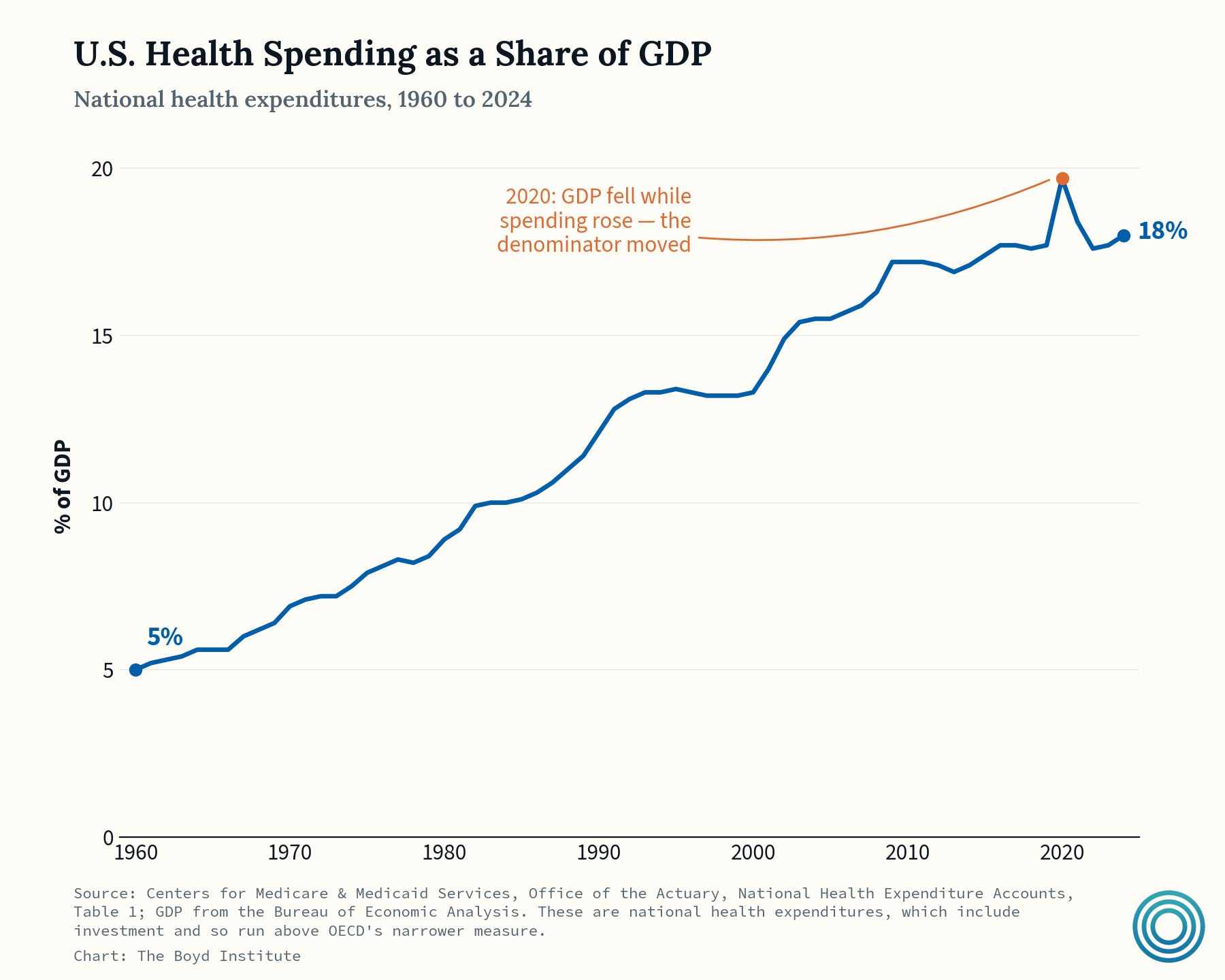
Switching to a universal system today would be extraordinarily difficult, as the transition would involve enormous disruption to a deeply entrenched, highly path-dependent system that now accounts for nearly one fifth of GDP.
For all the system’s faults, most people are satisfied with their current coverage arrangement. We see this with Medicare for All polling: the phrase polls well, but support plummets once people learn they would lose their private insurance. Insurers and hospitals would also fight tooth and nail against any change that threatens their viability.
How does the U.S. system stack up internationally?
Ranking healthcare systems is difficult and highly subjective, as different systems optimize for different metrics. The most commonly used metric in everyday parlance–life expectancy–is arguably one of the worst measurements to use. As we discuss here, life expectancy is heavily influenced by things the healthcare system can’t directly control: car crashes, gun deaths, drug overdoses, and poor metabolic health. For a useful illustration, consider this Johns Hopkins study examining the gap in life expectancy between the U.S. (78.6) and the U.K. (81.3):
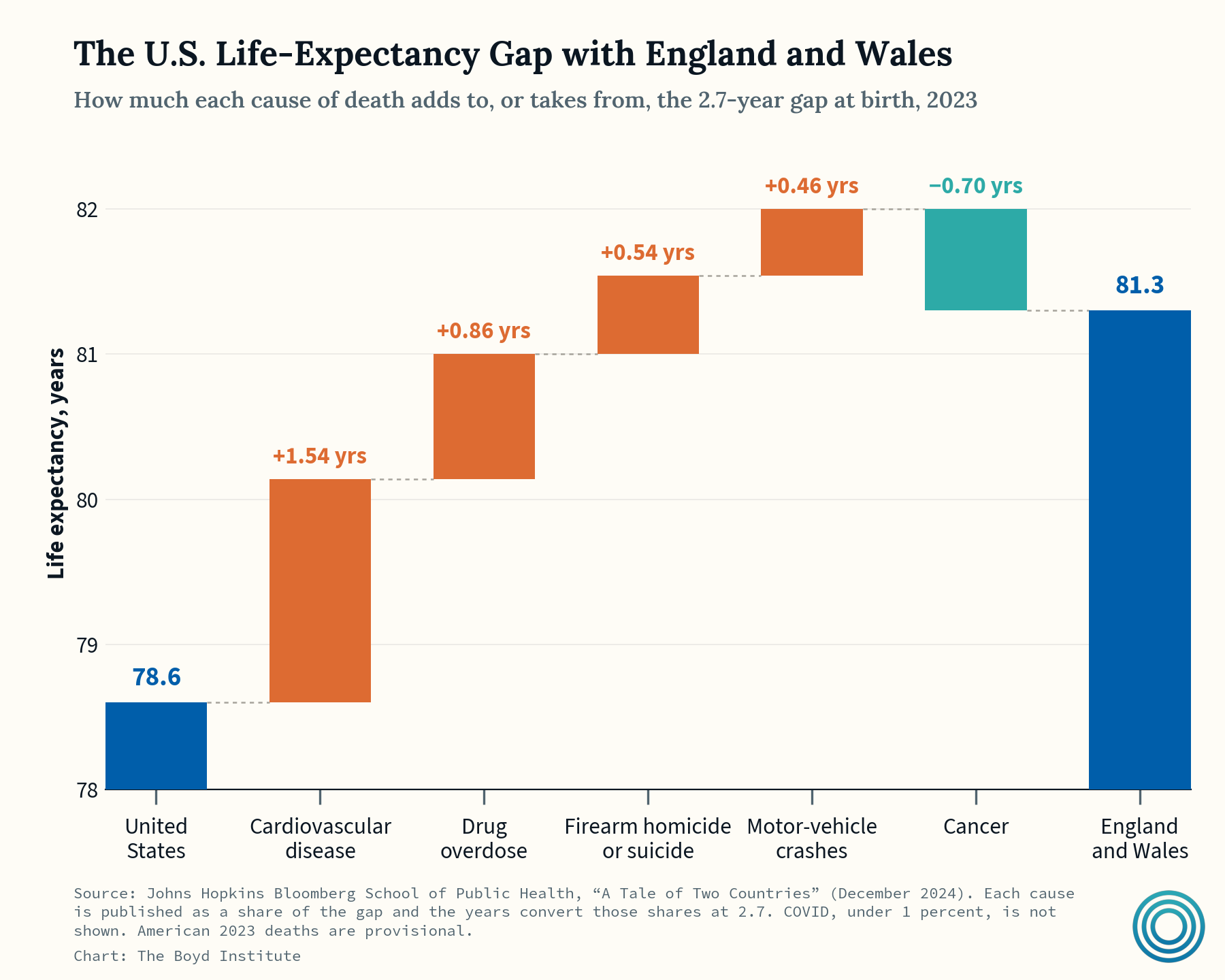
The category most reflective of actual healthcare system quality — cancer treatment — actually reduces the gap in life expectancy. Drugs, guns, and cars have little relation to the healthcare system, while cardiovascular disease is more a function of lifestyle choices. From Hopkins:
“The eight key risk factors and behaviors for the development of cardiovascular disease are suboptimal diet, sedentary lifestyle, tobacco use, overweight/obesity, hyperlipidemia (such as high cholesterol), elevated blood pressure (hypertension), diabetes, and insufficient sleep. Of these, evidence indicates that the U.S. has a lower-quality diet, less physical activity, more obesity, more hypertension (but also a higher rate of blood pressure control), greater intake of sodium (linked to hypertension), and more diabetes.”
All that is to say — we probably shouldn’t use life expectancy as our barometer for assessing the quality of a healthcare system. Better measures to look at are comparative access, treatment outcomes, and spending.
Access to Healthcare
All healthcare systems have either price or nonprice barriers to accessing care. Socialized and single payer systems have nonprice barriers; the biggest obstacle tends to be long queues. Managed competition systems can have price and/or nonprice barriers, depending on the system and the service in question. The U.S. tends to perform very well on wait times, but leads peer countries (by a lot) in reported incidence of foregone care due to price:
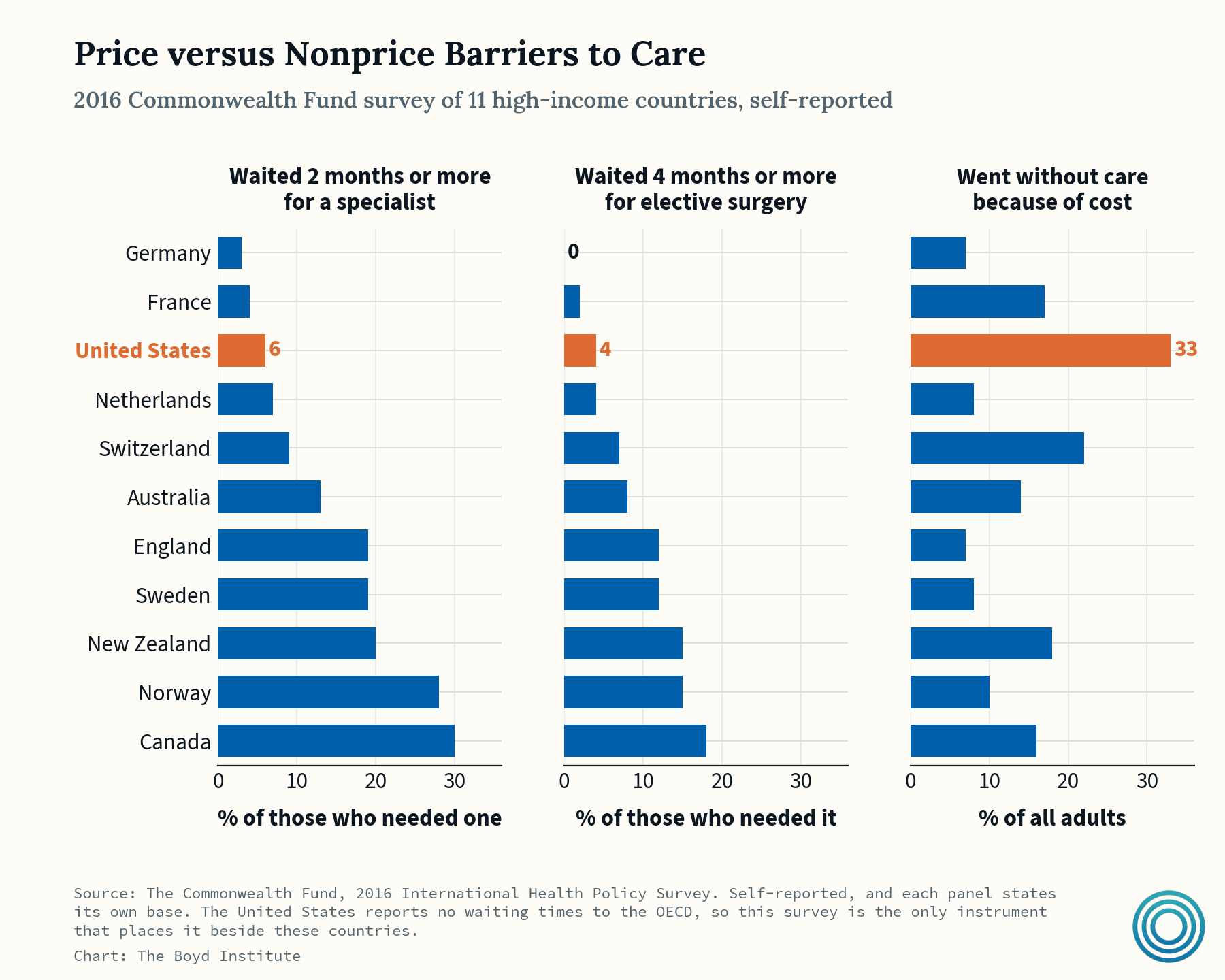
It should be noted that access to healthcare varies wildly in the U.S. depending on what kind of insurance you have. People on Medicaid actually have an experience more closely resembling Canada or the U.K.; they are largely shielded from price barriers, but often face very long wait times due to narrow doctor networks. On the other hand, a Medicare fee-for-service (FFS) patient with a generous Medigap supplemental plan can receive first-dollar coverage (no cost-sharing) and has access to almost every doctor in the country. Private insurance tends to be somewhere in the middle, though with considerable variation: a heavily subsidized ACA plan can look a lot like Medicaid, while a generous PPO plan can resemble Medicare FFS with Medigap.
The U.S. is also unique in having a considerable percentage of the population (~8%) with no health insurance. Uninsured patients face significant price barriers to obtaining outpatient care–and while hospitals will treat emergent conditions regardless of ability to pay, the subsequent bill can be financially devastating for the uninsured.
Treatment Outcomes
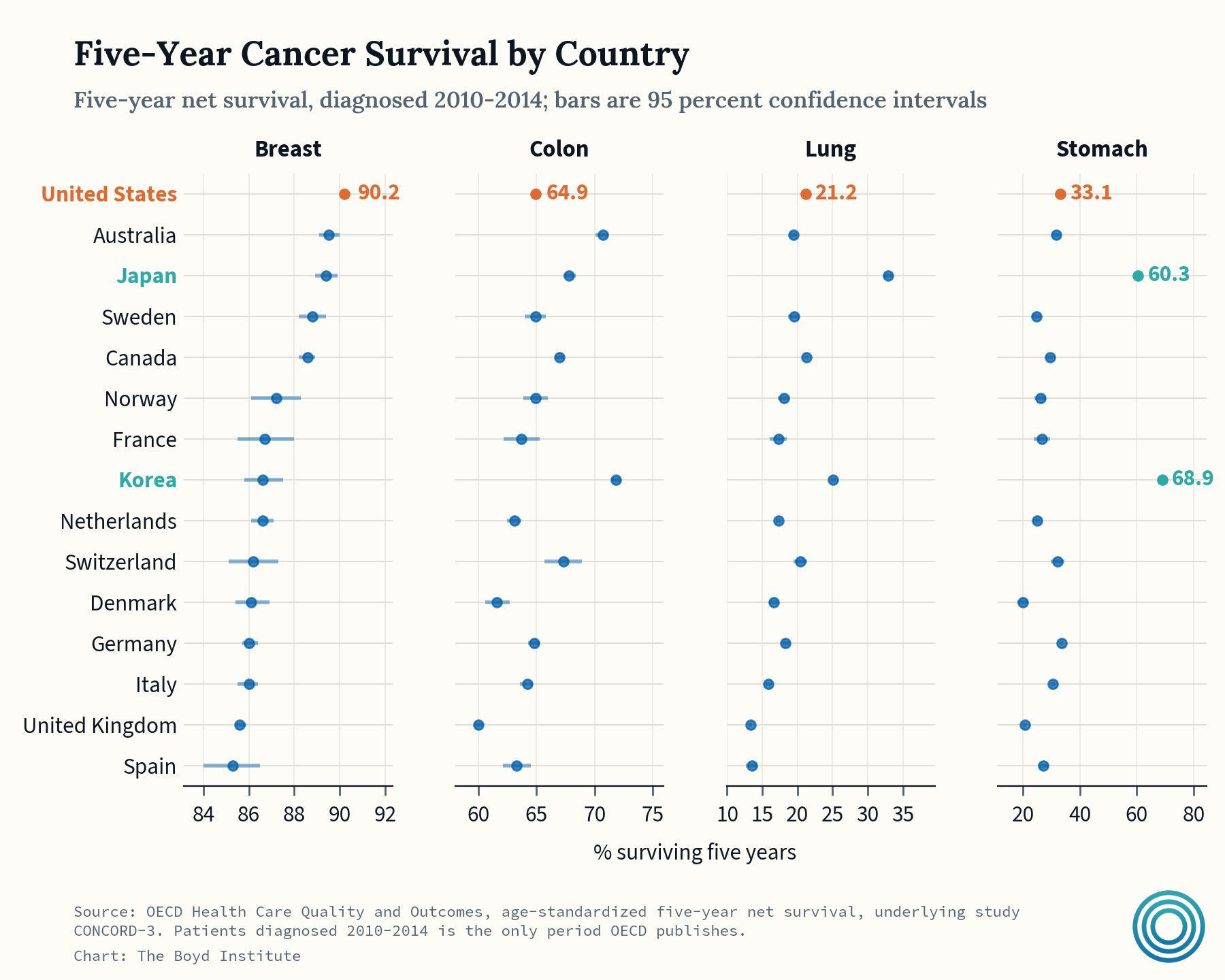
Cancer treatment is a notable bright spot in the U.S. healthcare system:
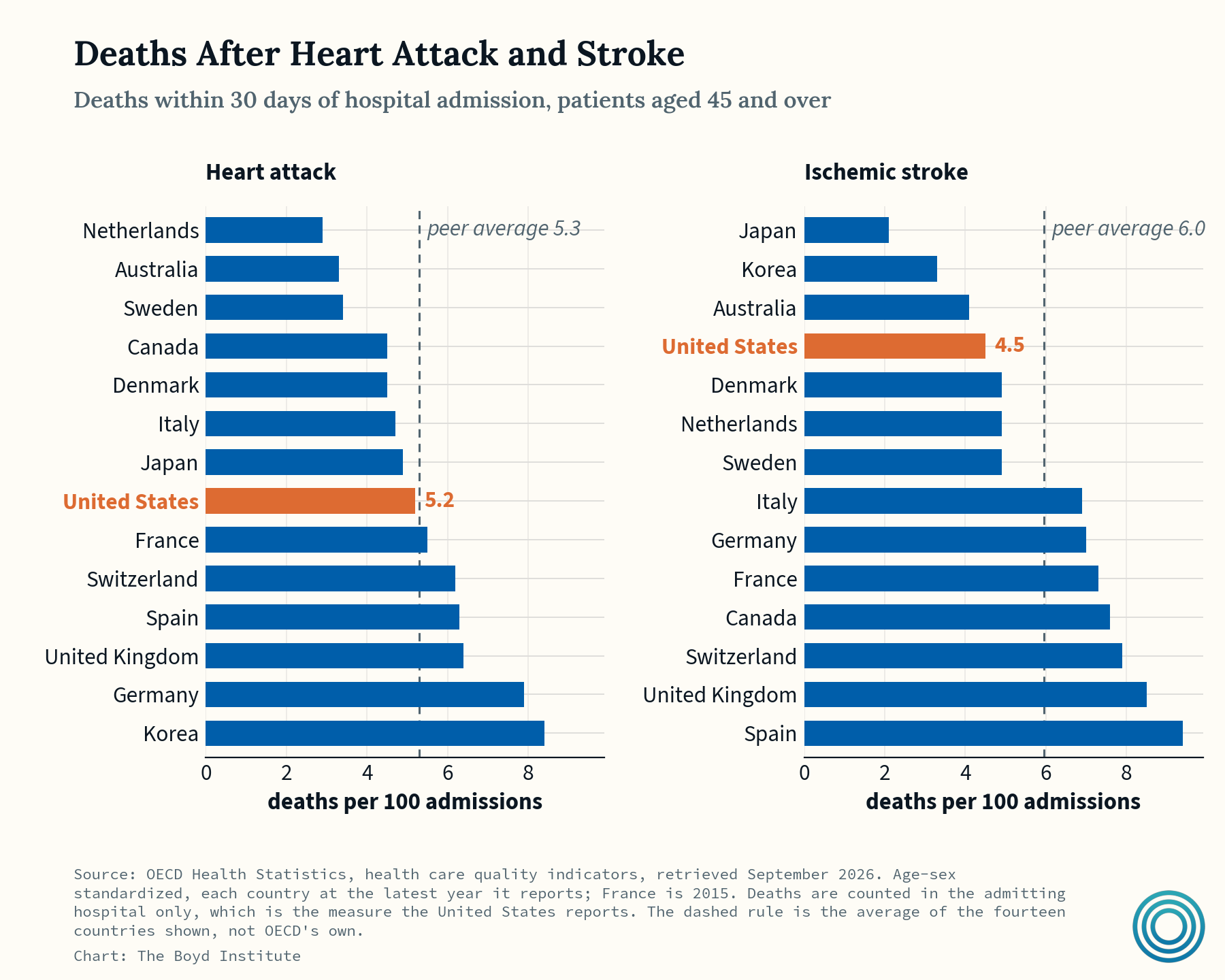
For acute-care outcomes, the U.S. is among the best of its peers at surviving a stroke, and about average after a heart attack:
However, the U.S. leads its rich-country peers in ‘treatable’ and ‘preventable’ deaths:
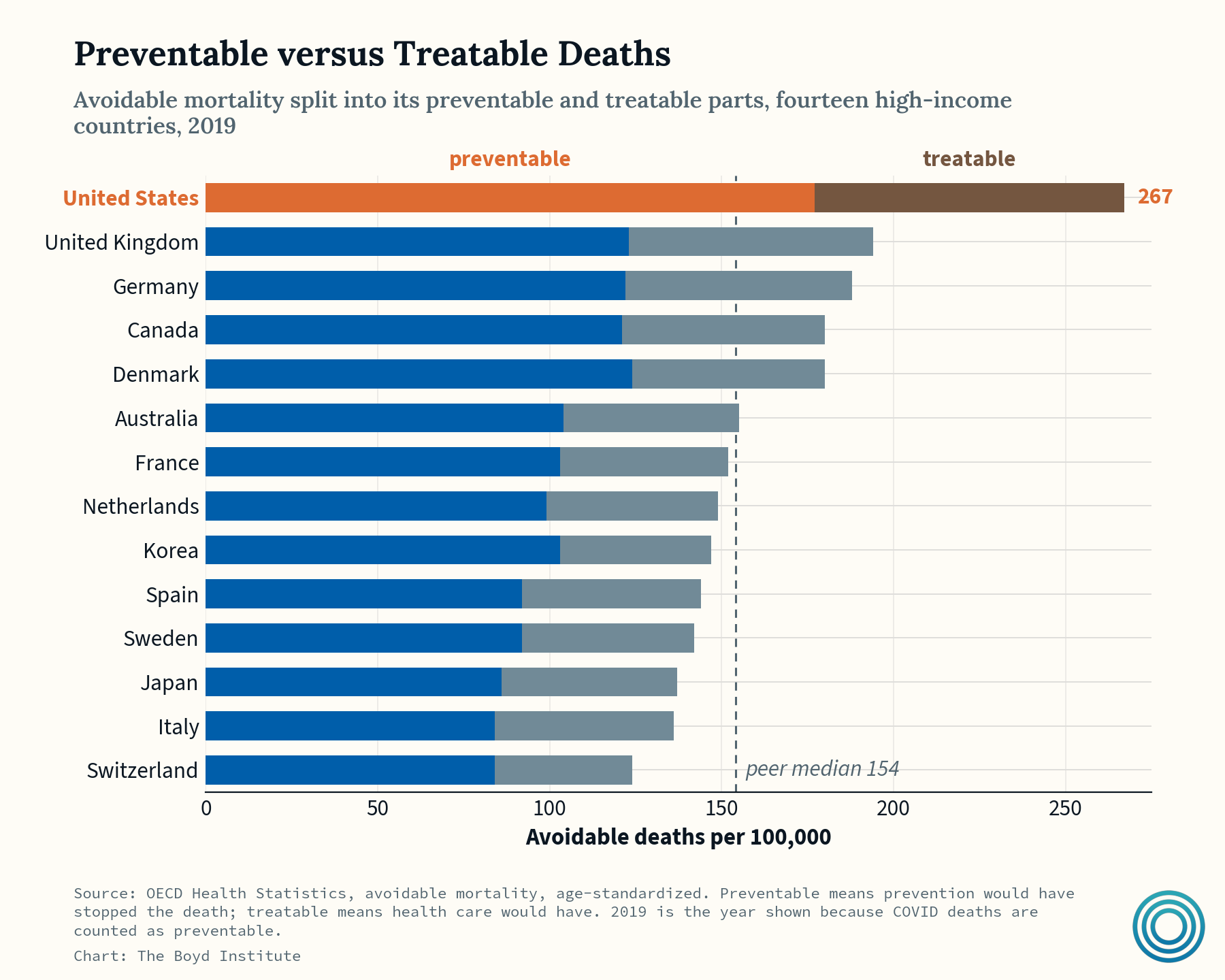
Importantly, poor population health affects both incidence and treatment outcomes for most diseases. It is difficult to isolate whether an individual treatable/preventable death was caused by poor health, poor healthcare access, or both.
Healthcare Spending
The U.S. has no peer when it comes to healthcare spending. We spend ~18% of our GDP on healthcare, roughly double the OECD average of ~9%. This astronomical spending is largely driven by higher prices, not by higher utilization. In other words: our dollars purchase fewer healthcare services than they would in other countries.
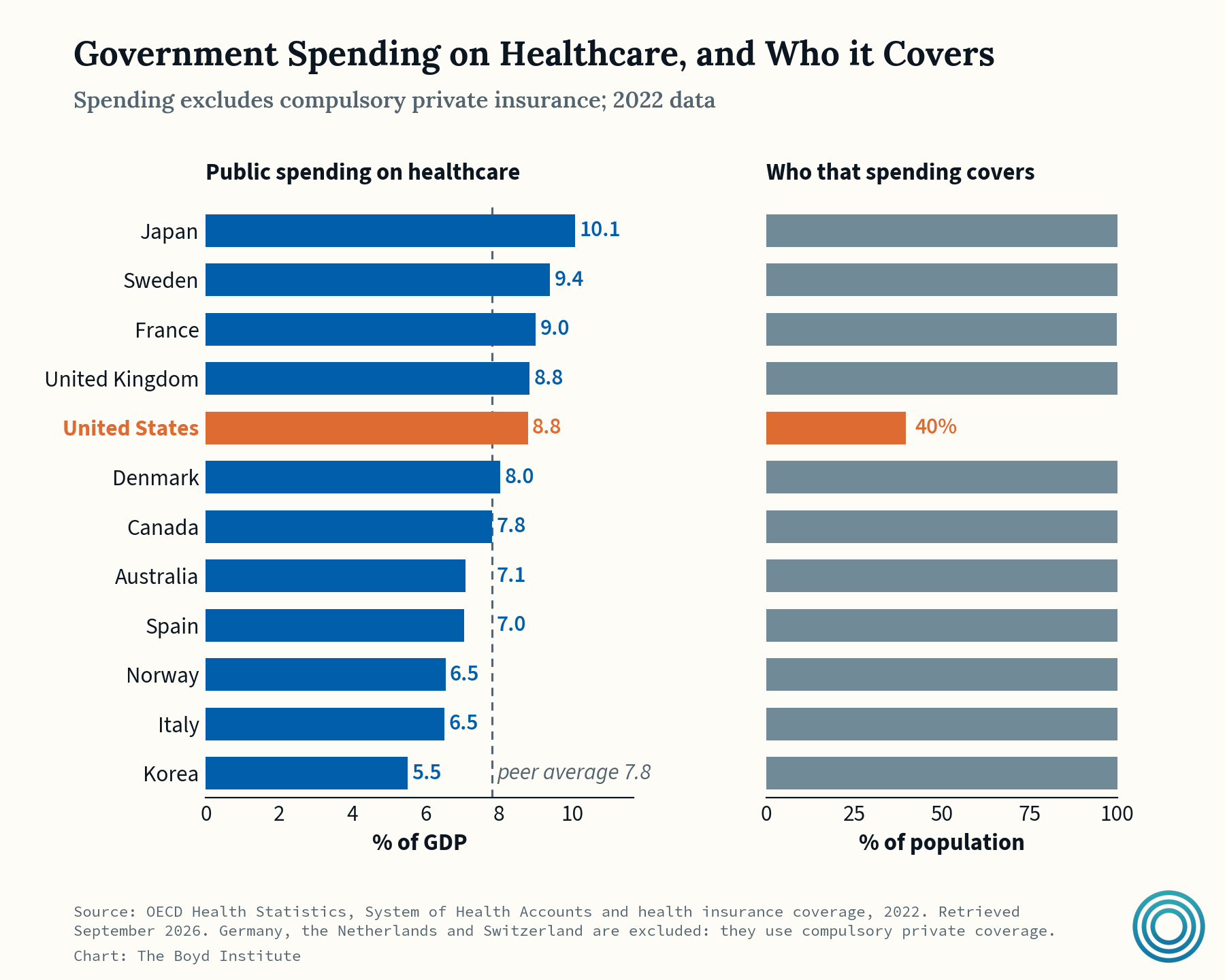
One rather startling way to visualize this is to compare public healthcare spending by country. Many healthcare pundits point to the government-run systems of Canada and Europe to make the case that the government can procure healthcare services more efficiently than the private market. Yet in the United States, despite public healthcare programs covering only ~40% of the population, public healthcare spending already rivals that of many countries with universal systems!
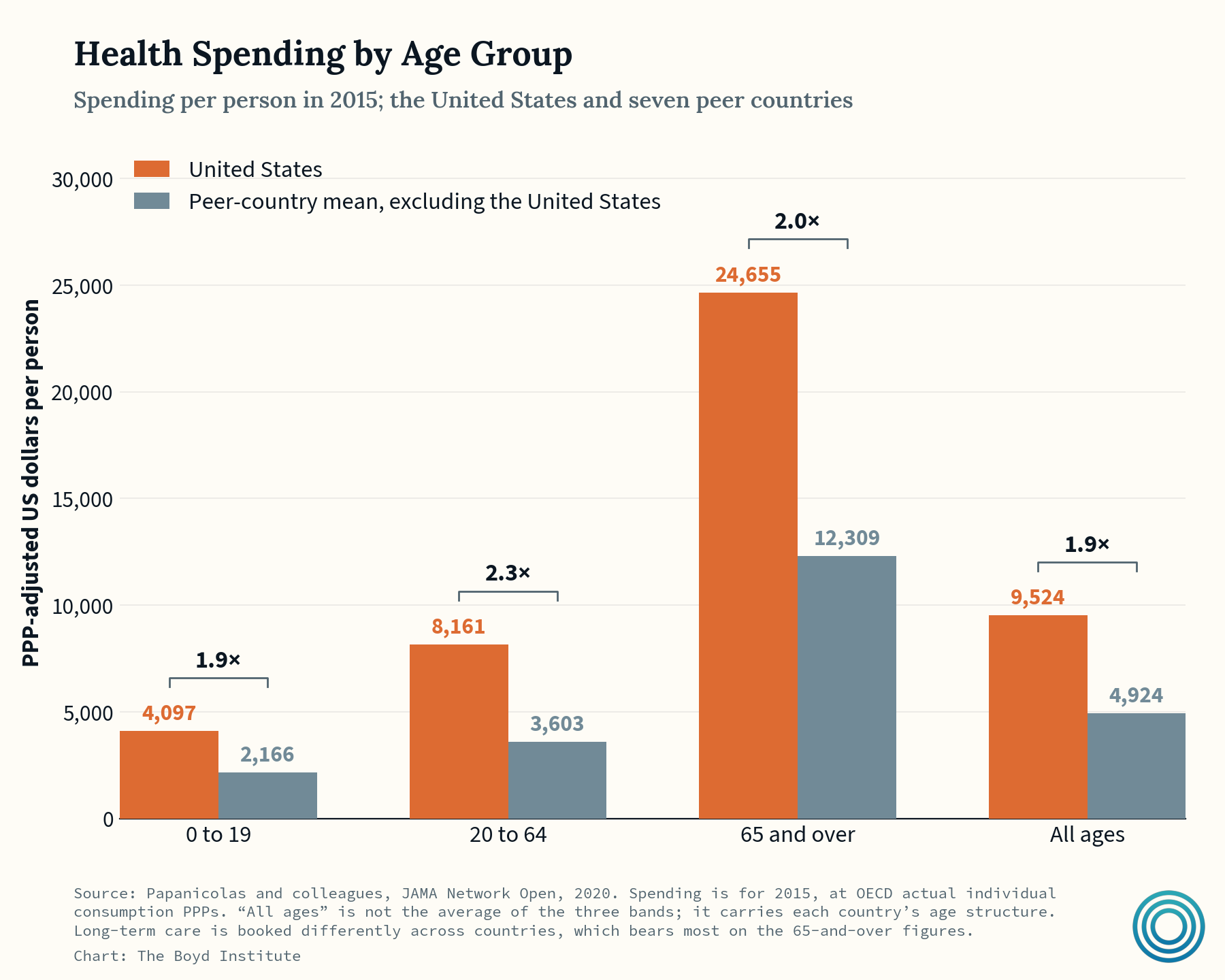
For another useful illustration, a JAMA study compared healthcare spending by age cohort relative to other countries. They found that all age groups vastly outspend their international peers–including the Medicare population.
Conclusion: There are no easy solutions in healthcare, only tradeoffs.
No single decision created the U.S. healthcare system as it exists today; rather, it developed through decades of path dependency. For all its faults, the U.S. system performs relatively well on timely access to care and certain treatment outcomes. The biggest challenge is runaway spending, which both the government and the private sector struggle to control.

We want Boyd’s funding to come from core supporters who want to be part of the conversation. For that to work, we need people like you to step up now, while it’s still early.
Here’s what we’re offering:
Supporter ($10/month or $120/year): Access to our private Signal chat and a quarterly call, where you can talk directly with us and other members.
Founding Partner ($1,000/year): Everything above, plus a monthly one-on-one call with us.
The Boyd Institute is a 501(c)(3). All contributions are tax-deductible. If you’re able to give through a Donor Advised Fund or make a direct donation beyond a subscription, it would meaningfully extend what we can do. Reach out to [email protected] for more information.
