




Democracy is rule by the majority. But what does it mean when the majority is dissatisfied with how democracy works? Across advanced democracies, that is now the case.1
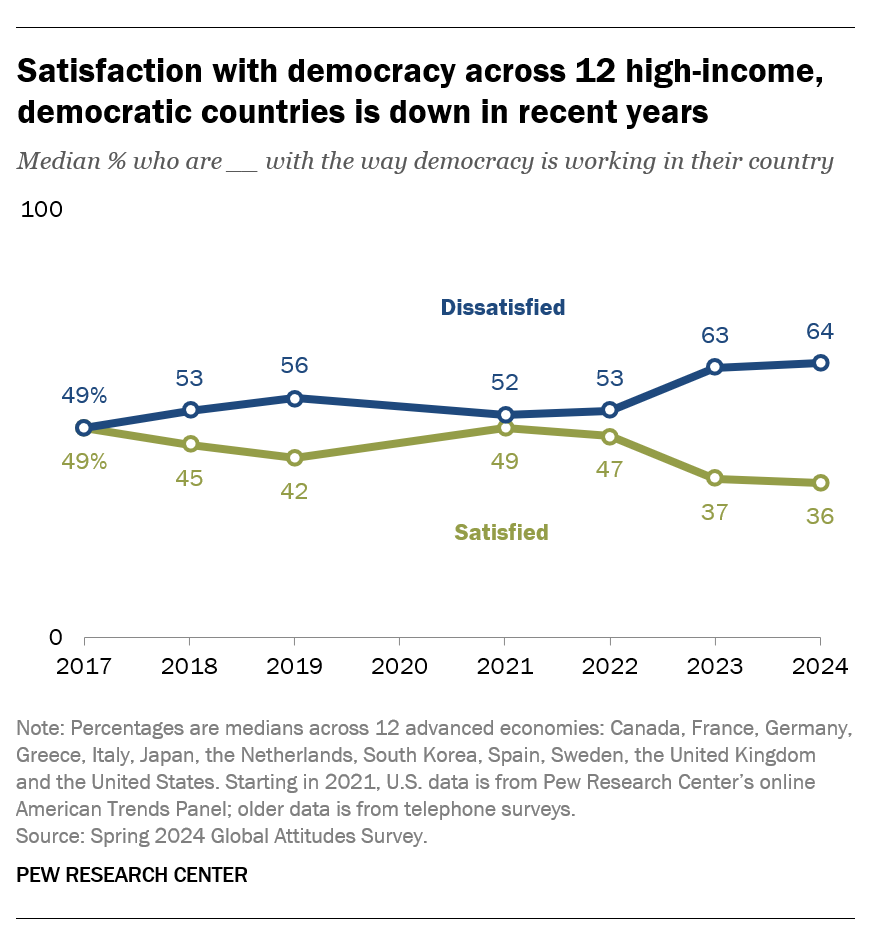
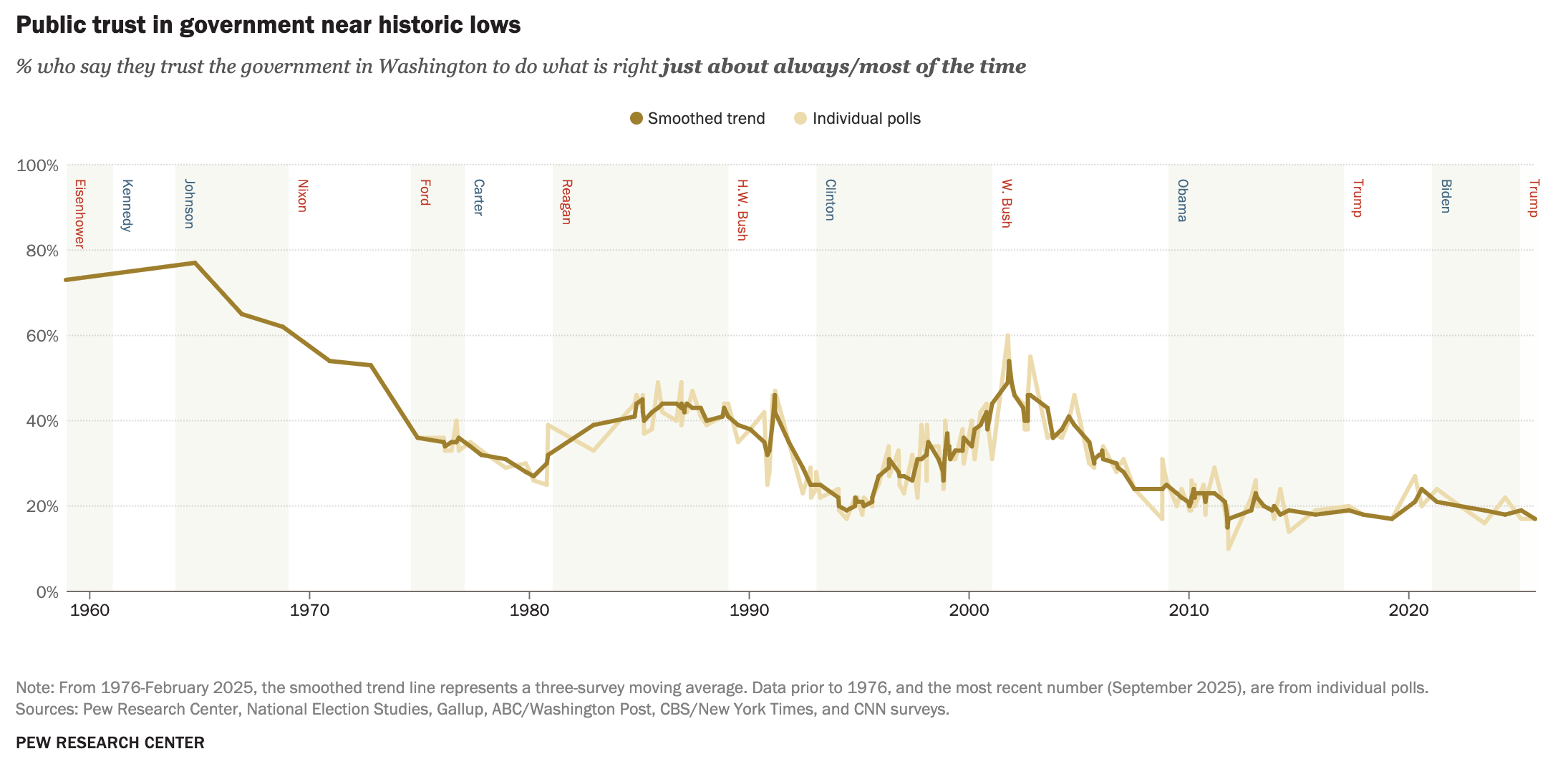
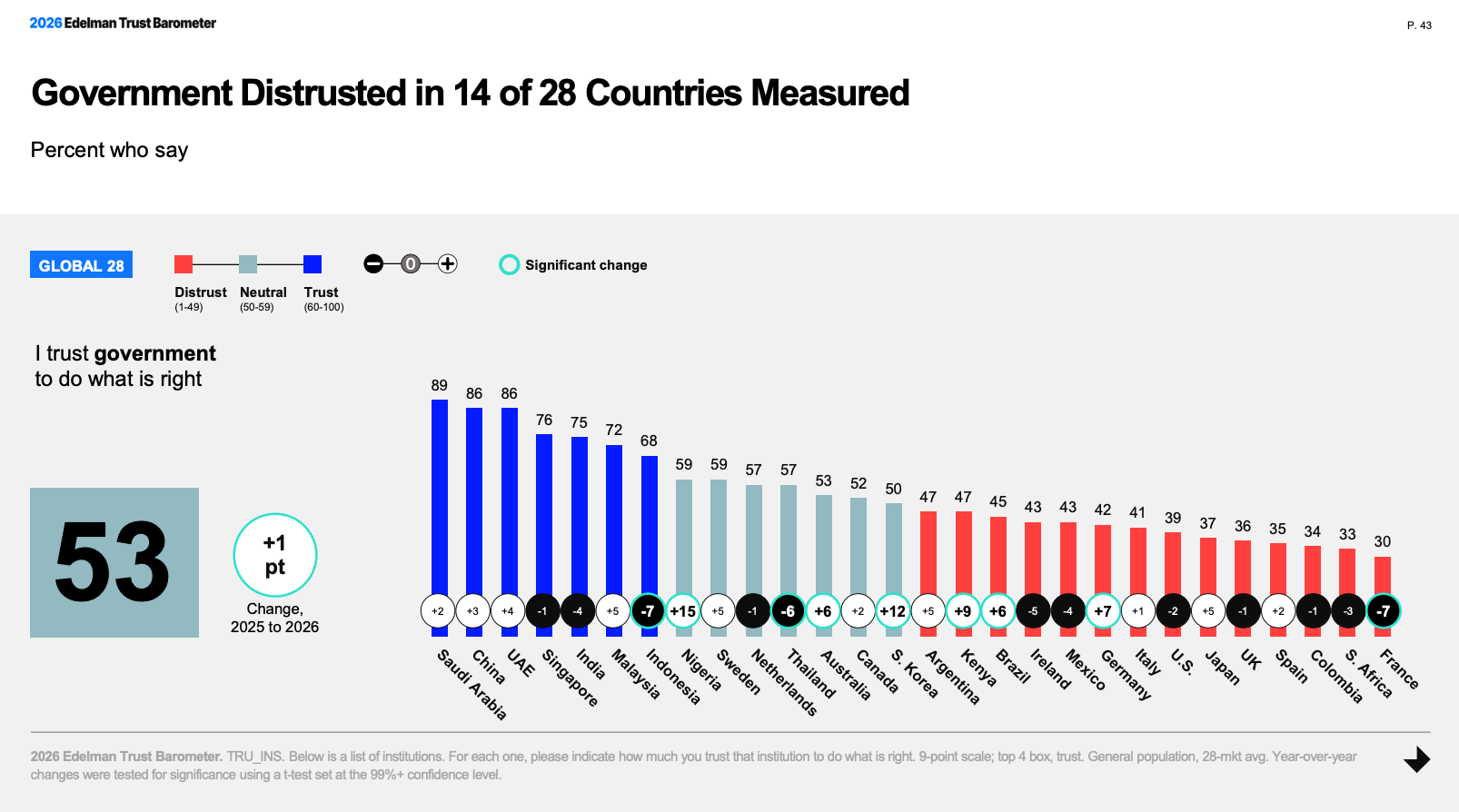
In the U.S., roughly six in ten say they are dissatisfied with the way democracy functions.2 Trust in the federal government hovers around 17 percent.3 Meanwhile, longitudinal polling shows trust in China’s central government above 80 percent, with similarly high figures for several other authoritarian states.4 These regimes aren’t free, yet they command more public confidence.5
At the same time, AI is reshaping markets, education, and warfare. Hiring is adjusting to automation.6 Tools are replacing established workflows.7 The underlying technology keeps advancing.8 It is unrealistic to assume governments will remain insulated. The question isn’t whether AI will reshape governance, but how deliberately democracies respond to it.
For many, AI looks like a threat to liberal democracy. That was my first instinct. I care deeply about freedom and limited government, and AI seemed inherently authoritarian. But as I’ve watched the technology mature and considered the structural pressures facing democracies, I have come to a different conclusion: embracing AI is our best path to renewal.
AI can’t fix aging populations, polarization, or bad leadership. But it can help address three pressures constraining democratic success: institutional capacity, geopolitical competition, and fiscal sustainability.
#1: State Capacity
Francis Fukuyama has warned that democracies decay when they can no longer execute. That sounds abstract until you look around. Permitting drags on for years. Infrastructure projects stall. Regulatory frameworks accumulate with no systemic review. California’s high-speed rail project begins to feel like a symbol diminished state capacity.
AI offers a way to upgrade what you might call “bureaucratic cognition” — the state’s ability to process information and move decisions through complex systems. In Austin, Texas, AI-assisted planning tools have reduced zoning review times by roughly half.9

Extend that logic to energy permitting, defense procurement, public health approvals, even passport renewals. AI can compress these loops, improving speed and responsiveness without sacrificing oversight. If democracies are to regain public confidence, they cannot ignore a tool that substantially increases their competence and execution.
#2: Geopolitical Competitiveness
In the twentieth century, liberal democracies prevailed not just because of their values but because of their technological and economic superiority. That link between technology and power remains. Authoritarian regimes are rapidly incorporating AI into their industrial base and military platforms, while expanding their economic and military weight. China produces roughly 30 percent of global manufacturing, graduates far more STEM students each year than the U.S., and commands shipbuilding capacity that dwarfs our own by hundreds of times.
As Palantir CEO Alex Karp recently warned, the race for AI supremacy is a “winner-take-all” struggle between the U.S. and China. “The country with the most powerful AI will determine the rules,” he noted.
Democracies cannot compete in the global order without aggressively embracing intelligent systems, full stop. This does not mean trying to “out-autocracy” China or abandoning oversight. Rather, protecting liberal democratic values should motivate us to advance AI with urgency. Just ask Ukraine, where drones and autonomous systems have become existential. If democracies lean back on AI — mired in “safety” debates while rivals build — they will find themselves reacting to a world shaped by others.
#3: Fiscal Sustainability
From Japan to Italy, advanced democracies are trapped between aging populations, shrinking labor forces, and exploding healthcare costs. The math is unforgiving. In the U.S., the CBO now projects that by 2026, interest payments on the national debt will eclipse the entire defense budget.10 On the current course, the West’s fiscal model is not sustainable.
Productivity growth is the most powerful lever to change that trajectory. And AI is the most promising engine for increasing productivity since the steam engine. Goldman Sachs estimates that AI-driven productivity gains could lift global GDP by roughly 7 percent over the next decade and meaningfully increase productivity rates.11 Compounded, that matters enormously.
Fears about labor market disruptions are valid. Technological transitions are rarely smooth. Yet previous waves of automation, from mechanized agriculture to the internet, ultimately expanded output and living standards. The alternative is slower growth, tighter budgets, and escalating distributional conflict. Democracies do not stabilize under those conditions. AI-driven productivity offers a path toward renewal.
Other Considerations
AI can’t solve gerontocracy, elite corruption, or polarization. It’s not a substitute for the thymos, the spiritual resolve required for renewal. Embracing it is necessary but not sufficient.
Some argue that keeping AI at bay is the “safer” path, even if it means gradual decline. But that assumes the status quo is stable. It isn’t. Democracy is already under strain. Excessive safetyism may feel responsible, even virtuous, but in a competitive world it becomes self-sabotage. Choosing stagnation in the name of caution weakens democracies further.
The most serious concern is that embracing AI will lead to a “rule by algorithm”—a techno-fascist surveillance state. This fear is legitimate. But the dual-use nature of AI is precisely why democracies must lead its development proactively with pro-democracy design principles: maintaining human control, embedding transparency and accountability, ensuring oversight, and allowing agile course correction.12
AI will reshape governance whether democracies design for it or not. Procedural excess, nostalgia, and degrowth are luxuries democracies cannot afford. Renewal requires embracing the AI era deliberately and strategically. It is the only credible path forward.
As Secretary of State Marco Rubio recently noted, “decline is a choice, and it is one we should not make.”13 The children of democracies deserve renewal. That renewal begins with adapting institutions to the AI era.
See studies from Harvard’s Ash Center and Edelman.
Authoritarian polling has real measurement problems. People are less likely to criticize the state when asked directly. Even discounted heavily, the trust gap with the U.S. is too large to explain away.
If there’s interest, I may write an essay building out these design principles.
Good article, but I would push back some on the idea that AI is a winner-take-all race between America and China.
That's not the case with technology in general. Ideas can spread across frontiers. You don't have to invent it in order to use it. The followers can be better off than the leader: they avoid the early mistakes and adopt mature technologies.
Military technologies are different, and presumably AI has military applications, although AI chatbots and military drones operating beyond line of sight are pretty different and may be a different space. But even military AI only seems like a winner-take-all race if one power gets ahead and then conquers the other by virtue of its its technologically enabled military superiority. Otherwise, there's time to catch up even if you "lose the race."
What exactly is the scenario where China "wins?" Do we keep using our American chatbots, but it's depressing to know that China's are better? Do we use Chinese chatbots, and get all the productivity gains, but must endure the shame of owing those gains to foreigners? Or does China charge us through the nose for their cutting-edge AI, or fill chatbot responses with Chinese propaganda? But then, wouldn't we just stop using them?
I'm all for adopting AI, but I'm not yet convinced that there's a meaningful "race" dynamic here. Or at least, it needs a lot more explanation to be credible, and whatever truth there is in it probably needs a better, more precise, less expansive description than "the AI race."
Great piece here Jeff.
It's probably no accident that modern democracy emerged in the industrial era. It emerged and was sustained in a world of relative abundance.
That's because this world of growth meant that progress was positive sum. Compare this to the zero-sum agrarian world before it.
Democracy must also embrace AI because of the growth potential if offers. Without it, a falling energy return on investment, among other headwinds, risks a return to zero sum growth and the collapse of democracy itself.