



Last month, a trip to the emergency room cost me $4,200. My health insurance paid $0.
That’s how my insurance is supposed to work. My Obamacare plan has a $7,500 deductible, so I’m on my own until I hit it. It’s a bitter pill to swallow, but I’ll take responsibility for my bill. What’s harder to accept is that, on top of my own premiums and medical bills, my taxes help pay for the healthcare of retirees who can easily afford it on their own.
I believe in having a safety net for the poor and disabled. Medicaid, for example, helps millions of people who genuinely can’t afford medical care on their own. But with our country already $40 trillion in debt, I struggle to grasp why Medicare is subsidizing seniors who don’t need the help. Why, in addition to my own medical bills, am I paying Warren Buffett’s?
The usual answer is that Medicare (along with Social Security) is different from other safety net programs because seniors earned their benefits through their tax contributions. According to the AARP:
“Social Security and Medicare are not welfare programs. They are earned benefits that older Americans have contributed to over decades of hard work.”
It’s an understandable position. Seniors didn’t have a choice whether to pay into these programs. Taxes were taken from their paychecks on the condition that these benefits would be available to them upon retirement. But these dollars weren’t saved and invested for them; they were used to pay benefits for earlier generations in a pay-as-you-go system. My generation, Gen Z, is now on the other end of the bargain.
There needs to be an honest accounting of what we are expected to pay.
Surely, no one would argue that seniors are entitled to unlimited benefits simply because they paid into these programs. Social Security was designed around reciprocity: workers support current retirees with the expectation that future workers will do the same for them. But for the program to be intergenerationally fair, each generation should be asked to make a similar contribution. If today’s retirees receive vastly more from the program than they contributed, at what point does an ‘earned benefit’ become an intergenerational transfer?
The Urban Institute examined this question by estimating the present value of Social Security taxes paid relative to benefits received for different retiree generations. It found that an average married couple retiring in 2030 would pay $872,000 in Social Security taxes and receive $918,000 in benefits, about $1.05 in benefits for every $1.00 in taxes.
This is pretty close to “getting back what you paid in,” though even a small imbalance matters for a program spending $1.7 trillion a year. And there are fewer workers per retiree today to pay these benefits than there were when the baby boomers were working. Combined, these issues are straining Social Security’s solvency. But no individual retiree is responsible for demographic change or flaws in Social Security’s formula. Reasonable people can disagree on how to distribute the burden of Social Security’s financing shortfall between generations, and I sympathize with seniors who feel they’ve earned their benefits and don’t want to lose them.
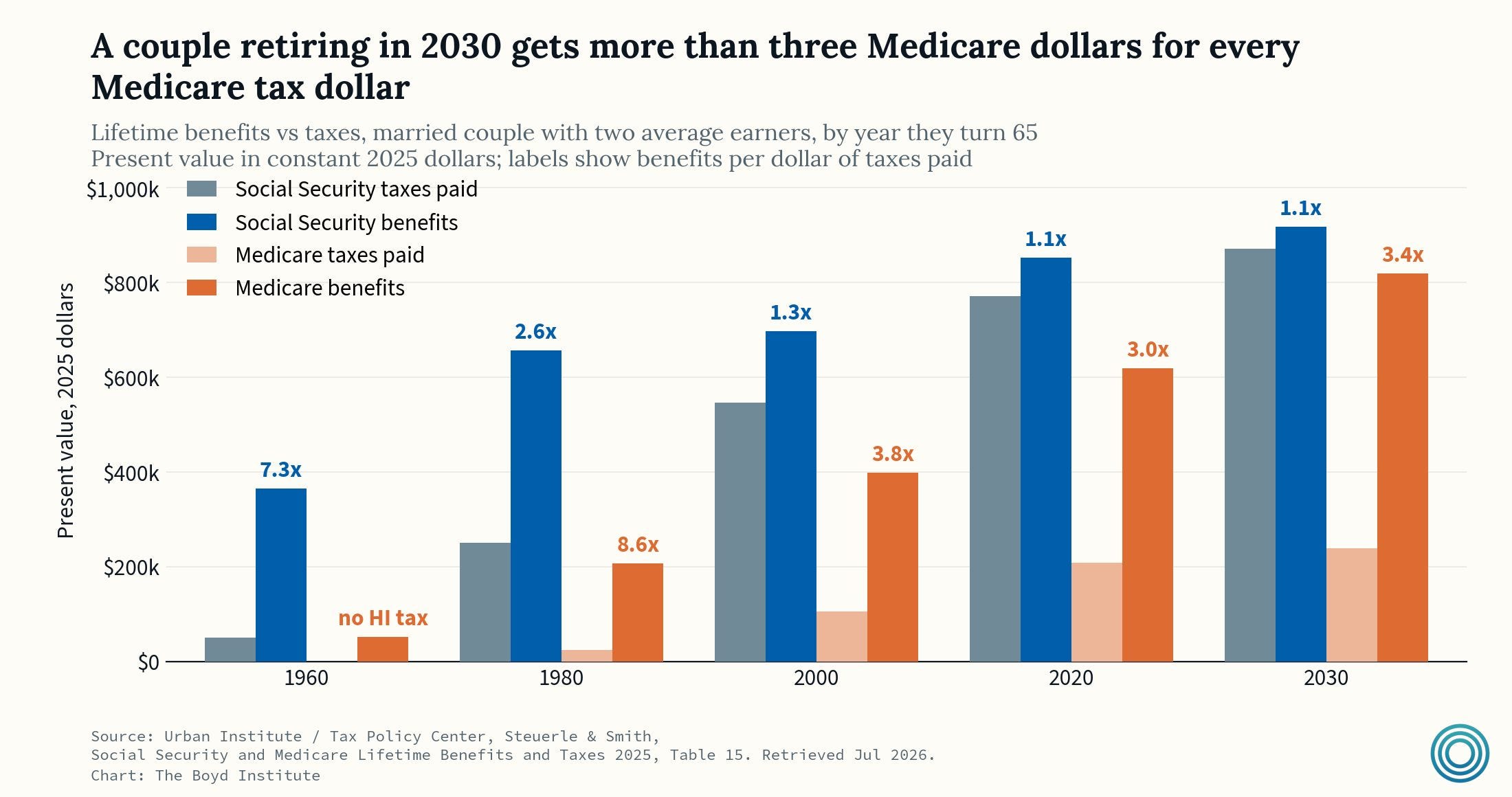
Medicare is a different story. For the same couple retiring in 2030, the Urban Institute finds that they will pay just $239,000 in Medicare taxes and receive $819,000 in benefits. That’s a difference of $580,000. For every dollar they put in, they get $3.43 in benefits.
Medicare is an intergenerational wealth transfer.
Medicare’s reciprocity stops at Part A. That’s not a demographic fluke but an explicit design choice.
Medicare is not one program but rather a collection of programs. Medicare Part A provides seniors with hospital insurance, Part B provides them with outpatient coverage, and Part D covers prescription drugs. Yet the Medicare payroll taxes that come out of every worker’s paycheck only cover Part A. Parts B and D are instead subsidized by general tax revenues, just like welfare programs such as Medicaid and food stamps.
Seniors may object to the Urban Institute’s accounting and say that their non-payroll taxes ought to be included in the analysis too. The reason that they are not is that Social Security and Medicare Part A were explicitly designed to be financed separately from the rest of the budget. These programs were sold to the public as social insurance, not welfare: everyone pays a dedicated payroll tax, and everyone gets something back when they retire.
Welfare programs are explicitly redistributional. As a society, we raise funds through progressive income taxation and use them to help those in need. We condition welfare eligibility on means, not prior tax contributions. Moreover, paying income taxes doesn’t mean you’ve earned every government benefit they finance. By that logic, anyone who pays income taxes could claim to have earned food stamps. There’s a reason we don’t give food stamps to Warren Buffett.
But we do give Mr. Buffett a subsidy for Medicare Parts B and D. Unlike payroll taxes, the money for Parts B and D was never earmarked for Medicare. It comes out of the common pot from which we fund the military, courts, infrastructure, and assistance for the needy. This is the same pot from which progressive priorities such as universal childcare or school lunches could be funded. That money could also go toward our ballooning federal deficit. Instead, it helps Warren Buffett buy pharmaceuticals.
The following graph illustrates the worsening reciprocity problem. The blue section represents the portion of Medicare actually funded by Medicare taxes, while the orange represents the general revenue subsidy. As the Medicare program has grown over time, general revenues have picked up the tab.
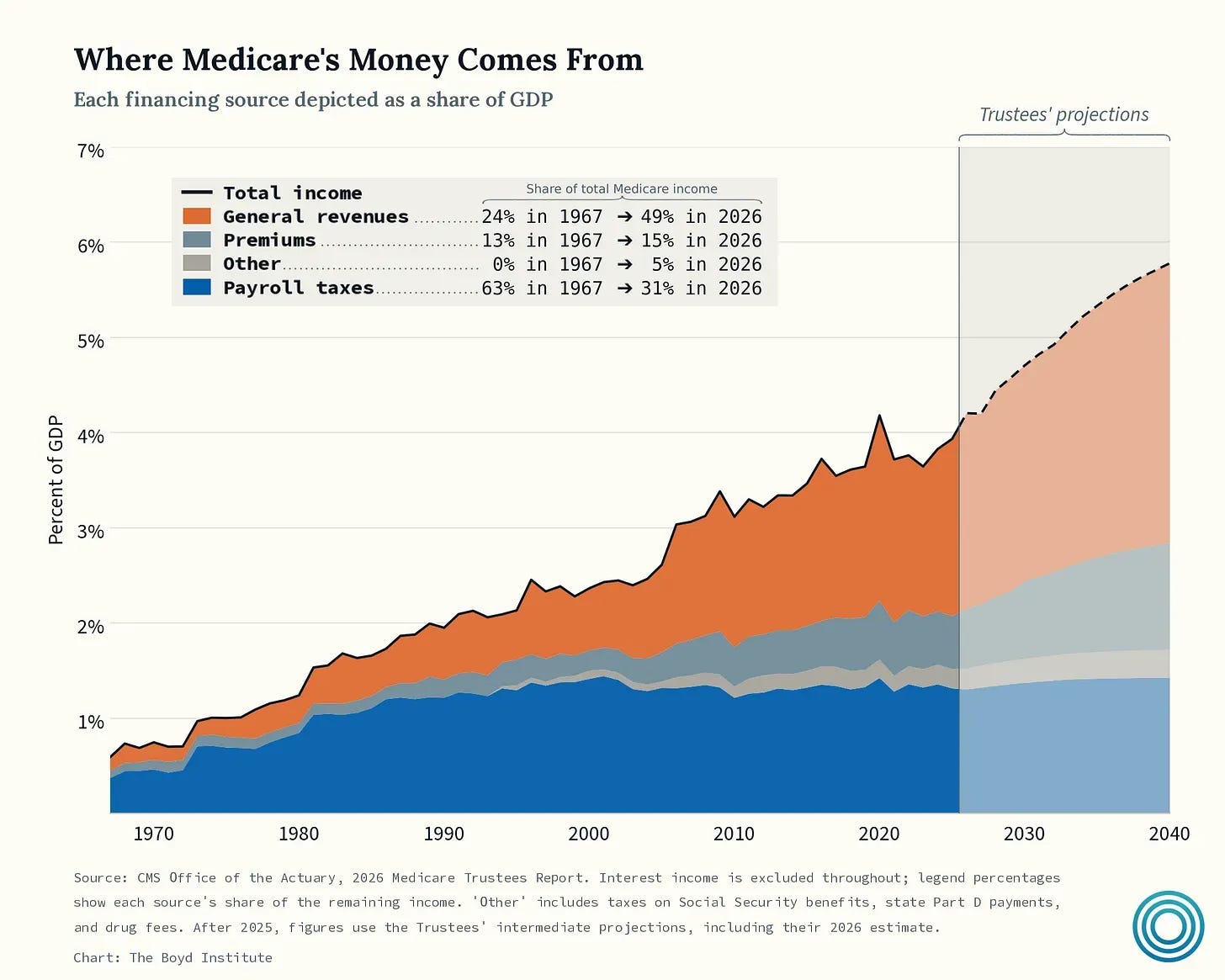
The Medicare Trustees say that Parts B and D will draw a staggering $662 billion from the general fund in 2026, roughly a third of the $2 trillion federal deficit. And with the baby boomers retiring, life expectancy increasing, and medical technology advancing, the problem is only going to get worse. Medicare is the largest long-term driver of our national debt, and younger generations will bear a disproportionate share of the burden of paying it off.
The intergenerational bargain is broken.
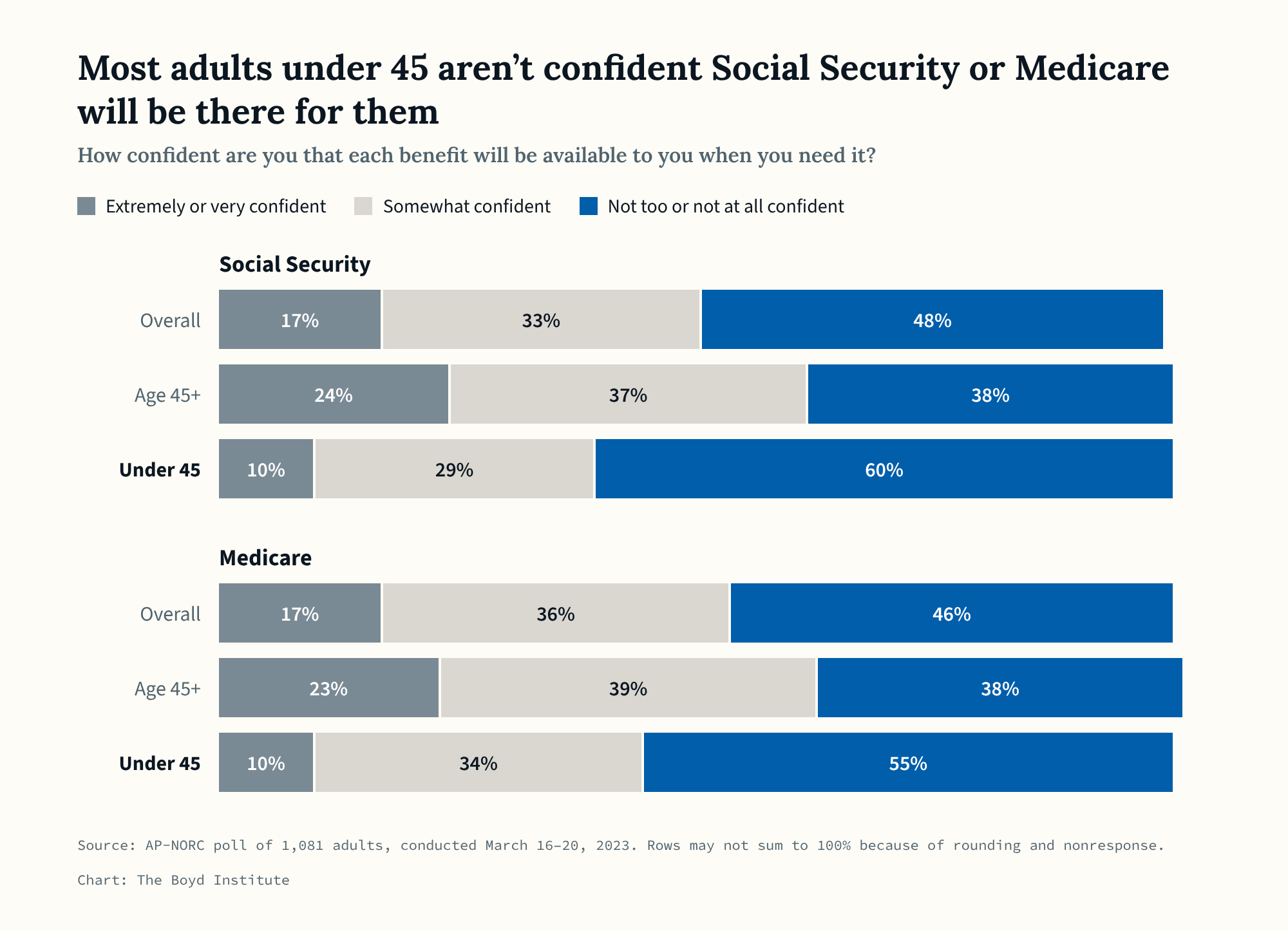
Some will point out that Gen Z will someday need and collect Medicare too. On paper, we’re promised the same deal as our grandparents. But few my age have any confidence that promise will be kept. Only 10% of adults under 45 have high confidence that Social Security or Medicare will be there for them when they need it, according to an AP-NORC poll from 2023.
A program that grows faster than the economy, with no limit on what it can draw from general revenues, won’t be able to deliver on its promises forever. When those promises break, they’ll break on generations after the boomers, like my own.
I understand the anxiety around any sort of Medicare reform for seniors. But it’s unfair to ask my generation to keep writing a blank check. Seniors should be able to acknowledge that the Medicare program is paying benefits that far exceed what they contributed through dedicated Medicare taxes.
I can understand the argument for protecting Part A, the part of Medicare that seniors contributed payroll taxes toward. But Parts B and D really ought to be means-tested like other welfare programs. These programs are already means-tested to a degree, but the subsidy architecture is backwards. They default to subsidizing everyone, with the subsidy declining, but not disappearing, for the wealthiest beneficiaries. Taxpayer assistance should instead be reserved for seniors who actually need it.
Means-testing Parts B and D alone won’t solve Medicare’s reciprocity problem, but it’s a start. Borrowing against my generation’s future to subsidize retirees who can pay their own way is a moral failure. Asking wealthy seniors to pay more for Parts B and D should be low-hanging fruit.
I’ll pay my hospital bill. All I’m asking is that Warren Buffett do the same.
Tried to explain to my parents that no, they did not in fact pre-pay their Medicare in full, not even close, and they just don't believe me.
It's not in politicians’ interest to tell the most politically active segment of the population that they are putting an unsustainable burden upon the younger generations.
Somebody else has to do it. Someone needs to start Old People for Entitlement Reform.
Wait. Why are you looking at me like that?