


Last week I attended the Liberty Acceleration (lib/acc) Summit hosted by Infinita City in Próspera, a special economic zone (SEZ) located on the Honduran island of Roatán. The summit was jam-packed with heavy-hitting speakers — one of whom was Niklas Anzinger, Infinita’s CEO, who was gracious enough to sit down with me for an interview. Our conversation was extremely substantive and wide-ranging, so please check it out!
During the summit, I also took over 10,000 words of notes, many of which were messy. Therefore I had ChatGPT neatly organize them into a dossier for those interested:

And now, some takeaways and themes from the lib/acc summit and my experience in Próspera.
Próspera: A Shining City in a Hill
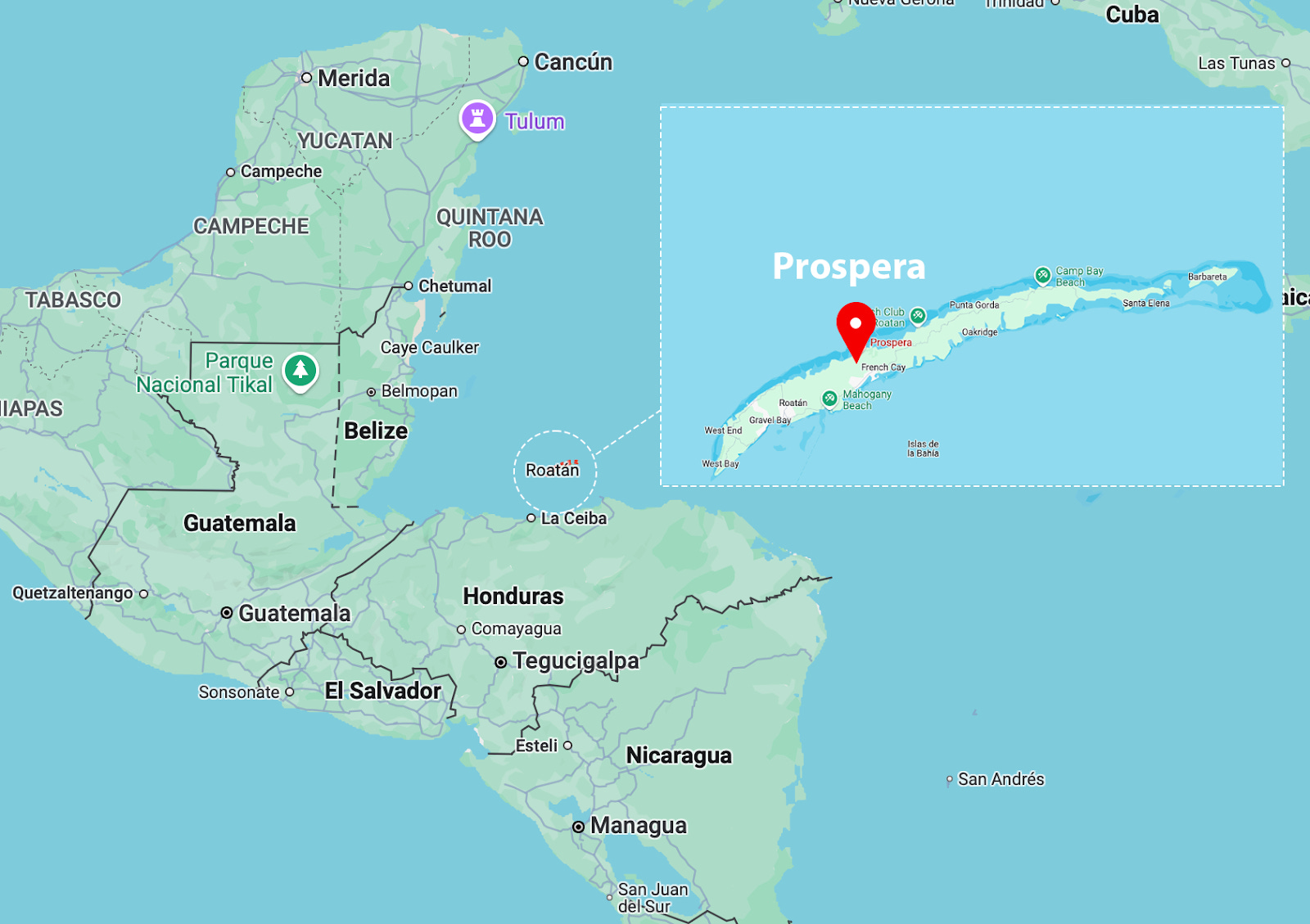
To get to Próspera from the island’s main artery, you leave behind the tourist-facing strip and wind your way up a half-paved road through lush, jungle-covered hills. Then, after a few minutes of switchbacks and scrub, what suddenly appears is an improbable little enclave nested into the tropical canopy, overlooking the Caribbean Sea.
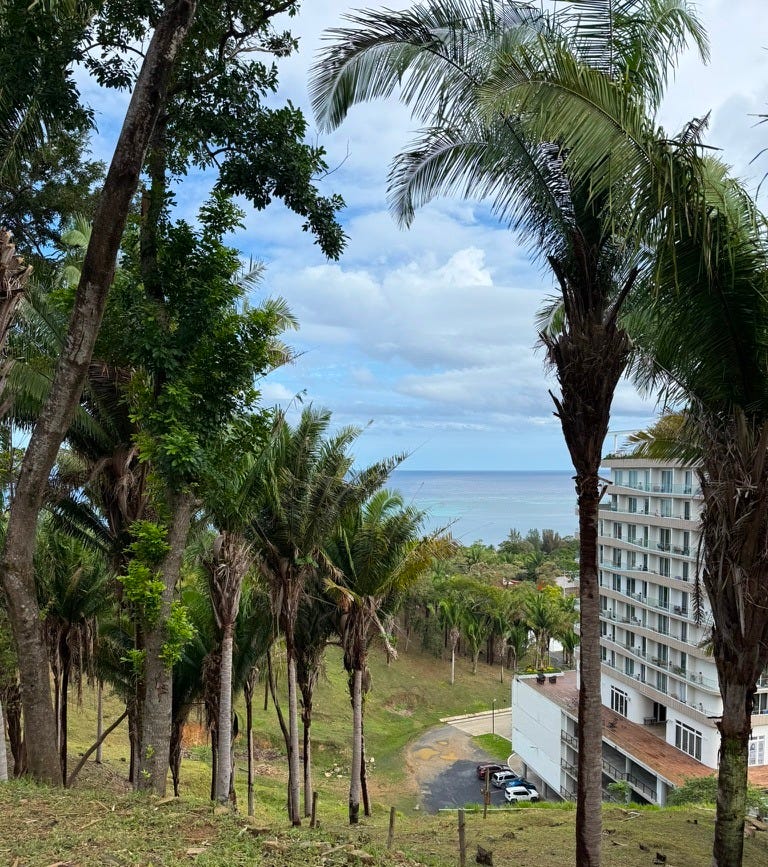
At first glance, it feels like equal parts White Lotus and techno-optimist. It’s certainly unique. But what’s most striking, with context, is not what you see but what you do not: nothing about it suggests a project that has spent years under existential political and legal threat. It looks, instead, like the early innings of a place that assumes it will play the full nine — and win.
That confidence is part of what makes Próspera interesting. It did not emerge simply because a few Silicon Valley libertarians had money and a taste for exit. Rather, it sits inside an older ambition: the charter-city idea associated with the economist Paul Romer’s work, and the attempt to build jurisdictions that compete on rule of law, predictability, and administrative quality rather than merely on low taxes.
The problem with the original idea was that it was basically like, let’s say, Canada running a jurisdiction in Zimbabwe — this inevitably leads to political issues and disputes. The critical change was around zones being run by private investors instead of other sovereign nation states. Honduras’ ZEDE framework (Zone for Employment and Economic Development), first legislated and constitutionally ratified in 2013, was one of the boldest efforts to operationalize this ambition. Since then, and since Próspera’s 2017 launch, the project has been battered by repeal efforts, court rulings, and arbitration battles. Yet through all the political hostility, on the ground, it keeps building.1
Some healthy candor before diving in: I fully expected, coming into this trip, to encounter a preponderance of rigid “individualism good, statism bad” dogma — basically a bunch of anarcho‑capitalist separatists hiding from the big bad state. This was not quite my experience. Granted, a surefire way to accrue social capital ‘round these parts is to quote Atlas Shrugged. But the vast majority of the network-state folks I encountered weren’t self-deluded purists. The prevailing sensibility was, instead, pragmatism.
Indeed, what I found in Próspera was something more interesting and, in some ways, rousing for anyone who cares about reforming institutions inside the United States. And that was a community of open-minded tinkerers — builders trying to treat governance itself as something that can be redesigned, iterated on, and improved.
Governance as an Industry
A central frame at the summit was treating government as the largest and least competitive sector of the global economy, characterized by massive firms (nation states), high switching costs, and enormous barriers to entry. “The best lose money, and the worst kill their own citizens,” argued Patri Friedman. Fundamentally, whereas most industries improve under competition, government quality stagnates or degrades because citizens face monopolistic providers with limited exit options and little feedback from price signals. Boyd definitely cosigns these contentions.
“Governance as a service” (GaaS) then reframes jurisdictions as platforms competing on regulatory quality, dispute resolution, and ease of doing business, rather than as monopolistic territorial providers. In this model, governance is the business, law is the source code. SEZs like Próspera aspire to export legal and regulatory infrastructure — offering menus of regulatory regimes, insurance‑priced risk, and digital residency — to firms and individuals globally, much as cloud providers export computing. Dubai’s financial free zones and their open‑sourced, common‑law‑inspired rulebooks are a key intellectual reference; so are the Free State Project in New Hampshire and various special economic zones in Asia, like Shenzen.
From this, juxtaposed with current systems of governance, looms “a tale of two regulatory regimes.” On one side is governments that have effectively outlawed progress through a tangle of process, overlapping mandates, and impossible evidentiary standards. Cited examples familiar to those of us thinking about proceduralism and the vetocracy in the US included:
Multi‑decade permitting timelines
Places like Boston and NYC where the majority of existing housing stock is now technically illegal
Nuclear projects that must spend half a billion dollars and millions of staff hours just to file an application
An FDA pathway in which most cost and delay sits in efficacy phases rather than genuine safety testing
On the other side is what Próspera is prototyping: a regulatory choice architecture where firms can select among accredited regulators, where insurers internalize both downside and upside risk, and where the “Better than the Beatles” standard2 that kills merely good innovations is replaced with a more incremental, portfolio‑style approach to risk. That is less a philosophical revolution than an industrial one aiming to re‑engineer the production function of law.
Concretely, Próspera offers a system where residents in regulated industries make a “regulatory election” to operate under Honduras rules, operate under a “peer country” regime, or propose an approved alternative. The enforcement novelty is that baseline insurance, supplemental regulated-industry insurance, and enhanced liability are positioned as the practical compliance engine. Here the underwriters, incentivized to price risk fairly, are the day-to-day regulators in lieu of bureaucratic agencies.
Lib/Acc: from Layer Zero to Application
The summit itself was explicitly organized as a march up the “governance stack,” borrowing the ‘stack’ metaphor from software and crypto architecture, where layers of infrastructure enable higher‑level applications. The organizers’ own framing is worth taking seriously because it’s basically a diagnosis of why “innovation policy” fails in mature states: app‑layer goals like faster drugs or more housing are downstream of the deeper underlying substrate of authority, legal permissioning, and institutional incentives.
In this model, Layer 0 enables politics and law, Layer 1 is the jurisdictional form factor, Layer 2 is real-world buildout and service delivery, and the app layer is comprised of ventures that exploit the new rule environment.
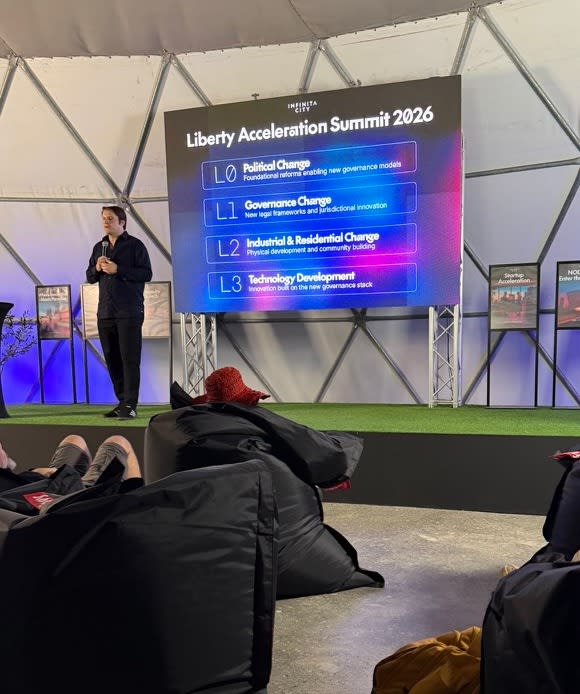
Layer 0 talks focused on the politics and law that made Próspera possible in the first place, such as the years of Honduran public‑choice maneuvering that produced ZEDE legislation, the five‑plus layers of legal protection woven through statutes, constitutional amendments, bilateral treaties, and stability agreements, and the painful lesson that any such project will eventually face a hostile administration determined to unwind it. Christian Betancourt, a Honduran attorney who helped draft the law, described how the designers tried to anchor ZEDEs in supermajority legislation, constitutional text, and international obligations precisely to survive the kind of backlash they recently faced under the previous socialist (and quite hostile!) administration in Tegucigalpa.
Layer 1 sessions were about jurisdictional form factors. Patri Friedman walked through his own path from seasteading — “fantastic as a meme,” in his words, but terrible in terms of the capex-to-opex ratio. Talks on various SEZ jurisdictions ranged from, of course, the ZEDEs in Honduras like Próspera and Morazán, to a 7km stip of unclaimed land between Serbia and Croatia where the Free Republic of Liberland was settled. Joseph McKinney talked about composing “legal primitives” inside “hacked zones” that leverage tribal sovereignty in the US to create special economic regimes within existing reservations to spin up digital‑first SEZs with their own company law, banking rails, and digital‑asset frameworks, then later compacting or ratifying them with state and federal authorities. Others included Floripa in Brazil, sold to the local government as an opportunity to reverse the country’s brain drain, as well as OurWorld, a full-stack digital free zone — “cyber city” — just launched in Zanzibar by Florian Fournier, the former Marketing Director at Apple.
At the center of the Layer 2 build‑out is Infinita City, the longevity‑focused city district that CEO Niklas Anzinger is building on top of Próspera’s legal substrate.3 His pitch throughout the summit was that Infinita is a “full‑stack” environment for biotech and DeSci founders — bringing them to the island, giving them labs and housing, wiring them into Próspera’s regulatory menu, and wrapping the whole thing in a village‑like social fabric so that serious work on aging and medicine “feels almost inevitable.”
If Infinita is the Layer‑2 on‑ramp, the app layer is where you see whether any of this matters. A few early “proof points” helped crystallize what a functioning governance startup can actually enable:
Biotech: Companies like Unlimited Bio, PopVax (funded by Vitalek, founder of Ethereum), and Herasight are using Próspera’s regulatory choice and arbitration mechanisms to run faster, cheaper trials on aging and cancer, including combination therapies that are nearly impossible to approve under current US protocols.
Finance: Niko Klein’s Próspera‑based bank — The Network Bank — pitched itself as the financial backbone for zones, offering multi‑currency accounts, custody, and crypto‑friendly services under a streamlined regulatory regime. Joey Langenbrunner’s Nomad Layer is laying the groundwork for Próspera to become a tax-residency locale for both individuals and corporates.
Education: Experiments with AI‑intensive “alpha schools,” where avatars handle dense instruction and the rest of the day is reserved for project work and mentorship, aim to turn the zone into a talent‑production engine.
Whatever else you make of the broader project, it was refreshing to hear pie-in-the-sky thinkers obsess over nuts‑and‑bolts institutional design at a conference that could easily have been a wall‑to‑wall exercise in libertarian political philosophy or crypto metaphysics.
Pragmatists, not Pirates
Centuries ago, ground zero for “Pirates of the Caribbean” was right here in the Bay Islands off the coast of modern day Honduras. Today this region is home to a new ground zero, one for institutional pragmatists.
Almost everyone that spoke at the summit or that I spoke with personally were, first and foremost, dedicated to building something that will last. The level of dissatisfaction and even disgust with the state of governance in the developed world was palpable, yes. But I found the lib/acc crowd to be overwhelmingly clear-eyed about the sacrifice and compromise instituting new governance paradigms requires.4 After all, the broader SEZ movement has undergone decades of failed experiments and political strife from which to learn what doesn’t work.
Mark Frazier, who has been chasing new‑country projects for decades, since the days of Tonga’s libertarian micro‑state schemes, offered another pragmatic heuristic: define a prize that governments want badly enough to compete for — jobs, infrastructure, prestige — and then use that competition to get policy reform. His stories of Uruguay’s ZoneAmerica, Israeli tech‑zone legislation, and African free‑zone pilots all sounded less like revolution and more like meticulous coalition‑building, including with multilateral institutions not typically seen as libertarian allies.
An important caution drawn from the broader SEZ literature is that zones succeed less by slogans and mantras than by integration — credible governance, infrastructure, and linkages to the host economy and reform agenda. The World Bank’s cross-regional stocktaking emphasizes that outcomes are heavily shaped by initial institutional design choices and by whether zones are built as pilots within a broader reform strategy versus isolated enclaves. The UN Conference on Trade and Development, similarly, warns that governance and sustainable-development fit determine whether zones become catalysts or cul-de-sacs.
Patri Friedman echoed this as he talked about “near enemies”: those giving in to the temptation to substitute vibes and LARPing and branding for hard, slow, legitimacy‑building work. It is much easier, in Patri’s view, to launch a “pop‑up city” for digital nomads than to negotiate an actual zone that delivers material outcomes — housing, safety, and schools — for people who are not just on Twitter.
Erick Brimen, Próspera’s CEO, also emphasized that for zones to be competitive, you need a special relationship with the host government, and you need the entity to feel “of the country”, not merely “in the country.” One way to bridge this is by having local money on the cap table, which is easier said than done. He described Próspera’s own posture as “MAYA”: most advanced yet acceptable — that is, whereas a lot of people interested in participating in this movement are antagonistic towards “the state,” if you want your zone to survive, you need to look less like a secessionist cult and more like an aggressive but plausible public‑private partnership in the eyes of the host government and, importantly, its citizens.
The pirates of this era, in other words, are more likely to survive and thrive by showing up with rev-share agreements and term sheets than with cannons and flags.
Corollaries to US Problem-Solving Capacity
The most interesting part of all this is not whether Próspera “wins.” On a personal level, yeah, I really fucking want it to “win.” I think tinkering is cool, and Próspera was made by tinkerers of institutions, for tinkerers of all kinds — longevity biohackers, crypto developers, fintech innovators, you name it. I like quirky people who just do things, irrespective of norms.
But I also want there to be serious competition in the market for governance, such that it creates more pressure for reform in the US. So the most interesting part, to me, is what the existence of Próspera and its peers across the broader movement reveal about the bankruptcy of mainstream institutions in the developed world — and what, if anything, should (or could) be copied in the US.
As I broached previously, on diagnosis, there is substantial overlap. The litany of institutional failures flagged at the summit — outlawed housing, decarbonization bottlenecked on nuclear phobia and permitting, an FDA that prices out prevention, a criminal justice system swollen by the drug war — could have been lifted straight from a policy wonk luncheon in DC. The through‑line is that centralized, one‑size‑fits‑all regulators with weak feedback loops are structurally incapable of keeping pace with technological and social change.
Where the SEZ and network‑state milieu diverges from those of us keen on finding workable solutions to US-based problems is on strategy. They want to increase the effective contestability of governance by:
Lowering exit costs for high‑agency individuals and firms.
Creating new providers — zones, tribal SEZs, digital free zones in places like Zanzibar — that can credibly offer alternative bundles of rights, taxes, and services.
Using jurisdictional arbitrage to run around legacy constraints: intrastate securities exemptions, tariff gaps, digital‑asset rules in small states, and so on.
For a small, open country — or even a tribal nation inside a federal system — that approach might be both realistic and welfare‑enhancing. For a continental‑scale democracy like the United States, it’s more complicated. Exit is an option for a thin slice of people and capital; most Americans are rooted in place by family, jobs, and assets. The question for those of us concerned with institutional reform in the US is therefore: how do we import the discipline of exit and the modularity of these experiments without assuming that 300 million people can or should move to Próspera?
The most promising US analogue, to my mind, is bounded institutional experimentation with guardrails. That is, regulatory sandboxes, special-purpose districts, and sovereignty-adjacent niches (including tribal commercial-law regimes). The OECD’s sandbox work emphasizes controlled experimentation as a way to test innovation that doesn’t fit legacy rules without abandoning consumer protection; and US examples like the Catawba Digital Economic Zone show how differentiated commercial codes can be created within America’s constitutional patchwork.
The relevant question then is whether we can build similar structures without making exit the only lever — and while keeping evaluation and democratic legitimacy in the loop. A few design patterns seem especially promising:
Legal containers at smaller scales: The idea that you can start with a single building, a district, or a sector‑specific sandbox, and expand only if it works, is powerful. It suggests that US reformers should fight harder for narrowly scoped, time‑limited exemptions in areas like biotech, housing, and energy, with clear outcome metrics and sunset clauses.5
Stability as a first‑order input: Listening to Próspera’s lawyers walk through their stability agreements and stacked legal protections drove home how much investors will trade lower taxes for predictable rules. US permitting and licensing reform could borrow from this by offering longer‑term, harder‑to‑reverse commitments — paired with higher standards and clear clawback mechanisms if projects underperform or abuse the rules.
Insurance‑priced risk: The notion that insurers, not solely agencies, can underwrite certain categories of risk is worth exploring — particularly where current processes are mostly about evidentiary overkill rather than genuine safety. Instead of specifying every contingency in advance, regulators could set guardrails and let underwriters price within them.
Outcome‑linked bureaucracy: A panelist’s aside about Singapore’s flex‑wage system — linking civil‑service compensation partly to economic performance — was a sharp contrast to US public‑sector incentives, which are almost entirely decoupled from outcomes. There is room to experiment with similar mechanisms in specific agencies or city departments.
None of these require ZEDE‑style autonomy. Yet all require political craft and coalition‑building that looks, frankly, more like what Mark Frazier described in Uruguay or Israel than like anything happening in Washington today. That contrast was top of mind for me as the summit concluded and as our problem-solving sprint draws to a close.
Came for the Summit, Stayed for the Vibes
I was originally slated to head back to the States Sunday, 3/29, the day after the summit wrapped up. I wound up extending my stay another six days not only because of how pleasant and beautiful the place was (the island vibes were immaculate), but also because I was curious to meet more people and experience Próspera in its steady state once the hubub from the lib/acc summit had abated. Flying out over the reef now, I found myself of two minds.
On one hand, it is hard not to be impressed by the sheer audacity and persistence on display: a decade‑long legal and political grind in Honduras, a summit full of people willing to negotiate with messy governments instead of retreating into pure cloud politics, and a portfolio of real projects trying to solve real problems under experimental rules.
On the other hand, there is an uncomfortable selection effect. If the only people willing to pioneer new governance paradigms are those who leave — or those who design governance explicitly for the “rootless” — then exit becomes a privilege for the mobile few, while the institutions that govern most citizens are left to ossify without their most ambitious reformers. A world of many Prósperas and OurWorlds and Liberlands might be better than our current equilibrium, but it does not automatically solve the problem of a large, aging democracy with tens of millions of people who cannot or will not move.
Nevertheless, these “Pragmatists of the Caribbean” are valuable precisely because they force this tension into the open. They show that “governance startups” are possible; that law can be treated as source code; that housing, biotech, finance, and education can be re‑bundled under different institutional assumptions. The task remaining for those of us who care deeply about American problem-solving capacity is to import these design patterns without outsourcing our responsibility — to ask, with some urgency, how to make our own institutions faster, more modular, and more accountable, so that fewer people feel the need to sail for the governance frontier in the first place.
As I write this on 3/31, I am sitting on a balcony overlooking an excavator that broke ground less than twenty-four hours ago on another residential building development.

The “Better than the Beatles” problem comes from work on Eroom’s Law — the observation that drug R&D is getting exponentially more expensive even as science improves. Once there is a very good incumbent drug, regulators and payers increasingly require new drugs to be not just safe and effective but clearly superior to that incumbent, which makes merely “good enough” therapies uneconomic and helps drive Eroom’s Law.
See notes dossier for other Layer 2 examples!
There was a clear understanding and openness among the network state builders that engaging with, e.g., authoritarian, often corrupt and messy, governments is a necessity in order to achieve their ends.

This is not a sovereign entity. This is a condominium/rental development with tax exemptions. And for all the seminars and political science theory, the "pragmatism" is the same as any gated community: the owners screen for creditworthiness and--since it's a property development on a Caribbean island and not an actual country with civil rights laws--whatever else they want, and enforce covenants by eviction or repossession, which requires a decree from an actual sovereign with actual guns.
At the level of a sovereign State, this would just be feudalism. Not that there's anything wrong with that, but feudalism doesn't scale beyond a small, rather intensely religious kingdom or patriarchy. Once the serfs start numbering in the hundreds of thousands or the millions, they can just revolt and seize the owners' properties and declare a democratic (Yarvin would say a "communist") State.
I think the free and open debate is fantastic but I think the development's owners are backflipping around the obvious: people make countries, and high levels of personal autonomy require extreme descaling and cultural homogeneity to keep the peace and maintain civic unity.