

The World Bank’s Government Effectiveness index shows a United States in decline. In the early 2000s, the US scored 1.93, near the top of the world. By 2023 that figure had fallen to its lowest reading on record, 1.36.1
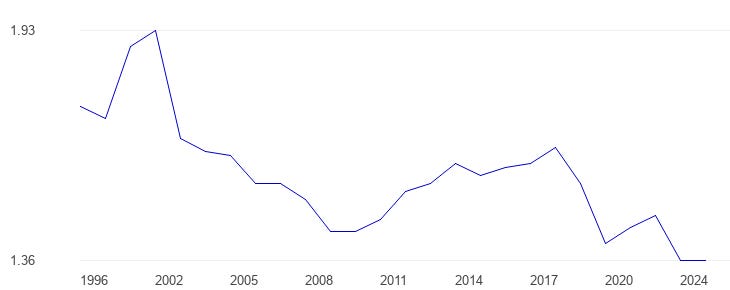
This deterioration corresponds to a phenomenon Americans experience daily: institutions that retain formal authority and vast resources increasingly struggle to translate decisions into outcomes.
America still has everything a high-functioning state should need. It remains rich, technologically dominant, and stacked with elite universities, engineers, and financiers. Venture capital flows and the IPO market have remained remarkably stable, even in the valleys of the past few business cycles, and as the Fed has transitioned away from ZIRP and QE. And despite the current administration’s efforts to thwart research funding, academic visas, and the rest, the US continues to host a surplus of scientific and technical talent. It is clearly not a human- nor a financial-capital problem.
But the symptoms are visible across myriad domains. Housing is built in chronically suboptimal quantities and locations. Infrastructure projects stretch across decades and are routinely overrun with costs. Energy projects are often face death by permitting. And industrial policy arrives late, partisanly packaged, or not at all. The US commands the most powerful navy the world has ever known yet lacks the shipbuilding capacity required to replenish or expand it at scale.
Part of the problem lies in what author Dan Wang, in his recent book Breakneck, calls the “lawyerly state.” In contrast to China’s “engineering state,” the lawyerly state evolved as a response to the excesses and negative externalities of growth. Over time, the state’s governing logic shifted from enabling production to minimizing risk — empowering litigation, procedural review, and regulatory vetoes. “The mission became to stop as many things as possible.” On those terms, it has succeeded.
Today, major projects in the US are treated like a future lawsuits waiting to happen. Environmental reviews have expanded in scope, regulatory checklists have multiplied, and the easiest way to halt progress is to demand another study. By structuring governance around procedural veto points, every decision is treated as a potential tort — transforming bridges, roads, and rail lines into legal liabilities rather than public goods. In the end, little gets built as the state becomes Leviathan by proxy and procedure.
This is not an argument against law. Rule of Law is a civilizational achievement of the West, and lawyers exist for good reason. It is (and they are) the mechanism behind the enforcement of codified norms. But when the legal process becomes the organizing principle of the state — rather than a constraint within it — the system tilts backward. Legal reasoning is inherently fault-seeking. It punishes visible failure while offering little reward for timely success.
You can see this in most regions across the US. A new transmission line is technically easy to build but might take a decade because it must survive an endless gauntlet of procedural challenges and diffused accountability. Even when everyone agrees that something should be built, and even when we have the technical know-how, projects move forward at a glacial pace.
China offers a revealing contrast not because it is virtuous but because it is coherent. What Dan Wang calls the “engineering state” is forward-looking and risk-tolerant. Infrastructure is often built ahead of demand — “bridges to nowhere” — under the assumption that physical access itself generates value.
This coherence is made possible by a kind of federalism — rule by law as opposed to rule of law — that is basically untenable in the US. State-owned banks, overseen by the central bank, provide the credit. Capital markets are tightly managed, so debt circulates inside the system. When Beijing decides to build, it issues new KPIs for provincial leaders to optimize toward.2 Then credit is made available through tightly-controlled channels. Coordinated buildouts inflate surrounding asset values and then value is recaptured through land sales to private developers — and then recycled into more new projects.
This system functions because property rights in China are intentionally incomplete. The state ultimately owns the land, allowing it to effectively tax growth directly without voter approval or bond referenda. The system depends not on broad public trust or buy-in, but on central planning and coercion (and achieving a very minimal threshold of public compliance).3
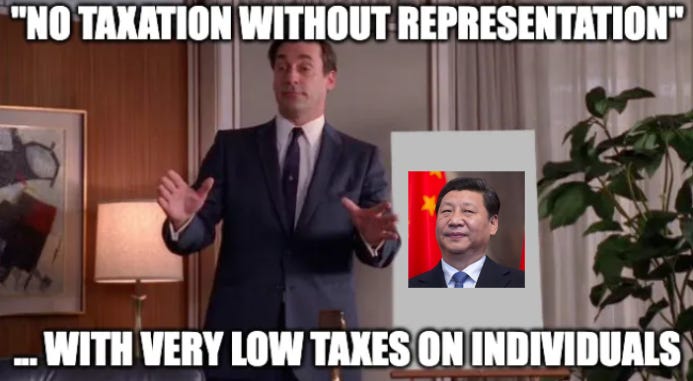
Are we simply at a structural disadvantage to China? Sure, China has been able to rapidly (and however frequently the Politburo chooses) pivot its industrial and technological trajectory — via Beijing decree, executed through its “mayorial economy” — without having to mind downstream political economy implications. This works in tandem with a robust, highly-centralized social engineering apparatus designed to foil even the most basic civil liberties.
But the point is not that this model should (or even could) be emulated wholesale in America. The point is that the US seems to have lost even the capacity to act decisively within its own institutional constraints.
America once had a different way of mobilizing resources to achieve outsize positive-sum results. New Deal era federalism reengineered the country’s physical substrate4; DARPA seeded entire critical industries; the jointly-funded SEMATECH consortium helped rescue the domestic semiconductor sector, which, at the time, was a major going-concern risk due to the dominance of Japan’s heavily-subsidized chip manufacturing sector. These wins were well-organized, technocratic efforts carried out inside, structurally, the same liberal society we live in today.
One can still observe more recent remnants of technocratic brilliance in how the US uses its financial prowess and heft to maintain international order. Why is there still such a strong global bid for Treasuries despite the spiraling (and well-documented) trajectory of debt and deficits? It is in no small part due to the fact that we engineered the hidden plumbing undergirding the vast majority of international trade and finance.5 Neither is it in small part due to the fact that our navy, engineered to move armaments and ass around the world at a breakneck pace, patrols and protects shipping lanes to keep commerce flowing.6 The US controls the global chokepoints, full stop. Dollar hegemony — America’s “exorbitant privilege” — is in no small part an engineering feat.
That same kind of technocratic lineage is visible in the evolution of the Federal Reserve, arguably the most technocratic non-defense institution in US history. The Fed was not always the credibility-anchored, independent authority it is today. The Arthur Burns Fed of the 1970s was openly subordinate to White House pressure, with hyper-inflationary consequences that eroded public trust. But that credibility was rebuilt — deliberately and painfully — under Paul Volcker, who reasserted institutional independence and imposed discipline through tethering monetary policy to aggregates, and signaled a willingness to truly optimize for price stability by hiking rates to unfathomable levels.
Since then, the Fed has operated less through command than through expectations management, anchoring markets by demonstrating competence and restraint. Central bank independence, now standard across advanced economies, was in this sense an American institutional innovation — one that illustrates what liberal technocracy looks like when authority is given to engineering-brained leaders (top economists).
What has made such efforts possible in America was not coercion but legitimacy — consent of the governed and a shared belief that institutions and the state ought to operate with some meaningful level of autonomy. People once trusted that leaders and administrators purporting to be acting in the public interest were telling the truth. That trust made it politically feasible to move fast and take risks (and tolerate failure). But it has eroded meaningfully — trust is at an all-time low, grievances are high, and when people are agrieved they increasingly harbor a zero-sum mindset:
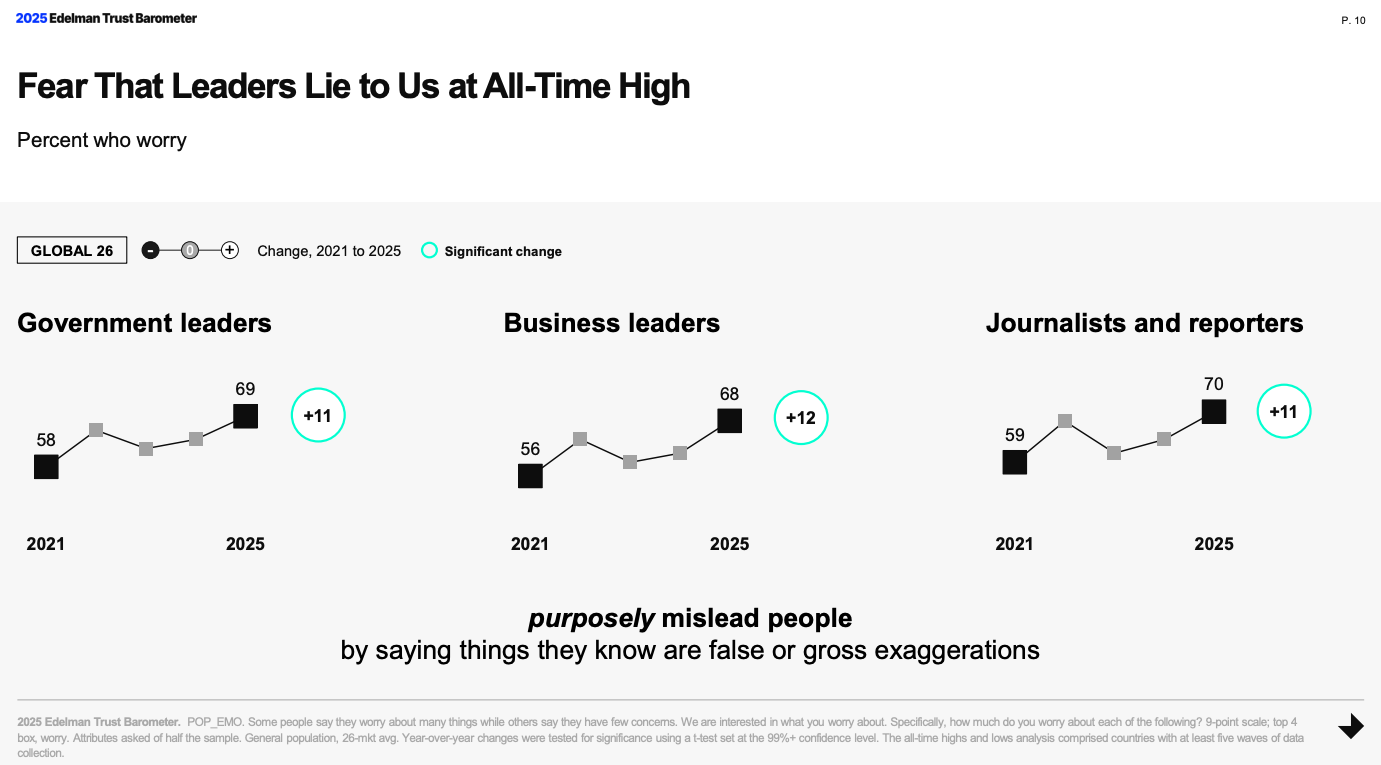
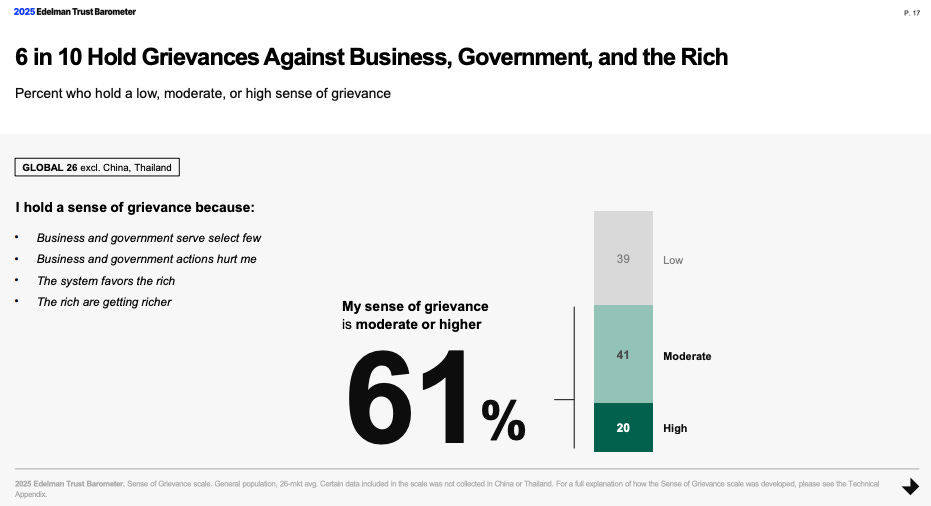
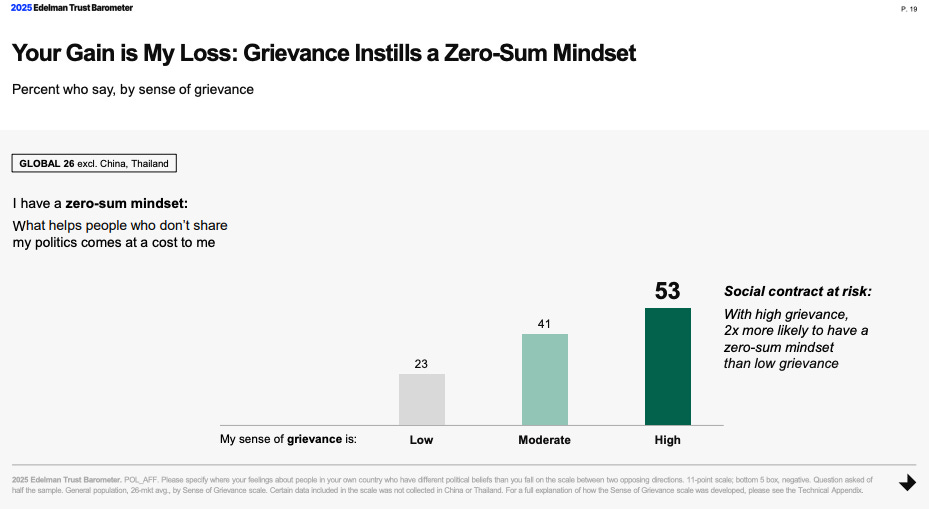
Trust in institutions seems to be a first-order determinant of America’s problem-solving capacity. In a productive, high-trust society, projects move forward at a reasonable speed and when damages are incurred, they are adjudicated accordingly. In my mind, the key difference between a high-trust environment and a low-trust one is that the lawyer machine is mobilized after the fact in the former but preemptively in the latter. This functional shift in the lawyerly state, I believe, is why America has entered an emergent era of institutional sclerosis.
The tradeoff that I think most Americans would rather not change — vis-à-vis China’s autocratic (quasi-capitalist) system, or “socialism with Chinese characteristics” — is that we demand representation in our government with the risk that that government may become paralyzed by an unconsenting populace. That is, the risk that the US becomes a vetocracy.
So my contention is that we should be aiming to dismantle the vetocracy. We should be aiming for something like an engineering state within liberal constraints: institutional frameworks that restore decisiveness, tolerate risk, and earn trust through performance rather than process and legalized preemption. The challenge then becomes galvanizing people to legitimately “trust the experts,” and “trust the science,” which became memes because that very trust was demanded rather than earned.
The Boyd Institute is currently running an essay contest with a top prize of $2,500 to answer the following question: “How can America improve its problem-solving capacity?” If, after reading this article, you feel inspired to tackle that question, please go check out our article with more information. Submissions close March 15th.

Formal definition: The index of Government Effectiveness captures perceptions of the quality of public services, the quality of the civil service and the degree of its independence from political pressures, the quality of policy formulation and implementation, and the credibility of the government's commitment to such policies.
And it is worth noting that provincial leaders risk their freedom and even their life in some cases if they screw up.
Infrastructure and material improvements are core to the CCP’s legitimacy. Permitting (quasi) free enterprise while building big infrastructure is part of the reason the CCP has maintained consent of the governed.
We even had a national investment bank, the RFC, which provided patient, quasi-sovereign capital and evaluated projects on strategic and productive value — not just short-term profitability — bridging the gap between Treasury finance and private capital markets.. It underwrote wartime industrial scale-up that became peacetime infrastructure, lending directly to railroads, utilities, steel producers, shipyards, and manufacturers.
This has enabled economic sanctions, and, importantly, secondary sanctions, that bite. Secondary sanctions were an innovation by Bush (W)-era “sanctions technocrats” — former Wall St. traders who went to work for Treasury. Basically they were rich autists (who wanted to serve their country) with Bloomberg terminals working out of shoebox offices at the Treasury building.
The other side of a trade deficit is a capital surplus — e.g., international firms that do business in the US park their cash in Treasuries because their cash flows are dollar-denominated. It is no secret that were some foreign nation to abuse its relationship with the US as a trade partner, at risk for them would be the commercial viability of their exports.
Or just get government out of the way and let the private sector do this stuff.
Very good article on China vs US on Central planning and the issue of freedom and liberty and its effect on efficient implementation. My work in 2013 sent me to China 2 times, and I was very impressed by the modern infrastructure, especially the bullet trains.
There's only one thing you cant' do in China: Don't talk about politics!