



For two generations the national debt was a problem the country agreed to have later. Deficit hawks were waved off with the dismissiveness reserved for someone technically right but socially tiresome. It was not an issue that was necessarily denied or widely refuted, but time and again, urgency was displaced by the notion that it was safely downrange on a horizon where future people lived, and present ones did not.
Boyd subscriber Erek Tinker responded to our essay contest announcement in April with a description of the whole problem in three sentences:
“My entire life people screamed about leaving debt to their grandchildren. Then they voted for policies that prioritized the elderly. But unfortunately you’re the grandchildren that the debt was left to.”
The horizon was always inhabited but we, the grandchildren, had not moved in yet. Fast forward to today, and what that dismissiveness in Washington has yielded is a paradigm in which, irrespective of the circumstances in the real economy — war or peace; crisis or stability — debt number go up.
Describing the problem is the well-trodden part. A good share of this sprint has done that; Ron Paul tanked an election doing it; the CBO does it every year. But even the CBO is thinking in (slight) exponentials now:
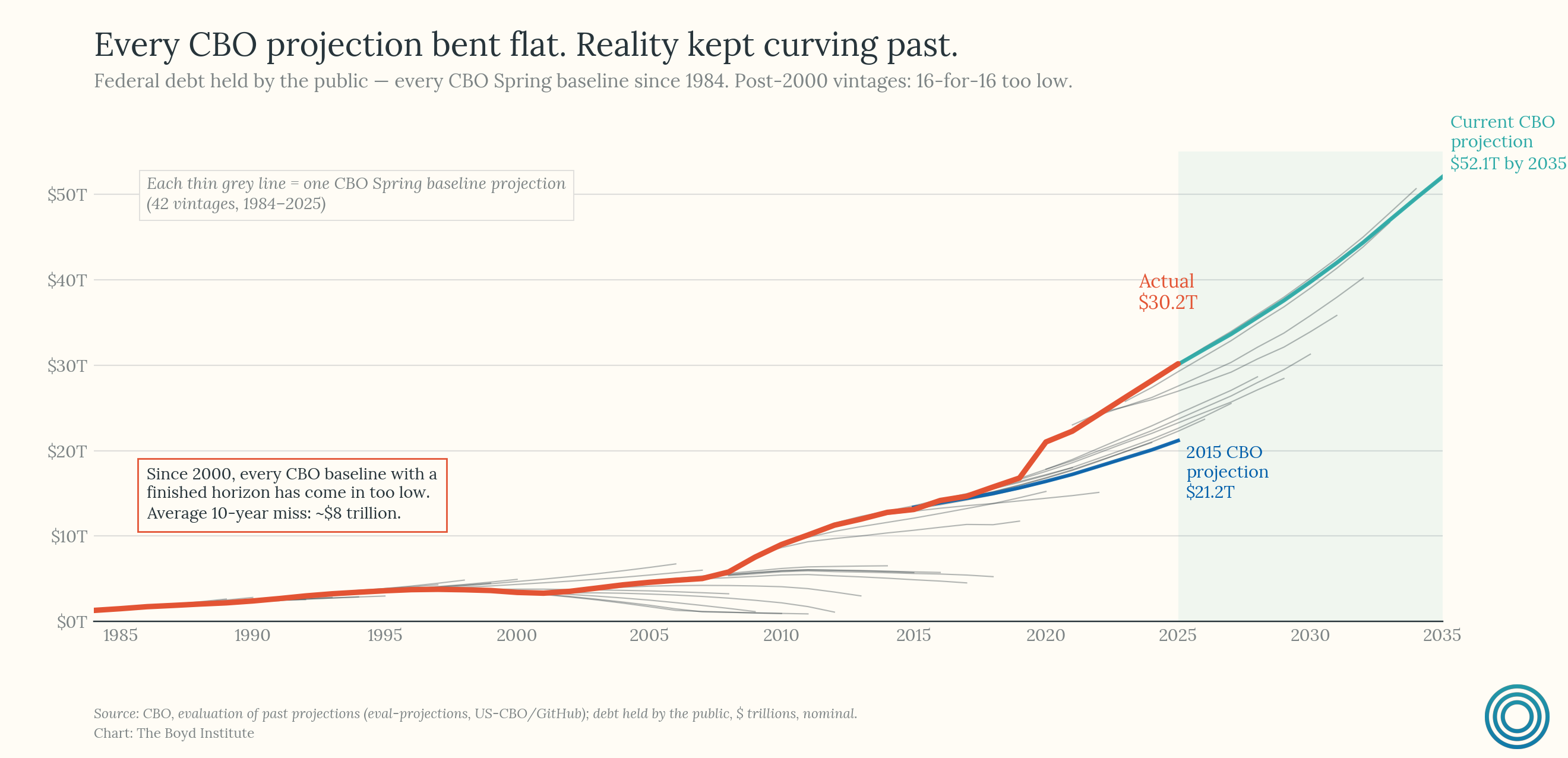
That is because the math is no longer abstract. It may have been “just a number” if the prevailing policy consensus that rates would be “lower for longer” turned out to be true. But that consensus was wrong and worse, it became a wager, a dangerous one without a margin of safety.1
Instead, the math is now straightforwardly a national security issue: interest payments on the debt exceed (and risk crowding-out) spending on defense. It is a retirement security issue: absent legislative reform, the Social Security trust fund will run dry in under seven years. It is a health security issue: Medicare spending — up 26x since 1967, in real terms — is being fraudulently looted to the tune of hundreds of billions a year while countless Americans avoid care they cannot afford. Alas, absent course-correction, the math now puts us peering over the event horizon — at an impending crisis with the upshot being austerity or inflation.
It is existential, and it is also the hardest problem to vote our way out of. Reform takes a plurality of people who do not depend on what has to be cut, and that plurality shrinks every year the beneficiary rolls grow. Counting on fiscal hawks with nothing personally at stake to assemble into a governing majority amounts to counting on a miracle. Which is why the exit runs through design more than persuasion — something that survives the incentives instead of pleading with them.
Indeed, the way out is the part nobody has nailed, and it is what we want from you. For these reasons…
We are extending our debt-and-deficits sprint by another month, the essay contest deadline moving with it — from June 15th (previously) to July 15th.
Our hope is that this extra month yields more substantive and numerous answers to the question “How does America escape its fiscal trap?” — entitlement reform that can engineer a soft landing, a budget process that does not reward deferral, a waste-fraud-abuse commission with actual teeth, a Promethian-pilled productivity-side answer, a constitutional debt brake, or something more radical we have not thought of. Anything but another restatement of the (albeit now slightly parabolic) CBO baseline.
A problem of this size and scale rewards the extra diligence, and because the contest runs in public, the longer window has little cost with substantial upside: more time to write, more essays to learn from, more iteration before anyone has to call their work final. In the meantime, we intend to leverage the extra time by fully transitioning from the descriptive to the prescriptive. We are developing a few bold policy ideas ourselves, and look forward to seeing what you all cook up by mid July as well!
With that, below is a reminder of the essay contest terms, and how you can participate.
For attribution we ask you put the following blurb at the top of your article:
“This article is part of The Boyd Institute’s quarterly policy sprint on the debt and deficit. To learn more about them and the work they do you or submit your own article click here”.
Prizes and Recognition
Grand Prize: USD $2,500 cash, re-publication and promotion on our Substack, and the honorary title of Boyd Fellow for one year.
Second Prize (Runner-Up): USD $1,000 and re-publication/promotion on our Substack.
Third Prize (Runner-Up): USD $1,000 and re-publication/promotion on our Substack.
Additional Publication: We may offer a USD $300 honorarium to authors whose essays we choose to re-publish beyond the top three.
Eligibility
Human (not AI) entrants aged 18 or older are eligible — one essay per author.
The contest is open worldwide, but the focus of this contest is on identifying novel solutions for the United States.
Essays should either be (a) Published on the author’s personal Substack account, attributed to the Boyd Institute at the top of the submission, with the link shared via THIS Google Form; or (b) Submitted directly to us as a PDF attachment through the same Google Form. Substack publication is strongly preferred.
Submission Guidelines
Format: An article will be considered for the prize pool if it is either:
(Preferred) Published without a paywall on the author’s personal Substack account before the deadline, with an acknowledgment at the top of the article that it was created as part of the Boyd Institute essay contest; or
Submitted as a PDF attachment via the Google Form before the deadline.
In either case, the author must submit the Google Form HERE with a link (or PDF), acceptance of terms and conditions, and other contact information.
Language: Submissions must be in English.
Original Work: Essays must be original and authored by the entrant.
AI Assistance Disclosure: If you use AI tools to brainstorm or edit your essay, briefly describe how you used them in a note attached to your Google Form submission. Fully AI-generated essays are not permitted.
Deadline: 11:59 PM Eastern Time on Wednesday, July 15th, 2026. Late entries will not be accepted. We will announce the winners and award prize money at the end of June.
Evaluation Criteria
Our judges will evaluate submissions based on:
Originality: How novel and creative is the idea? This is a gnarly challenge, and we need outside-the-box thinking!
Potential for Impact: If your idea were implemented, would it meaningfully address America’s debt and deficit trajectory? We are looking for ideas that substantially move the needle.
Actionability: Does the proposal offer a concrete and realistic path forward? Is it feasible within existing technological and/or political-economy constraints?
Clarity and Quality: Is the essay well organized and easy to follow? Is the proposal articulated persuasively for the general public, policymakers, and experts? While polished prose helps, we care most about the strength of your ideas.
How to Submit
Prepare your essay following the guidelines above.
Either publish the article on your Substack, or prepare a PDF.
Complete the online submission form HERE.
Provide your contact details.
Link to your Substack post or attach your PDF.
Confirm that you have read and agree to the Terms and Conditions.
Ready to share your bold, asymmetric idea? Click the link below to submit your essay.
👉 Submit Your Essay 👈
If you have any questions, do not hesitate to reach out via DMs, and we will be sure to respond with clarifications. Best of luck, and may the best essay(s) win!
MMT is dumb, and dangerous

What follows is the story of how MMT’s central operational claim — that government bond yields are a policy choice rather than a market outcome — went from fringe heterodoxy in the 1990s, to operational practice under Ben Bernanke’s Fed, to the “new normal” by the late 2010s, to the foundation of a roughly fifteen-year experiment in what monetary policy could be made to do.
Lol CBO as bad as UN demographers
Great idea. I’ll pencil in some time for an essay. It’ll be good to have a solid body of work ready to reference for the 2031 legislative craziness.