


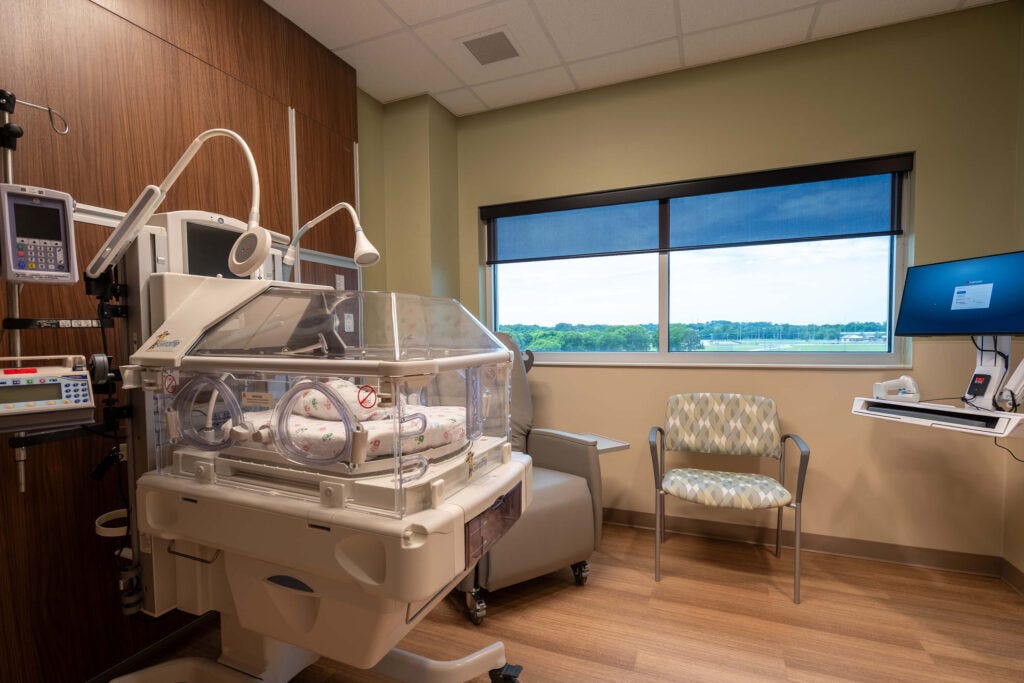
Soft mid-October light filtered through the window, illuminating the office three of us were crammed into. I sat in the small plastic chair set aside for husbands to wait politely in while I tried to pay attention to the words coming out of the OB’s mouth. Terror tumbled around in my head, jostling and competing for neurons with important details I should have been paying attention to.
Just moments ago we had been whisked into this room by our ultrasound tech after she had informed us that our daughter, who was some two weeks away from being born, was potentially in mortal danger. Specifically, what had been a routine appointment had turned darker when the scans seemed to show her abdomen had stopped growing and was now measuring literally outside of the range and could be signified only by the terrifying symbol of “<1%”.
The doctor was clearly trying to put on as good a face as possible, but her brave smiles stubbornly refused to break through into her eyes or the corner of her mouth. A sub-1-percentile abdomen, as she was explaining, could imply a ton of huge problems — genetic abnormalities, a placenta which was not able to transmit blood properly, or a host of other unambiguously bad outcomes. But she reassured us that, because we were so close to the end of the pregnancy, the real question now was whether to induce my wife immediately, and so get the baby into a NICU where doctors could address the underlying problem outside of the womb, or wait and hope the situation resolved itself.
What we needed to do right now was confirm she was alive, so to speak, and so we were rushed into a hospital for an NST (a non-stress test), which watches the baby’s heart rate to make sure her nervous system is responding. Thankfully, she passed. Then we were hurried into the maternal-fetal medicine unit, a specialist floor for the more serious cases, where they reran the measurement tests using a more advanced machine. We sat in the waiting room feeling as if a nuclear bomb had just gone off, waiting to meet with a doctor and wondering if the life we had just planned out was evaporating before our very eyes. Were we about to have a disabled child? Or, even if she was fine, were we going to be having a baby this Tuesday? We hadn’t even finished setting up the nursery, and I was desperately texting my mom to try and arrange the details just in case we had to spend the night at the hospital and my parents had to come over to our house and finish setting it up for us.
Finally, we were admitted and they remeasured her on the fancier ultrasound machine. As it turned out, the tech in the previous building had botched it. We got it quadruple-checked, and our daughter has a completely standard, completely healthy abdomen. The doctor apologized to us for the stress and we were dismissed, elated beyond articulation, to go home and face the standard ups and downs of bourgeois existence.
I want to reiterate that everything is fine, hence why I’m willing to write about it at all. But this experience, only weeks ago, helped reframe my thinking about medical spending in a way I want to talk about today. Because in that moment I was not thinking remotely rationally. They could have quoted me any amount of money, any possible test, any conceivable intervention, and I would have signed it. If the hospital had looked me in the eyes and told me it would cost $600,000 to save our child, I would have signed the piece of paper without even hesitating, and no part of me would have asked for a payment structure, or said, okay, wait a second, can we wait a day to do these tests until the right person is in the office.
If the tech had been right and our daughter really was on the verge of death or permanent disability, the danger, the loss, would have been so catastrophic that I just wouldn’t have considered anything else. Prices meant nothing to me in that office and I suspect they would have meant little to you as well.
That scare made the case for catastrophe protection visceral for me. It also showed me that terror is a bad basis for designing healthcare policy. We need to decide what we’ll guarantee before any of us is sitting in that chair.
There is a basket of interventions for conditions — a childbirth gone wrong, a gunshot, a car crash, an infected wound — that are decisive and impossible to shop for in the moment. It is this collection we tend to point to when we celebrate the miracle of modern medicine because it has eliminated an incalculable amount of human suffering, and the terror of losing it lingers in all of our minds. Then there is the long and expensive fight against the body’s decline, where we have to ask what each additional intervention actually buys.
I want to argue for a more mature approach to health: protect people from catastrophe, and give them more freedom over everything else. We should socialize the care we collectively agree to guarantee within a public budget, and leave additional healthcare to people’s own money and choices. In practice, this would mean, basically, adapting Singapore’s system.
An absurdly efficient intervention
For most of my life, the healthcare I have consumed has been the kind I could think rationally about. I’ve gone to chiropractors, done physical therapy, met with therapists and psychiatrists, gotten annual checkups, and gone in for strep throat. For all of these, I could have been reasonably expected to be able to consider prices and quality, or even if it was care I needed at all.
That Tuesday was different in three specific ways. We couldn’t be expected to behave rationally. There was something concrete the doctors could do. And the upside was a whole lifetime for our daughter. Those three things together make for a perfect state-level intervention.
Consider what we needed that day. The ultrasound was some gel, some electricity, the time of the person running the scan, and a machine that is not particularly complicated and lasts for years. Had the worst been true, we might have needed Pitocin to induce labor, the time of some different professionals, and the nexus of tools and drugs which exists within the NICU. When you set that against a future taxpayer — or a lifelong recipient of support, in a country that has committed to taking care of disabled people — it is an absurdly efficient intervention. Making parents run cost-benefit ratios on it is ridiculously dangerous from a fiscal perspective alone.
This argument applies much more broadly to solving an acute, definable problem that returns a person, if not to full health, then to near full health. You can think of someone who has been shot and is bleeding out on the ground as the perfect example. All that is needed in that moment is to stop the bleeding, and their own body will essentially restore them. Or a bacterial infection which can be extraordinarily deadly to an eight-year-old, but once you remove it, the kid is totally fine. When I was an infant I had meningitis, an infection of the membranes around the brain, and medicine cured me. It hasn’t affected me since. But had I been born a century earlier, I would have risked death or permanent mental disability.
We have had unimaginable success with this category, and for an almost incomprehensibly small cost.
I cannot escape the inexorable fact that life expectancy soared in communist China during the middle of its Maoist economic experiment, which left tens of millions starving. This is the real miracle of modern science, that we could reap most of the benefits of medicine with pennies while careening Chinese society off the edge of a cliff.
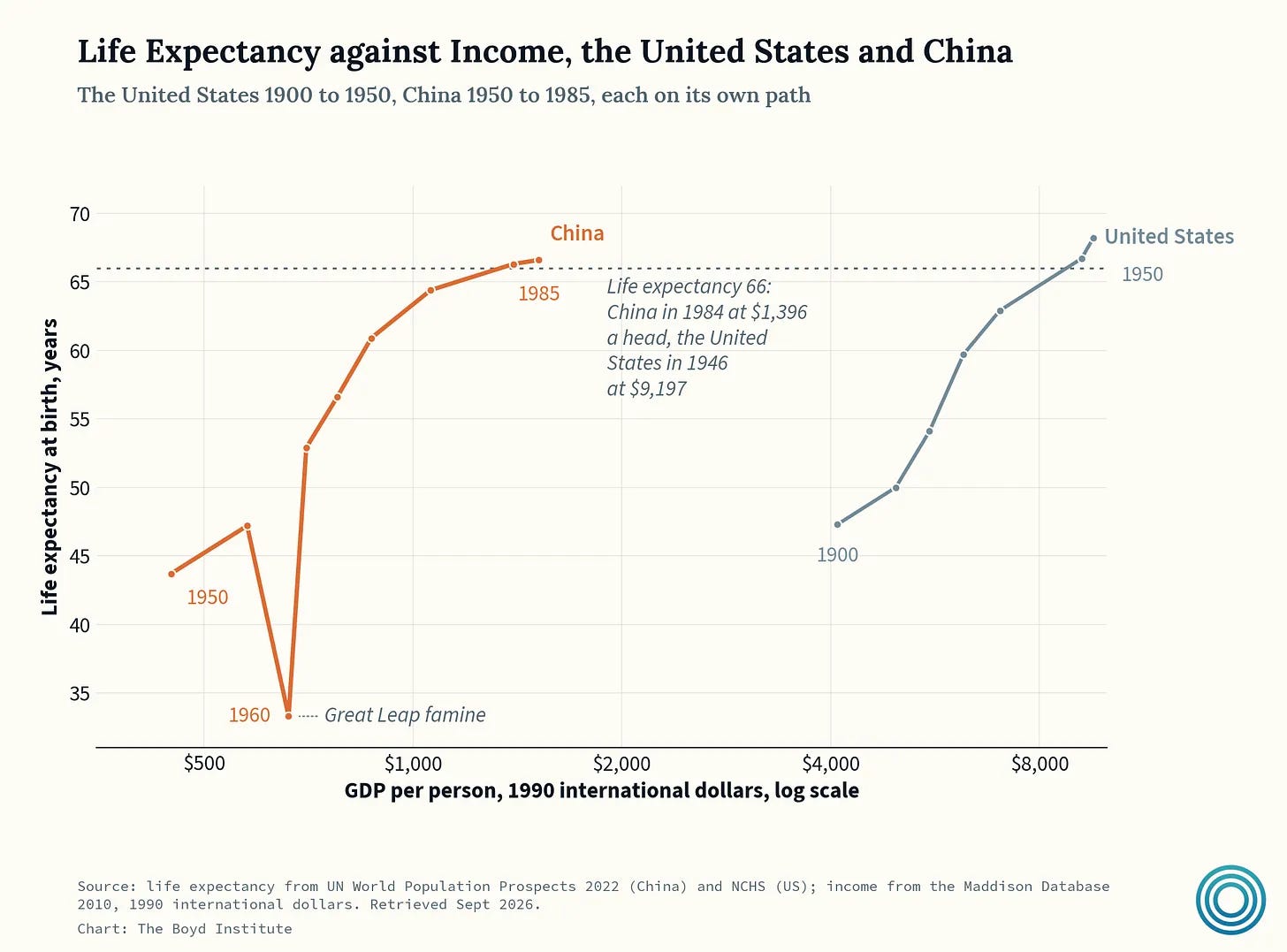
Public health campaigns such as child immunization and sanitation account for the large majority of these gains, and the cheapest wins were not even from professional doctors. For our entire history as a species, for example, a baby coming down wrong — an arm first, the head badly positioned — was a death sentence, but even limited training can nearly totally eliminate the risk.
Managing decay
Fundamentally, the problem we want medicine to solve has changed over the decades. No longer are we primarily confronted by discrete health complications whose removal restores you to near perfect health. Instead, increasingly, as most of us survive into senility, the issue has become addressing the cumulative problem of physical decay. An event horizon of sorts exists, for those willing to look, in your late 70s or early 80s, where the moment you cure one aspect of your ill health you are immediately faced with a hydra of other conditions. Even if we can cure each individual issue with more and more precision and ability, the best case is we push our life expectancy back on the order of single-digit years, or even days. In America we are no longer in the world where relatively small interventions unlock huge gains; we are somewhere much messier, much more complicated, that I just don’t feel our culture has understood or appreciated.
This second category is the attempt to undo the accumulated damage done to the human body by existence itself. I call it managed decay. That problem is unsolved, and in all likelihood it is unsolvable. Treatment still has value. But “whatever it costs” is hard to defend when the fight is against mortality itself and the public is footing the bill.
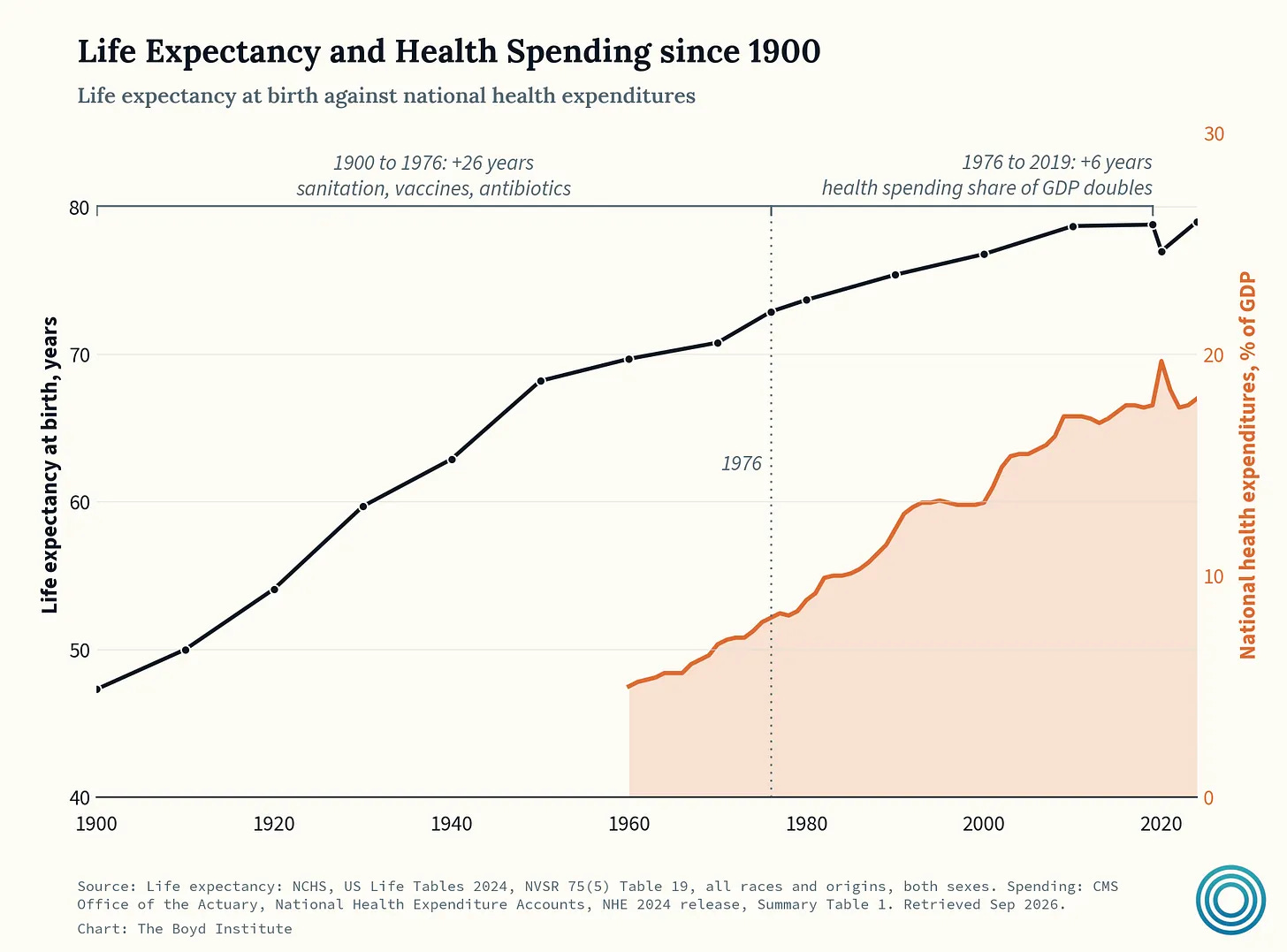
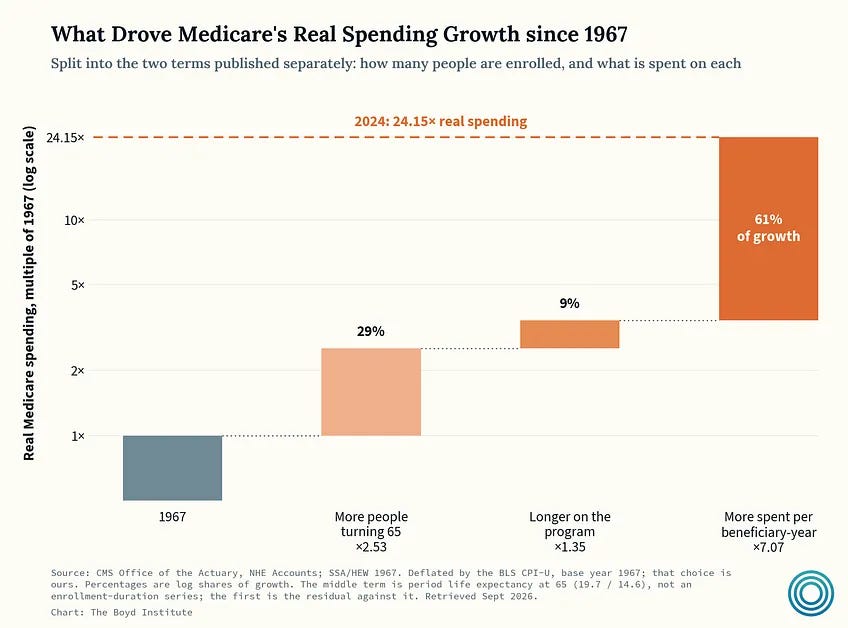
This is where the money ~really~ goes. Real Medicare spending grew about 26-fold between 1967 and 2024, for example, and only about 29 percent of that growth came from more old people and 9 percent from longer lives. Nor is it even just concentrated at the deathbed — the share spent in the last year of life has stayed roughly flat for decades. Fully 62 percent of the increase in costs has come from more intensive treatment per person per year.
As our basket of tools has grown, so too has the expected cost. Dialysis shows clearly how we can bundle the baskets: in 1972 Congress extended Medicare to anyone with kidney failure as a small, dramatic, life-saving program, and by 2016 it had ballooned to about $35 billion a year in public expenditure. That’s bigger than the economies of half the countries on earth.
To add to this, there is the additional burden of everything else we call healthcare: psychiatry appointments, yearly checkups, blood pressure medication, and physical therapy to name just a few. For example, I take two hair-loss medications, finasteride and minoxidil — that is modern medicine too, and it is handled through the same system as anything else. All of these things are ~important~ in their own way, and I don’t want to say to the person inside of them that they don’t matter enormously. For somebody who is extremely depressed, psychiatric care can be deeply necessary. But it is reasonable to ask whether this is something the state should subsidize, and what society actually gains from socializing all of these treatments.
And let’s be clear that money is real. Your doctor’s house and boat were purchased with real human labor, and the tax revenue they collect from you to pay for Medicare is real money you could have spent. Every dollar is taken from money the state could spend on education or roads, or that parents could spend on their children.
So if all of this is plain, why do we keep spending?
It sounds like something only an evil person would do
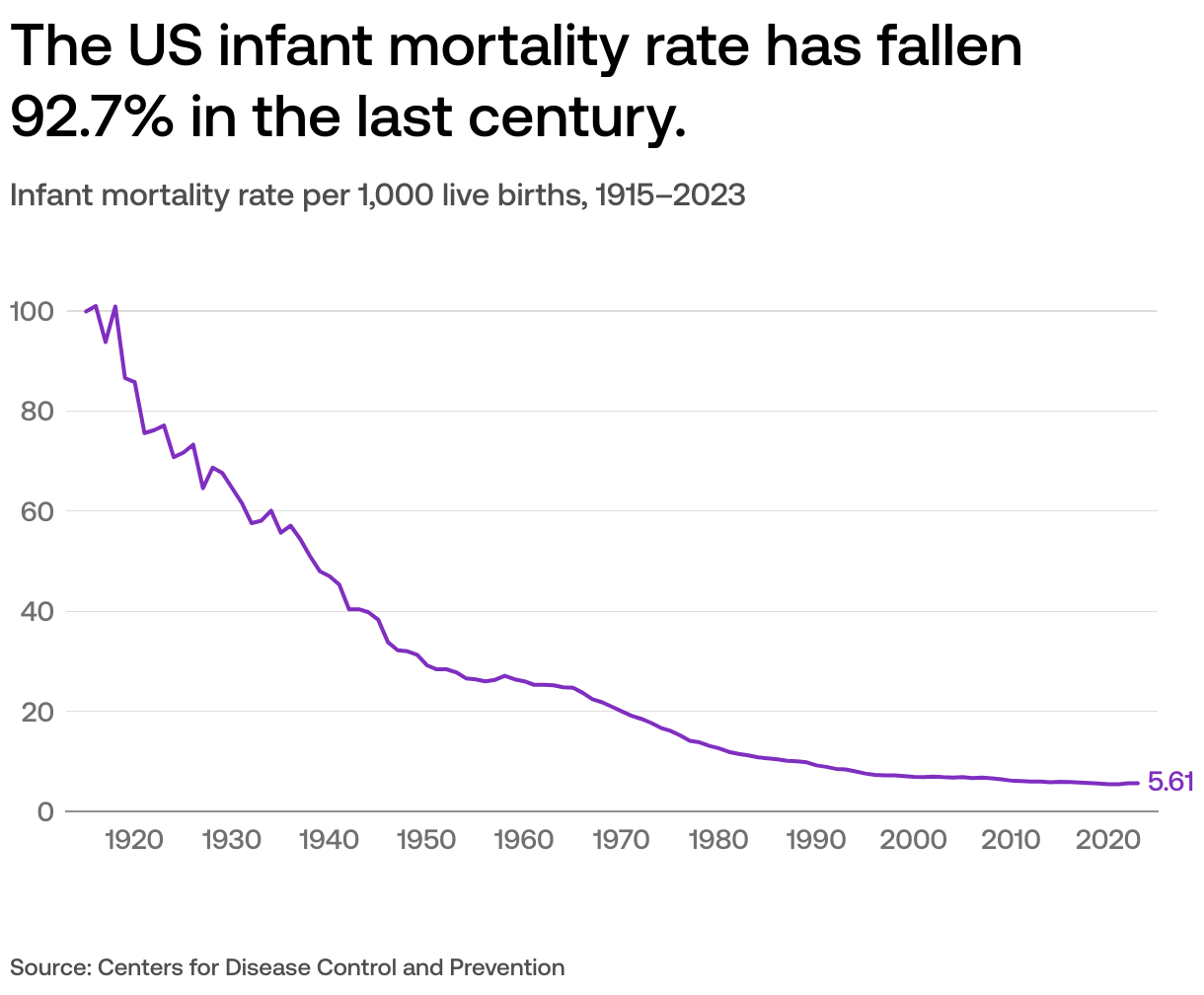
We are mentally stuck in a period of time that ended forty or fifty years ago. When I say to someone that I think modern medical science is overrated, they are not going to point out some rare cancer we’ve cured. They point to the fact that a hundred years ago, many women died giving birth, and many people died at forty. But these were all largely solved by the 1990s at the very latest, and in most cases by the 1970s.
It is remarkable to me, anecdotally, how often you talk to people — especially elderly people — who seem to think they are immortal. There is a cultural feeling, to some extent inarticulate but I think always there, that we can get past this basic problem of human decline, and if not achieve immortality, then at least eternal youth. Call it a cult of health, a cult of being curable, a cult of medicine, whatever you want — it runs on guilt.
We feel obligated to treat everything that involves medicine the way I felt on that Tuesday in the OB’s office. We will do whatever it takes, pay whatever it costs, whatever the odds, and fight with everything we have. Too often that means subjecting people to medical tortures as they inevitably plod toward death.
Robin Hanson’s work has drawn me back here again and again, though I don’t want to pretend we have the same opinion — Hanson is much more libertarian than I am. His main observation is that we just consume too much healthcare, for basically no gains at the margin. His strongest evidence is the RAND Health Insurance Experiment, which ran from 1971 to 1986 and randomly assigned families to plans ranging from free care to heavy cost-sharing. What it found was that those who paid most of their own bills spent about 30 percent less on healthcare, but there was little or no difference in outcomes. His explanation is that medicine is how we show we care and that this drives us to behave in pathological ways.
In America this is made worse by separating choice from cost. Because everything falls into the basket of medicine, we feel obligated to all of it — and in many cases we don’t even pay the costs ourselves. We can spend hundreds of thousands of dollars of society’s resources without ever asking whether it makes sense, because we have chained all of this together to the point that even asking the question sounds evil.
The answer is ultimately a more mature relationship with our mortality — and even more than that, a more mature relationship with our degradation, the infinite and impossible-to-resist decline of every system in the body at once. But I don’t think we are going to get there within our lives, and we should not tie sound public financing to our ability to emotionally handle death. We should instead be aware of our pathologies and design systems that accommodate them. Neither side of our current debate is designing for that.
Protection from catastrophe
Too often I feel like libertarians underestimate what it means to face catastrophe. People who see the problems I’ve articulated above want to impose the price signal on everyone, because they correctly assume it is relatively good at allocating scarce resources. But they include interventions with such huge upside, or such little space for rational thinking, that the tail-risk scenarios make people terrified of any medical reform at all. In that moment in the office I was immensely grateful for insurance because I did not want to have to think to myself about the relative value of an intervention. It is very hard for me not to realize that I myself may one day be willing to throw away everything I have just to save a person I love, and forgoing that tail risk is well worth the tax dollars from my point of view.
But outside of the libertarian sphere, people clamor for a version of public healthcare which would bankrupt this nation. In the United States the concept of what healthcare means is so broad and nebulous that accepting a socialized version of it would do nothing but eliminate what scraps of a price signal we do have and juice the demand for interventions with no, or negative, value, out of an expectation that this is what a ‘good’ person would do.
My experience living overseas is that where medicine is socialized, there is at least more of a basic understanding of the separation I’m discussing. On paper, most European systems cover nearly everything, but in practice they tend to draw the line through agencies like Britain’s NICE, which has judged new treatments since 1999 against roughly £20,000–£30,000 per year of healthy life gained. Americans, almost uniquely in the world, have confused the bundles permanently, which is why every proposal to socialize health insurance comes with such astronomically high expected costs and the public is so terrified of libertarian reform.
So the real question is what to socialize openly and how that’s decided.
Learning from Singapore
If I were going to make a single specific policy recommendation, it would be this: adopt the Singaporean model. Putting aside the political feasibility of getting it passed, it does just seem like the correct system. Singapore has incredibly good outcomes, the state is able to subsidize the most vulnerable, and it avoids many of the pathologies our system has, all while consuming about ¼ of what we do per person on healthcare, and roughly 5 percent of GDP compared to the United States’ 18.
Singapore combines pooled protection against large bills with individual savings and payments, running its healthcare system on three layers. MediSave is a compulsory personal savings account, funded out of wages, that pays for hospital bills, some chronic care and insurance premiums. MediShield Life is universal insurance covering everyone from birth, regardless of age or pre-existing conditions, for large bills in subsidized wards, with a yearly deductible and co-insurance. And MediFund is a means-tested net for those who still can’t pay.
That net exists because being able to plan for an expense doesn’t mean being able to afford it. It’s designed to catch you if something goes wrong so that you don’t face tail risk, but it’s definitely not the place you want to spend the rest of your life.
The hardest case is old age, because most heart attacks, strokes and broken hips happen to the very old, and they are definitionally acute, even if they are representative of something broader. Singapore’s solution is not to ration openly by age but instead to raise premiums with age, and apply claim limits and co-payments that send an expensive late-life ICU stay back to savings and family. Let me be plain that this is rationing by another name, and that I think Singapore is right to do it. If a ninety-year-old and a five-year-old both need scarce public resources, it is very reasonable for the money to go to the child.
Which raises the question of who draws the definitionally messy lines. In my piece on the generational contract and pensions, I argued that some government tasks are engineering problems, where the goal is fixed and you should hand the lever to experts judged only on outcomes. Medicine is another, where society should decide how much it is willing to collectively socialize. And then an impartial, collective technocratic body should decide how that social surplus is allocated.
Where I go beyond Singapore is that you should be allowed to try whatever medication you want. Market insurance plans, health-sharing plans, any cost-sharing or risk-sharing arrangement people can come up with should be allowed. Nothing will ever get close to the price signal for letting people decide what they actually want to spend money on and where they actually see the value of their care. Singapore does not go far enough in its enforcement of the basic distinction between what the state has an interest in subsidizing and what it does not.
Deciding the limits in advance
Setting limits on what we collectively guarantee saves money. It also lets healthcare work more efficiently. Today, price can’t do the rationing, so queues, crowding, and red tape do it instead. If we cover catastrophic risk separately, the rest can behave like a market, and we can stop living with the quasi-socialized system we have now.
It is possible that one day we will postpone the decline into death. But that specific basket is unknown, and it doesn’t seem like pouring more gasoline onto the fire of the interventions we have right now is going to get us over that line. Giving people more freedom to experiment and figure out what actually works, while separating it from the terror of that OB room, is the bargain I want.
We must settle what we owe each other before any of us is sitting in that chair. Give me freedom, but protect me from catastrophe.
The hybrid system seems like the only one that makes sense. Singapore's system has the advantage of separating the government's help for the acutely and chronically sick and injured and the poor.
Politically, that means a system designed by bipartisan compromise that nobody likes is optimal.
But there's no way to avoid saying no to somebody. And someone will call that a “death panel.”
Caring for the elderly is hard. Some amount of socialization will be really important in the coming dearth of young people, I'm afraid, but it won't be easy.